JOOLA Hyperion Pro IV Review
Same core, same face, same throat foam as the Perseus Pro IV — one curved edge is the entire difference, and it is the only thing you are actually choosing between them.
Disclosure: Drive Dink earns a commission from qualifying Amazon purchases at no extra cost to you. We accept no free products and no paid placements — commissions never change our picks. How this works.
There are seven paddles called Hyperion on JOOLA's own store right now, so the first job of this review is to tell you which one this is. The Hyperion Pro IV is the generation built on JOOLA's Pro IV platform — the same core, face and throat construction as the Perseus Pro IV, with a curved head instead of a flat one. It is not the cold-pressed Hyperion CFS we review separately, and it is no longer JOOLA's top Hyperion, because a Pro V version of the line now exists above it at a materially higher price. Everything below is read from JOOLA's published specifications and the independent reviewer record; we have not hit this paddle ourselves.
JOOLA Ben Johns Hyperion Pro IV 16mm
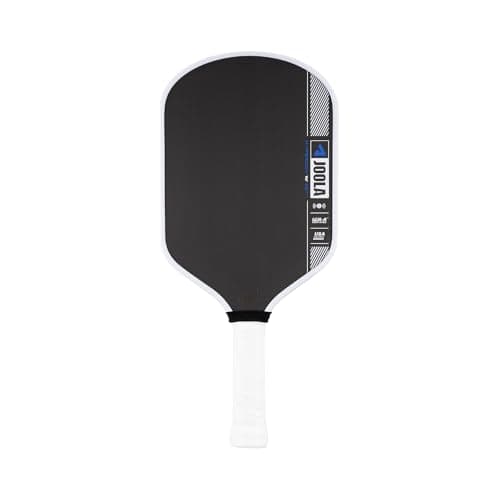
The Perseus Pro IV platform under JOOLA's curved Aero Curve head — the same core, face and throat foam, built to swing quicker and sitting a generation behind the current Pro V on price.
JOOLA publishes the same build for this paddle as for the Perseus Pro IV: a 16mm Propulsion polypropylene honeycomb core with a Hyper-Foam Edge Wall, a Textured Carbon Fiber face, and the Tech Flex Power throat foam that narrows the honeycomb channel to add flex. What differs is the outline — the Hyperion's top edge is curved rather than flat, which reviewers describe as quicker in hand battles at the cost of a little hitting area and mass at the top of the face. The 16mm core is the forgiving one, with a 4 1/4in grip.
If you are coming off any 16mm paddle, this is the version to buy, and the reason is boring: changing core thickness and head shape in the same purchase makes it impossible to work out which change you are feeling. The 16mm core is also where the Hyper-Foam Edge Wall does the most for you, because a thicker core already has more material to move energy sideways into the perimeter. The cost is honest — it is the slowest-feeling of the three in hand, and JOOLA lists it with the widest grip in the line at 4 1/4in, which some players will want to size down from rather than overgrip.
- Core
- 16 mm
- Shape
- Hybrid
- Face
- Textured carbon-fiber surface (Tech Flex Power)
- Weight
- ~8.1 oz (7.9-8.3)
- Build
- Thermoformed
- Gen
- Pro IV (Gen 4)
Manufacturer-listed as USA Pickleball approved. Approvals and delistings change — verify against the current USAP equipment list before tournament play (checked 2026-07).
JOOLA Ben Johns Hyperion Pro IV 14mm
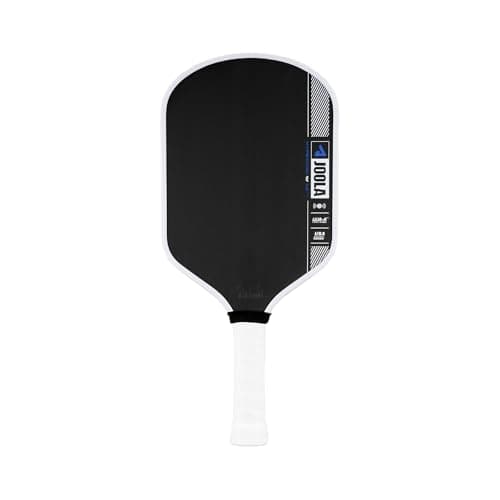
Same curved head and same Pro IV build on a 14mm core — the lightest and liveliest paddle in the Hyperion line, and the least forgiving.
Two millimeters of core is the whole difference, and JOOLA's own listings show where it lands: 7.9 oz average against the 16mm's 8.1 oz, and a thinner 4 1/8in grip. A thinner core is poppier off the face and faster through the air, which stacks with the Aero Curve head. The cost is the usual one — less cushioning behind the ball on a reset and a smaller margin when you catch it off-center.
Buy this one only if you can name the shot you want it for. The thin core and the curved head both work on the same axis — being late — so this is the Hyperion for a player who keeps arriving a beat after the speed-up rather than one who cannot finish. What it will not do is cover a soft game you have not built yet. Pickleball Studio's verdict on the Pro IV platform was that it requires skilled soft-game technique, and that bites harder on the thin core than the thick one. Check the grip before you order, too: JOOLA lists this SKU at 4 1/8in against the 16mm's 4 1/4in, so the two are not interchangeable for a hand that is already between sizes.
- Core
- 14 mm
- Shape
- Hybrid
- Face
- Textured carbon-fiber surface (Tech Flex Power)
- Weight
- ~7.9 oz (7.7-8.1)
- Build
- Thermoformed
- Gen
- Pro IV (Gen 4)
Manufacturer-listed as USA Pickleball approved. Approvals and delistings change — verify against the current USAP equipment list before tournament play (checked 2026-07).
JOOLA Simone Jardim Hyperion Pro IV 16mm
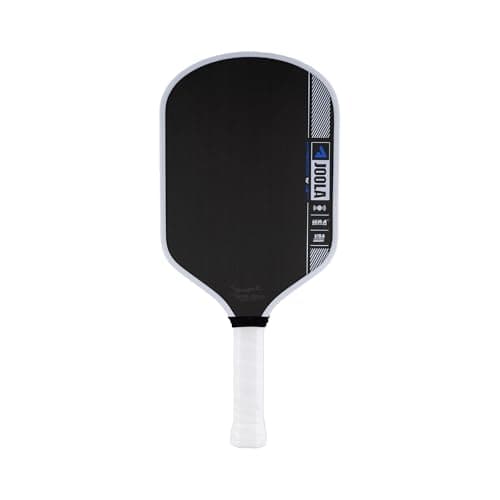
Spec-for-spec the 16mm Hyperion Pro IV with a 4 1/8in grip instead of 4 1/4in — the version to buy if your hand is between sizes.
A signature colorway is usually just paint, but here it changes a number that matters. Every published spec is identical to the Ben Johns 16mm — 16.5 x 7.5in, 5.5in handle, 16mm Propulsion honeycomb, Hyper-Foam Edge Wall, Textured Carbon Fiber face, 8.1 oz average — except the grip, which is listed at 4 1/8in rather than 4 1/4in. If you overgrip every paddle you own, that is the smarter starting point, because an overgrip adds roughly an eighth of an inch back.
Worth being clear why this is on the page at all: it is not a women's paddle and we are not selling it as one. It is a second SKU of the 16mm Hyperion Pro IV, and we checked it line by line against Pickleball Central's spec tables for both paddles before saying so. Who it is actually for: anyone who adds an overgrip. An overgrip typically puts back roughly the eighth of an inch this SKU starts you lower at, which lands you where the Ben Johns 16mm begins — so starting here gives you a usable paddle with or without the wrap, and starting there does not. The cons are choice and supply: one colorway, take the paint you are given, and signature SKUs are usually the first to sell through.
- Core
- 16 mm
- Shape
- Hybrid
- Face
- Textured carbon-fiber surface (Tech Flex Power)
- Weight
- ~8.1 oz (7.9-8.3)
- Build
- Thermoformed
- Gen
- Pro IV (Gen 4)
Manufacturer-listed as USA Pickleball approved. Approvals and delistings change — verify against the current USAP equipment list before tournament play (checked 2026-07).
Who it's for
The Hyperion Pro IV is for the player who has already decided they want a JOOLA Pro IV, and now has to pick a shape. That is a narrower description than it sounds, because the Pro IV platform is the paddle a lot of upgrading players land on: certified to the top of the power bracket, grippy enough to be a genuine spin paddle, and — since the Pro V generation arrived above it — no longer priced like a flagship.
Within that platform, the Hyperion is the one to buy if your problem is hand speed rather than pace. The curved top edge is the whole pitch, and it is a real one. Who should not buy it: anyone who wants the absolute most power JOOLA will sell them on this platform, because the reviewer record is consistent that trimming mass off the top of the face costs you a little drive. For that, go to the Perseus Pro IV or straight to our most powerful USAP-legal paddles roundup.
What the Pro IV platform actually is
Worth being precise here, because JOOLA names four technologies on the Amazon listing alone and they are not four separate things. JOOLA publishes the core as a polypropylene honeycomb with an EVA foam wall — marketed as the Propulsion Core and the Hyper-Foam Edge Wall — and the face as Textured Carbon Fiber. The foam is injected into the perimeter of the paddle, where JOOLA says it adds weight and stability and widens the sweet spot. That is a Gen-3 style construction: a honeycomb core with a foam band around the edge, not a core made of foam. Our Gen 3 and Gen 4 foam paddles guide explains why that distinction decides more about how a paddle plays than the generation number stamped on the box.
The one genuinely new thing on the Pro IV is Tech Flex Power. Pickleball Studio, who took the Pro IV apart, describe it as a section of high-density foam added inside the bottom corners and throat, which narrows the channel of honeycomb running from the handle into the head. Narrowing that channel lets the face flex more on contact, which they report as more dwell time, more forgiveness and better ball feel. That is the mechanism behind JOOLA's claim of "power with unparalleled forgiveness" — and it is a structural claim you can see rather than a marketing adjective.
One spec JOOLA does not publish for the line is a molding method. The product pages list the core, the face, the foam wall, the certifications and the warranty, but nowhere do they say thermoformed or cold-pressed. The independent reviewer record consistently describes the Pro IV as thermoformed, and that is what we have recorded on the spec cards above — labeled as the reviewer consensus it is, not as a JOOLA-published figure. Our thermoformed paddles guide covers what the process does and the durability questions that came with it.
The Aero Curve: what the curve buys and costs
JOOLA describes the Hyperion's head shape as designed "to move through the air more efficiently by reducing drag." Strip the marketing and the geometry is simple: the Hyperion's top edge is rounded, the Perseus's is flatter. Both paddles are listed at the same 16.5 x 7.5in with the same 5.5in handle, so the curve is not buying you a different footprint. It is removing a small amount of material — and therefore mass — from the corners at the top of the face.
Two independent reviewers report the same two consequences. Pickleheads put it plainly: "The Hyperion has a rounded, curved top while the Perseus has a flatter head. The curve makes the Hyperion a little faster." The Kitchen Pickle's series review agrees the curve is "more maneuverable in hands battles at the kitchen line" and gives "more whip through the hitting zone on serves" — then names the price: "slightly reduced hitting area toward paddle top" and "marginally less power than the Perseus due to less mass concentration."
So the trade is legible and small. You are giving up a sliver of the top of the face and a little drive weight to get a head that turns faster in a firefight. Whether that is worth it is a question about your game, not about the paddle: if you lose points at the net to hands you cannot match, it is worth it; if you lose them because you cannot finish from mid-court, it is not. Our paddle shape guide works through the same trade across the whole market, and explains why we classify a 16.5 x 7.5in outline as a hybrid rather than a true elongated — retailers usually label this paddle "elongated", which is a fair description of its length but understates how much face width it keeps.
What the measured numbers do and don't say
Here is the honest limit of this review. We could not verify any published machine measurements for the Hyperion Pro IV specifically — no swing weight, twist weight or spin RPM figure for this paddle from a lab we trust and can cite. Pickleheads publish static weights only (7.9 oz for the 14mm, 8.1 oz for the 16mm), which match JOOLA's own listings.
What does exist is Pickleball Studio's measured data for the Pro IV platform in the Perseus and Agassi shapes, and because the Hyperion shares the core, the face, the throat foam and the outline, that is the closest honest reference point:
| Pickleball Studio measured (NOT the Hyperion) | Static | Swing wt | Twist wt | Spin |
|---|---|---|---|---|
| Perseus Pro IV 16mm | 8.04 oz | 116 | 6.04 | 2,170 RPM |
| Agassi Pro IV 16mm | 8.17 oz | 117 | 6.17 | 1,997 RPM |
| Perseus Pro IV 14mm | Not published | 113 | 5.9 | 2,018 RPM |
Read those as the platform's neighborhood, not as the Hyperion's numbers. The useful inference is the gap between the 16mm and 14mm Perseus — three points of swing weight and roughly a tenth of a twist-weight point — because that is the same two millimeters of core you are choosing between on the Hyperion. Our swing weight and twist weight guide explains what each number actually changes in your hand, and how pickleball paddles are tested covers why a figure measured on one shape should never be quietly reprinted as another's.
Note the direction of the spin numbers too. The Perseus Pro IV's 2,170 RPM is a strong figure but not a class-leading one, and the Textured Carbon Fiber face is a treated surface rather than a raw one. If spin is the single upgrade you are shopping for, a raw-carbon paddle is the more direct route — see the highest-spin paddles and our how paddle spin actually works guide for why the finish, not the fiber, is what grips the ball.
Specs and build
| Spec | Hyperion Pro IV 16mm | Hyperion Pro IV 14mm |
|---|---|---|
| Core | Propulsion polypropylene honeycomb with an EVA Hyper-Foam Edge Wall | |
| Core thickness | 16mm (0.629in) | 14mm (0.551in) |
| Face | Textured Carbon Fiber | |
| Throat | Tech Flex Power — high-density foam in the throat and lower corners | |
| Dimensions | 16.5 x 7.5in, curved (Aero Curve) head | |
| Handle length | 5.5in | |
| Grip circumference | 4 1/4in (4 1/8in on the Simone Jardim SKU) | 4 1/8in |
| Listed weight | 8.1 oz average (7.9-8.3) | 7.9 oz average (7.7-8.1) |
| Factory grip | JOOLA Feel-Tec, perforated and cushioned | |
| Certification | UPA-A certified; USAP approved; USAP PBCoR .43 certified | |
| Warranty | 12 months, registration required | |
| Molding method | Not published by JOOLA (reviewer record: thermoformed) | |
Every figure above is JOOLA's own published number from the Hyperion Pro IV 14mm and 16mm product pages, cross-checked line by line against the Pickleball Central and Pickleball Warehouse spec tables for all three SKUs. Where the two disagreed we kept JOOLA's. How we score a paddle we have not hit is set out in full on our methodology page.
Hyperion Pro IV or Perseus Pro IV?
This is the decision, and it is almost entirely about one shot. Both paddles are the same platform at the same price in the same outline. The Hyperion's curve makes the head quicker; the Perseus's flat top keeps more mass and a slightly larger hitting area up high.
- Take the Hyperion if you lose net exchanges on hand speed, if you serve big and want whip through contact, or if you are coming off a head-heavy paddle. Pickleheads specifically note it "doesn't feel overly head-heavy like the original JOOLA Hyperion CFS 16", which is the most common complaint about the generation it replaced.
- Take the Perseus if your deficiency is finishing — drives, counters, put-aways from mid-court. Marginally less power is still less power, and if pace is the reason you are upgrading you should not pay for aerodynamics instead.
- Take neither if what you want is plush touch. Both are power-first frames. Pickleheads' honest con on the Hyperion is that it "lacks the plush feel of softer paddles", and Pickleball Studio's conclusion on the platform was that it "requires skilled soft-game technique." Start at our control paddle roundup instead.
If you want the generational question rather than the shape question — whether to buy any Pro IV at all when the cold-pressed Hyperion sells for less and the Pro V sells for more — that is covered in JOOLA Hyperion vs Perseus and Perseus Pro IV vs Pro V. The 14mm-versus-16mm half of the decision is worked through in detail in our 14mm vs 16mm core guide and JOOLA Perseus 14mm vs 16mm, which applies to this paddle unchanged.
What you can't buy through us
JOOLA sells a Hyperion Pro V above this paddle — the same curved head on the newer Pro V platform, with a raw carbon surface instead of a treated one, at substantially more money. We are not linking it, and the reason is worth stating: Amazon's Pro V listings are titled simply "JOOLA Pro V Pickleball Paddle" and do not name the shape anywhere in the title or description we can read. We will not send you to a listing and let you find out which paddle arrived. If you want the Hyperion Pro V, buy it direct from JOOLA — we earn nothing on that, and we would rather tell you than pretend the option does not exist.
That is also the honest frame for this paddle's price. The Hyperion Pro IV is the superseded generation, and superseded flagships are usually the smartest buy in any gear category. Our Perseus Pro V review covers what the newer platform changes — a raw-carbon face and a flexing throat — so you can judge whether that is worth the difference before the Pro IV stock runs out. Several Pro IV SKUs are already showing thin inventory.
Pros
- The full Pro IV build — Propulsion honeycomb, Hyper-Foam Edge Wall, Tech Flex Power throat, Textured Carbon Fiber face — at previous- generation money.
- Measurably certified to the top of the power bracket: UPA-A certified and USAP PBCoR .43 certified.
- The curved head is a real, reviewer-corroborated gain in hand speed and swing whip, not a cosmetic change.
- A 5.5in handle on a 16.5in frame, which is genuinely usable for a two-handed backhand.
- Three SKUs at one price covering both core thicknesses and both grip sizes, so you can buy the configuration your hand needs.
- 12-month warranty with registration, and JOOLA honors it.
Cons
- Marginally less power than the flat-top Perseus Pro IV, per the reviewer record — you are paying for speed with drive.
- Slightly less hitting area at the top of the face, which is exactly where a stretched overhead or a high block lands.
- Not a soft-game paddle. Reviewers describe high pop that inexperienced players struggle to control, and no plush feel on resets.
- No verifiable machine measurements exist for this specific paddle, so swing weight and spin comparisons have to be inferred from its Perseus sibling.
- JOOLA publishes no molding method for the line, so build-versus-build comparisons are incomplete.
- It is the superseded generation. A Hyperion Pro V exists, so stock on this one will keep thinning rather than replenishing.
- Treated carbon rather than raw, so it is not a spin specialist — a strong spin paddle, not a class-leading one.
What we'd skip it for
If your elbow or shoulder is the reason you are shopping, skip the whole Pro IV platform and read best paddles for tennis elbow. A stiff, high-pop thermoformed frame is the wrong experiment to run on a sore arm. If you want the biggest, calmest sweet spot you can get rather than the quickest head, the most forgiving paddles roundup ranks on exactly that. And if the honest answer is that you want this paddle's surface for less money, the best spin paddles under $100 get you a textured carbon face without the certified power ceiling.
The verdict
The Hyperion Pro IV is the right JOOLA for a specific player: someone who already wants the Pro IV platform and loses more points to fast hands than to a lack of pace. You get the whole platform — the Propulsion core, the foam edge wall, the Tech Flex Power throat, the certified power ceiling — plus a head that genuinely turns faster, and you pay for it with a sliver of drive and a sliver of face at the top. That is a fair, legible trade, and it is now a previous-generation price.
Buy the 16mm by default, the 14mm if hand speed is the whole point, and the Simone Jardim SKU if you want the 16mm with a smaller grip. If you are not yet sure whether power, spin or control is the upgrade your game needs, start at how to choose a paddle, then see where this platform lands against the field in our best thermoformed paddles roundup.
What is the difference between the JOOLA Hyperion Pro IV and the Perseus Pro IV?
The head shape, and essentially nothing else. Both are listed at 16.5 x 7.5in with a 5.5in handle, a Propulsion polypropylene honeycomb core with an EVA Hyper-Foam Edge Wall, a Textured Carbon Fiber face and the Tech Flex Power throat foam. The Hyperion's top edge is curved (JOOLA's Aero Curve) and the Perseus's is flatter. Reviewers consistently report the curve makes the Hyperion quicker through the air and in hand battles, at the cost of a slightly smaller hitting area at the top of the face and marginally less power.
Is the Hyperion Pro IV the same as the JOOLA Hyperion CFS?
No, and the difference is a whole generation. The Hyperion CFS and CAS are the older cold-pressed Hyperions with a Carbon Friction Surface over a polypropylene honeycomb core. The Hyperion Pro IV is built on JOOLA's Pro IV platform with the EVA Hyper-Foam Edge Wall and the Tech Flex Power throat foam, and the reviewer record describes it as thermoformed. We review the CFS separately; Pickleheads specifically note the Pro IV does not feel as head-heavy as the original Hyperion CFS 16.
Should I buy the 14mm or the 16mm Hyperion Pro IV?
16mm unless you specifically want hand speed. JOOLA lists the 16mm at 8.1 oz average with a 4 1/4in grip and the 14mm at 7.9 oz with a 4 1/8in grip. The thinner core is quicker and poppier off the face; the thicker one has more cushioning behind a reset and more margin on off-center contact. Pickleball Studio measured three points of swing weight between the 16mm and 14mm Perseus Pro IV, which is the same core choice on the same platform.
Is the Simone Jardim Hyperion Pro IV a different paddle?
Only the grip. Checked against Pickleball Central's spec tables for both, every published figure is identical to the Ben Johns 16mm except grip circumference: 4 1/8in on the Jardim SKU against 4 1/4in on the Ben Johns. Same 16.5 x 7.5in outline, same 5.5in handle, same 16mm Propulsion core, same Hyper-Foam Edge Wall, same face, same 8.1 oz average, same USAP and UPA-A certification.
Is the JOOLA Hyperion Pro IV USAP approved?
JOOLA lists it as USAP approved, UPA-A certified and USAP PBCoR .43 certified — PBCoR .43 being the ceiling the certification allows. Approvals and delistings change, so check the current USA Pickleball equipment list before you play it in a sanctioned tournament. That applies to every paddle we cover, not just this one.
Is there a Hyperion Pro V?
Yes. JOOLA sells a Hyperion Pro V above the Pro IV at substantially more money, on the newer Pro V platform with a raw carbon surface. We do not link it because Amazon's Pro V listings are titled generically as 'JOOLA Pro V Pickleball Paddle' and do not identify which shape you are buying. If you want it, buy direct from JOOLA — we earn nothing on that sale.
- JOOLA — Hyperion Pro IV 16mm product page and specifications
- JOOLA — Hyperion Pro IV 14mm product page and specifications
- JOOLA — Hyperion collection (current line-up, including the Pro V)
- Pickleball Central — Ben Johns Hyperion Pro IV 16mm spec table (grip 4 1/4in)
- Pickleball Central — Ben Johns Hyperion Pro IV 14mm spec table (grip 4 1/8in)
- Pickleball Central — Simone Jardim Hyperion Pro IV 16mm spec table (grip 4 1/8in)
- Pickleball Warehouse — Hyperion Pro IV specifications (Propulsion Polymer Honeycomb, Feel-Tec grip)
- Pickleball Studio — JOOLA Perseus & Agassi Pro IV review (Tech Flex Power teardown, measured swing/twist weight and spin)
- Pickleheads — JOOLA Hyperion Pro IV review (head shape, static weights)
- The Kitchen Pickle — JOOLA Pro IV series review (curve vs flat top, hitting area and power trade)
- USA Pickleball — approved paddle list
- JOOLA Perseus Pro IV — full review
- JOOLA Ben Johns Hyperion (cold-pressed CFS) — full review
- JOOLA Hyperion vs Perseus
- JOOLA Perseus Pro IV vs Pro V
- JOOLA Perseus: 14mm vs 16mm
- Best thermoformed pickleball paddles
- Elongated vs standard vs widebody shapes
- Swing weight & twist weight explained
- JOOLA Scorpeus Pro IV — full review