Best Spin Paddles Under $100
Raw carbon and thermoformed builds have reached the value bracket — here is what that money buys, and where the flagship premium still earns its keep.
Disclosure: Drive Dink earns a commission from qualifying Amazon purchases at no extra cost to you. We accept no free products and no paid placements — commissions never change our picks. How this works.
The value end of the paddle market changed faster than almost anyone expected. Raw carbon-fiber faces and thermoformed unibody construction — the two things that define a modern spin paddle — used to be flagship features. They are now available well under the price of the paddles the pros endorse, and the gap in grip has narrowed to the point where it is no longer the reason to spend more.
Units we claim to have tested: 0. We compile manufacturer-published specifications, cite the independent labs that measure spin, and rank by who each paddle suits. Prices move constantly at this end of the market, so we never type one into the copy — the live Amazon price renders at the top of the page and is the only price you should trust.
| # | Paddle | Best for | Score | Price |
|---|---|---|---|---|
| 1 | 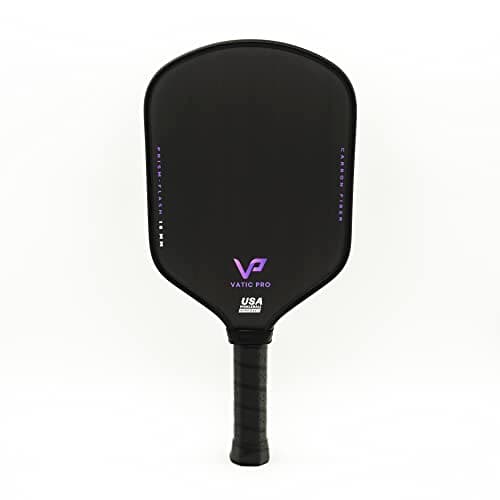 Vatic Pro Prism Flash 16mm The value spin champion (best under ~$110) | Best spin under $100 | 8.0 | $99.99 · View on Amazon #adPrice as of October 22, 2026 |
| 2 | No image Ronbus R1 Pulsar Lowest-cost entry to thermoformed carbon | Cheapest thermoformed carbon | 7.5 | |
| 3 | 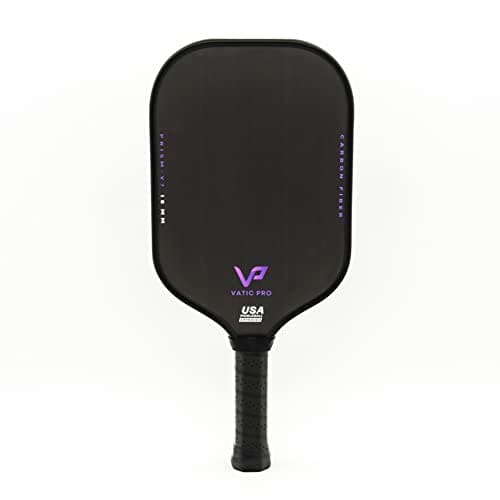 Vatic Pro Prism V7 16mm Value control in a standard shape | Best standard shape under $100 | 7.8 | $99.99 · View on Amazon #adPrice as of October 22, 2026 |
Tap any row to jump to the full write-up. Prices are pulled live from Amazon.
Vatic Pro Prism Flash 16mm
The value-shopper's spin paddle: raw T700 carbon and a thermoformed build that punches well above its price.
Vatic built a reputation on giving you 90% of a $250 paddle for around a hundred bucks. The Prism Flash's raw T700 face grips for spin and the elongated frame adds reach — the paddle we recommend when 'best spin under $100' is the search.
A raw Toray T700 face and a genuine thermoformed build in an elongated 16mm frame. On the specification that decides spin - the hitting surface - this is the same class of material the flagships use, which is why it keeps turning up in value conversations. What you give up is brand support, retail availability and put-away pace, not grip.
- Core
- 16 mm
- Shape
- Elongated
- Face
- Raw Toray T700 carbon fiber
- Weight
- ~8.0 oz
- Build
- Thermoformed
- Gen
- Prism
Manufacturer-listed as USA Pickleball approved. Approvals and delistings change — verify against the current USAP equipment list before tournament play (checked 2026-07).
Ronbus R1 Pulsar
The budget thermoformed pick: raw T700 carbon and a real thermoformed build at a price that undercuts almost everyone.
Ronbus is the value-brand's value brand. The R1 Pulsar gets you a raw-carbon, thermoformed paddle for the least money of anything we cover — a smart first 'real' upgrade from a big-box starter paddle before you commit to a $200 frame.
Ronbus is the value brand's value brand, and the R1 Pulsar is the least expensive way we know of to get a real raw-carbon, thermoformed paddle rather than a painted composite. The honest con is margin: it is the least forgiving paddle on this short list, and Ronbus has the smallest support and resale footprint of any brand we cover.
- Core
- 16 mm
- Shape
- Elongated
- Face
- Raw Toray T700 carbon fiber
- Weight
- ~8.0 oz
- Build
- Thermoformed
- Gen
- Pulsar
Manufacturer-listed as USA Pickleball approved. Approvals and delistings change — verify against the current USAP equipment list before tournament play (checked 2026-07).
Vatic Pro Prism V7 16mm
The standard-shape Prism: the same value-carbon face in a more control-friendly, maneuverable body.
The V7 is the Prism for players who prefer a standard shape — a lower, wider sweet spot and quicker hands than the elongated Flash, at the same wallet-friendly price. A lot of paddle for the money on the control end.
The same value-carbon face as the Flash in a standard body, which lowers and widens the sweet spot and makes hands battles at the net far more winnable. It is also the lowest-power paddle on this page by design, so if you want to end points from the baseline, the elongated Flash is the better buy.
- Core
- 16 mm
- Shape
- Standard
- Face
- Raw Toray T700 carbon fiber
- Weight
- ~8.0 oz
- Build
- Thermoformed
- Gen
- Prism
Manufacturer-listed as USA Pickleball approved. Approvals and delistings change — verify against the current USAP equipment list before tournament play (checked 2026-07).
What your money actually buys in a paddle
Before comparing anything, it helps to know which parts of a paddle cost money and which parts cost brand. Four things genuinely drive manufacturing cost: the face material (unpainted, high grade carbon fiber costs more than fiberglass or painted composite), the construction method (thermoforming a unibody frame under heat and pressure is more expensive than gluing a face to a honeycomb core), the core (foam injection is the current premium feature), and quality control (consistency between two paddles off the same line).
What does not cost much to produce, but does cost a lot to buy: pro endorsements, tour presence, retail distribution, packaging, and the marketing machine that makes a paddle feel like the obvious choice. None of that changes how the ball comes off the face.
The reason spin is the best value hunt in the sport is that the property you are shopping for lives almost entirely in the cheapest-to-copy layer. A raw T700 carbon face on a value paddle is genuinely the same family of material as a raw carbon face on a flagship. It is not marketing to say the grip is close; it is marketing to imply the whole paddle is equivalent, which it is not. Our carbon fiber vs fiberglass guide explains why the face material dominates the spin conversation.
How we picked
This list is short on purpose. To qualify, a paddle had to have a genuine raw carbon-fiber hitting surface — not paint or clear coat over composite — and a real thermoformed build, because those two things together are what separate a modern value paddle from a rebadged starter paddle. It also needed a first-party Amazon listing, and it had to sit consistently around or below the hundred-dollar mark rather than dipping there occasionally on sale.
Plenty of paddles are cheap. Very few are cheap and built like the expensive ones. We would rather name three we would actually hand a friend than pad the list out with paddles we would not. Scores for spin, power, control and forgiveness are our editorial read of compiled specs and the wider reviewer consensus — not measurements, and never published as a star rating in our structured data. For measured spin figures we defer to Pickleball Studio, which runs calibrated testing and publishes the results. The full approach is on our methodology page.
Why "thermoformed and raw carbon" is the line to draw
The value bracket contains two completely different kinds of paddle, and they look similar in a listing photo. The first is a traditional composite paddle: a honeycomb core with a face glued on, usually painted or clear-coated, often marketed with words like graphite or carbon without specifying that the surface is raw. These are fine to learn on and they will not spin the ball.
The second is a thermoformed paddle with a raw carbon face — a unibody frame molded under heat with a foam perimeter, and an unpainted surface whose weave is exposed enough to grab the ball. That is the construction every paddle on this page uses, and it is the same construction used at the top of the market. Our thermoformed paddle guide covers what the process does and why it changed the sport.
One honest caveat about thermoforming at any price: early thermoformed paddles across the whole industry had a reputation for edge-foam cracking under heavy play, and the failure mode is a paddle that goes dead rather than one that snaps. Manufacturing has broadly improved, but this is a real reason to buy from a brand with a warranty process you can actually reach — which is one of the things you are giving up at the value end.
Who should buy which
- You want the most spin for the least money and you like a longer paddle: the Vatic Pro Prism Flash. Highest spin score on this page and the one we recommend most often.
- You want a real carbon paddle for the absolute minimum spend: the Ronbus R1 Pulsar. The cheapest honest entry into thermoformed carbon we know of.
- You lose hands battles at the net, or you are coming from a wide starter paddle: the Vatic Pro Prism V7. A standard shape is far easier to defend with.
If none of those describe you and the budget is flexible, the honest advice is to look at the full spin paddle roundup before buying at this level. Buying a value paddle you will replace in six months is not cheaper than buying the right paddle once.
How the three compare
All three share a raw Toray T700 face and a 16mm core, which is why they feel more like siblings than rivals. The differences that matter are shape and brand depth.
Flash versus V7 is the shape decision, and it is the one most buyers get wrong. The elongated Flash gives you reach on stretch volleys, leverage on drives, and a slightly higher spin ceiling because of where the mass sits. The standard-shape V7 gives you a lower, wider sweet spot, a head that turns faster in a fast exchange, and less twisting when you catch the ball toward the edge. If you are upgrading from a wide big-box paddle, the V7 will feel like home and the Flash will feel like a project. Our elongated vs standard shape guide goes through the trade properly.
Vatic versus Ronbus is the brand decision. Both build the same category of paddle, and Vatic has the larger following, the wider model range, and more people who can tell you what to expect. Ronbus undercuts on price and has a smaller footprint in every other respect. If the deciding factor is the last few dollars, Ronbus wins; if it is the ability to get help or resell later, Vatic does. We put the two head to head in Vatic vs Ronbus.
What you give up at this price
Vatic Pro Prism Flash 16mm
Power. It is a strong spin paddle and a moderate power paddle, so finishing points from the baseline takes more work than it does on a thermoformed flagship. Vatic is also a direct-focused brand with limited retail presence, so demoing before you buy is unlikely.
Ronbus R1 Pulsar
Forgiveness and support. It carries the lowest forgiveness score on this page, which means off-center hits cost you more than they would on the Flash. Ronbus is also the smallest brand we cover — thinner support, thinner resale market, and fewer people to ask when something goes wrong.
Vatic Pro Prism V7 16mm
Pace and reach. It is the lowest-power paddle in this catalog, and the standard shape costs you the extra coverage an elongated frame provides. If you get stretched wide often, that is a real loss rather than a preference.
And one thing all three share: grit longevity is not the value bracket's strength. Raw carbon polishes smooth with play regardless of price, and none of these paddles market an abrasion-resistant face the way the durability-focused options do. If you play most days, factor replacement into the cost — our grit durability guide covers what actually wears, and the top of our highest-spin page is where the longevity-first option lives.
What to avoid at this price
Three things reliably signal a paddle that will disappoint a spin shopper. The first is a painted or glossy face: if the surface shines, the texture is filled in and it will not grip. The second is vague face language— "graphite," "carbon look," or "carbon composite" without the word raw. Manufacturers who use a genuine raw carbon face say so explicitly, usually with the material grade. The third is the multi-paddle bundle: two paddles, four balls and a bag for one low price is a set built to a cost, and none of that cost went into the hitting surface.
Also be skeptical of listings that show a familiar flagship shape with an unfamiliar name. Shape is the easiest thing to copy and the least relevant to how the paddle plays.
Buying well at the value end
A few habits make the difference between a good value purchase and a frustrating one.
Buy from a first-party listing. Value paddles attract third-party resellers, and a listing sold by an unrelated seller complicates warranty claims and returns. Every product we link is chosen because the listing is a real, first-party one — that is part of why this list is only three paddles long.
Check what generation you are buying. Value brands iterate quickly and older revisions linger in stock. The model designation matters: two paddles with the same family name can be different builds. Read the listed core thickness, shape and face material rather than trusting the product name.
Budget for a grip, not a second paddle. An overgrip costs very little and does more for how a paddle feels in your hand than almost any other change. If the handle feels thin — and value paddles often ship on the thin side — add one before deciding the paddle is wrong for you.
Do not buy two. The most common mistake we see is buying a value paddle plus a backup instead of putting the same money into one better paddle. Backups matter when a paddle is a tournament tool you cannot afford to lose mid-event; they do not matter for club play.
Finally, weigh your whole kit. If you are still playing in running shoes, court shoes will do more for your results than any paddle in this bracket — running shoes have no lateral support and pickleball is almost entirely lateral movement. Our court shoe picks cover it, and the rest of the gear section handles balls and bags.
When spending more is genuinely worth it
There are three situations where we would tell you to skip this page. If you mishit under pressure, a foam-core paddle from the current generation adds forgiveness that no value paddle currently matches, and forgiveness converts directly into points. If you play most days of the week, an abrasion-resistant face may be the cheaper paddle over two seasons. And if you need put-away power, the value bracket is where power is most obviously rationed — that is what the power paddle roundup is for.
Everyone else is well served here. A club player who wants more bite on rolls and drops, a beginner ready to leave a starter paddle behind, or anyone buying a second paddle for the car will not get meaningfully more spin by spending three times as much. If you are still working out which property to upgrade at all, read how to choose a paddle first, then decide between spin with control and spin with power.
A note on USAP legality
Value paddles are approved paddles — price has nothing to do with it. Every paddle here is manufacturer-listed as USA Pickleball approved, and we date-stamp that note on each product card. But approvals and delistings change, and they apply to specific model revisions, so if you play sanctioned tournaments check the current USAP approved paddle list before you enter. Our USAP-approved paddles guide explains how the process works.
The bottom line
For most people arriving on this page, the Prism Flash is the answer: the grippiest face of the three, a forgiving 16mm core, and a thermoformed build that has nothing to apologize for. Take the V7 instead if a standard shape suits your hands, and the R1 Pulsar if the goal is the smallest possible spend on a genuinely modern paddle. All three will put real rotation on the ball. The rest of the money the flagships ask for buys power, forgiveness and longevity — not spin.
Can a budget paddle really spin the ball as much as a flagship?
Close, yes, because spin is a face property. A raw Toray T700 carbon surface on a value paddle is the same family of material used on premium paddles, and the exposed weave is what grips the ball. Where flagships pull ahead is power, forgiveness, quality control and grit longevity — not raw grip. Independent labs such as Pickleball Studio publish measured spin figures if you want to see how close the gap is.
What should I look for on a cheap paddle listing?
Two phrases decide it: raw carbon fiber (ideally with a grade such as Toray T700) and thermoformed or unibody construction. If the listing says graphite, carbon composite, or just carbon without the word raw, and the face looks glossy in the photos, the surface is likely painted and it will not grip the ball. Avoid multi-paddle bundles — the cost saving comes out of the hitting surface.
Is a 16mm core the right choice at this price?
For most buyers, yes. All three picks here use a 16mm core, which flexes more at impact, absorbs incoming pace and gives a bigger margin on off-center hits. Thinner cores are poppier and faster but less forgiving, and forgiveness matters more when you are upgrading from a starter paddle than an extra gear of pace does.
How long should a value spin paddle last?
The frame will usually outlive the grip. Raw carbon faces polish smooth with play, and outdoor concrete with a hard outdoor ball wears them faster than indoor sessions. Playing a couple of times a week, expect the bite to stay strong for many months; playing most days, plan on noticing a drop sooner. Keeping the face clean and never scraping it along the court both extend it.