Vatic Pro vs Ronbus: The Budget Showdown
Two raw-carbon thermoformed paddles, nearly identical on paper, at the two ends of the value tier — Vatic Pro Prism Flash vs the Ronbus R1 Pulsar.
Disclosure: Drive Dink earns a commission from qualifying Amazon purchases at no extra cost to you. We accept no free products and no paid placements — commissions never change our picks. How this works.
Put these two spec sheets side by side and you will struggle to tell them apart. Both are elongated. Both run a 16mm core. Both use a raw Toray T700 carbon face. Both are genuinely thermoformed. On paper this is the same paddle at two prices, which is exactly why the comparison gets asked so often and why the spec table below does not settle it.
What separates them is refinement rather than ingredients. Live Amazon prices for both are above. Units we claim to have tested: 0 — everything here comes from published specifications and reviewer consensus, and we say plainly where each one falls short.
| # | Paddle | Best for | Score | Price |
|---|---|---|---|---|
| 1 | 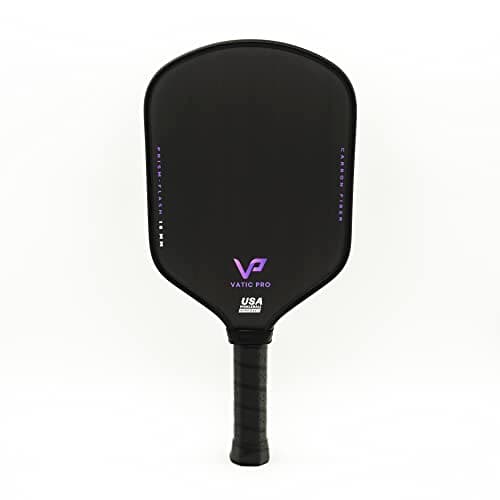 Vatic Pro Prism Flash 16mm The value spin champion (best under ~$110) | The value spin champion | 8.0 | $99.99 · View on Amazon #adPrice as of October 24, 2026 |
| 2 | No image Ronbus R1 Pulsar Lowest-cost entry to thermoformed carbon | The cheapest real carbon paddle | 7.5 |
Tap any row to jump to the full write-up. Prices are pulled live from Amazon.
Vatic Pro Prism Flash 16mm
The value-shopper's spin paddle: raw T700 carbon and a thermoformed build that punches well above its price.
Vatic built a reputation on giving you 90% of a $250 paddle for around a hundred bucks. The Prism Flash's raw T700 face grips for spin and the elongated frame adds reach — the paddle we recommend when 'best spin under $100' is the search.
Vatic's reputation is built on giving you most of a flagship for a fraction of the money. The Flash pairs a raw Toray T700 face with a thermoformed elongated frame — the paddle we name when the search is best spin on a budget.
- Core
- 16 mm
- Shape
- Elongated
- Face
- Raw Toray T700 carbon fiber
- Weight
- ~8.0 oz
- Build
- Thermoformed
- Gen
- Prism
Manufacturer-listed as USA Pickleball approved. Approvals and delistings change — verify against the current USAP equipment list before tournament play (checked 2026-07).
Ronbus R1 Pulsar
The budget thermoformed pick: raw T700 carbon and a real thermoformed build at a price that undercuts almost everyone.
Ronbus is the value-brand's value brand. The R1 Pulsar gets you a raw-carbon, thermoformed paddle for the least money of anything we cover — a smart first 'real' upgrade from a big-box starter paddle before you commit to a $200 frame.
The lowest-cost entry to a genuinely modern paddle we cover: raw T700 carbon, real thermoformed construction, a 16mm core. The sensible first upgrade from a big-box starter paddle.
- Core
- 16 mm
- Shape
- Elongated
- Face
- Raw Toray T700 carbon fiber
- Weight
- ~8.0 oz
- Build
- Thermoformed
- Gen
- Pulsar
Manufacturer-listed as USA Pickleball approved. Approvals and delistings change — verify against the current USAP equipment list before tournament play (checked 2026-07).
Vatic Pro Prism Flash vs Ronbus R1 Pulsar: the specs
| Spec | Vatic Pro Prism Flash 16mm | Ronbus R1 Pulsar |
|---|---|---|
| Shape | Elongated | Elongated |
| Core | 16 mm | 16 mm |
| Face | Raw Toray T700 carbon fiber | Raw Toray T700 carbon fiber |
| Build | Thermoformed, Prism | Thermoformed, Pulsar |
| Leans toward | Spin and all-court value | Lowest cost of entry to thermoformed carbon |
| Best for | Budget shoppers who want the most spin available | First real upgrade from a big-box starter paddle |
Why the spec sheet cannot decide this one
Spec sheets describe ingredients, not cooking. Toray T700 is a specific grade of carbon fiber that both brands buy from the same kind of supply chain; a 16mm core is a 16mm core; thermoforming is a process both factories can run. What a spec sheet cannot tell you is how carefully the core is bonded to the face, how consistently the perimeter is formed, how the weight is distributed within the frame, or how the paddle sounds and feels when a ball hits it a little off center.
Those are the things that separate a good budget paddle from a great one, and they are exactly the things that do not appear in marketing copy. It is also why two paddles with matching specifications can produce noticeably different measured twist weight and swing weight figures. Independent testing at Pickleball Studio is the best available source for those measurements, and our swing weight and twist weight guide explains why twist weight in particular predicts more about how a paddle plays than anything a brand prints on the box.
The other thing worth saying up front: both paddles are legitimately modern. Neither is a compromise in the way a fiberglass big-box paddle is a compromise. If you are coming from a starter paddle, either one will feel like a different sport — the spin especially. Our carbon fiber vs fiberglass guide covers why that jump is so large.
What actually separates them
The consensus difference is refinement of the sweet spot. Vatic Pro has spent several product generations tuning the Prism line, and the Flash is the more polished of these two: a more forgiving effective hitting zone and a slightly more aggressive spin face are the two properties that come up repeatedly. Ronbus delivers the same construction list at a lower price, and the thing it gives up is that last measure of off-center stability.
That distinction sounds small and is not. Off-center contact is where a paddle either helps or hurts you, and it happens far more often than most players admit — every stretched dink, every jammed block, every ball you reach for at the sideline. A paddle that keeps those shots on line is winning you points invisibly. It is the reason we rank the Flash higher overall even though the Ronbus is a genuinely good paddle and costs less.
The second difference is positioning. Vatic has become a recognized name among enthusiasts, with a broad line that includes the standard-shape Prism V7 alongside the elongated Flash, so there is a natural next step within the brand if you decide you want a different shape. Ronbus is more of a specialist proposition: it exists to be the cheapest credible entry point, and it executes that brief well. Neither has the after-sales infrastructure of the major brands, which is a real consideration if warranty support matters to you.
Spin, grit and how long it lasts
Both faces are raw T700, unpainted and unsealed, so the texture of the weave itself grips the ball. That mechanism is the entire reason modern paddles generate the topspin they do, and it is explained in how spin actually works. On peak grip, the Flash rates as the more aggressive spin surface of the two and is one of the paddles we point to when the question is which budget paddle spins hardest — see our spin roundup and budget spin picks.
The more important question for a budget buyer is how long that grit lasts, because a paddle that spins beautifully for one season and then goes smooth is not actually cheap. Raw carbon faces wear — all of them do, across every brand and price tier — and the rate depends heavily on how much you play, whether you play outdoors on abrasive courts, and how the paddle is stored. We cover what to expect and what genuinely slows it in paddle grit and durability.
Neither brand publishes durability data, and we are not going to invent any. What we will say is that at these prices, replacing a paddle when the grit dies is a far less painful proposition than it is with a flagship — which is a legitimate argument for buying budget on purpose rather than as a compromise.
Shape, and who each paddle suits
Both are elongated, which means both give you reach and leverage at the cost of maneuverability in a hands battle. If you already know you prefer a shorter, more balanced paddle, neither of these is the right buy in this exact configuration — Vatic's standard-shape Prism V7 is the answer within the same value tier, and it appears on our control paddles for intermediate players list. Our elongated vs standard shape guide will tell you which camp you are in.
Assuming elongated suits you, the split is straightforward. The Flash is for the player who has decided pickleball is a habit and wants the best paddle they can get without entering the premium tier. The Pulsar is for the player who is not there yet — trying the sport seriously for the first time, buying a backup, kitting out a family, or simply unwilling to spend more until they know what they want.
There is one more group worth naming: the player who should buy the cheaper paddle and spend the difference elsewhere. A proper pair of court shoes prevents more lost points and more injuries than any paddle upgrade, and if you are still playing in running shoes, that is the higher-value purchase by a wide margin.
Price and value
Both sit well under the flagships, and the gap between them is smaller than the gap between either of them and a premium paddle. Live prices are at the top of this page and they move, so we will not quote figures — but the shape of the decision is stable: the Ronbus is the cheapest credible modern paddle we cover, and the Vatic asks a modest step up for a more refined version of the same recipe.
Framed as a percentage, that step up is a meaningful increase on a small base. Framed in absolute terms, it is small enough that most players who intend to keep playing should simply pay it. The exception is the buyer who is genuinely uncertain about the sport, where the cheapest credible option is the rational choice. To see how either one holds up against a mid-tier paddle rather than each other, read Six Zero vs Vatic Pro.
Before you buy: approval, weight and expectations
Tournament approval.Both brands list their paddles as USA Pickleball approved, but approvals and delistings change and the manufacturer's claim is not the current official list. Value brands also refresh models more often than the majors, so the version on sale may not be the version that was listed. If a sanctioned event is anywhere in your plans, check the exact model against the USA Pickleball approved paddle list first, and read our guide to USAP-approved paddles for how the process works.
Weight consistency. Both paddles are sold around the standard mid-weight range for a modern frame, but manufacturing tolerance at the budget end tends to be wider than at the top of the market. That is not a scandal — it is what the price buys — but it does mean the paddle you receive may sit at either end of the stated range. A little lead tape at the sides is the cheapest fix available for a frame that feels unstable, and it costs a fraction of what upgrading would.
Expectations. Neither paddle will feel like a flagship. What both will do is give you the two things that actually changed pickleball in the last few years: a raw carbon face that grips the ball hard enough to hit real topspin, and a thermoformed perimeter that returns energy instead of absorbing it. Those are the properties that separate a modern paddle from a starter paddle, and you get all of both here. What premium money buys beyond that is consistency, off-center stability and a more pleasant feel — genuinely worth paying for eventually, and genuinely not necessary yet.
The verdict, by player type
- Buy the Vatic Pro Prism Flash ifyou are committed to the sport and want the most refined paddle available before the premium tier begins. It has the more forgiving effective sweet spot and the more aggressive spin face of the two, in the same raw-carbon, thermoformed, 16mm recipe. The trade is that it costs more than the Ronbus, it is elongated so it is less nimble at the kitchen than a standard shape, and Vatic's support infrastructure does not match the major brands. Read the full Vatic Pro Prism Flash review.
- Buy the Ronbus R1 Pulsar if price is the binding constraint, you are upgrading from a big-box starter paddle, or you want a second paddle without a second serious purchase. You still get raw T700 carbon, a real thermoformed build and a 16mm core — the construction that matters. The trade is the least forgiving frame of the two: mishits are punished more, and you are buying ingredients rather than refinement. Read the full Ronbus R1 Pulsar review.
If neither feels like enough paddle, the honest next step is not a more expensive budget paddle — it is a mid-tier all-rounder. Start with how to choose a paddle, then look at the control and all-court roundup or the thermoformed paddles guide to understand what your money buys as you move up.
Is Vatic Pro or Ronbus better?
The Vatic Pro Prism Flash is the better paddle overall — a more forgiving effective sweet spot and a more aggressive spin face, in the same raw carbon, thermoformed, 16mm recipe. The Ronbus R1 Pulsar is the better buy if price is the binding constraint, since it delivers the same construction list for less and is the cheapest credible modern paddle we cover.
Are budget pickleball paddles worth it?
Now, yes. Both paddles here use raw Toray T700 carbon faces and genuine thermoformed construction, which is the same headline recipe as paddles costing several times more. What premium money buys is refinement — sweet spot consistency, off-center stability and feel — not access to the core technology.
Why do these two paddles have almost identical specs?
Because specs describe ingredients, not execution. Core thickness, face material and construction method are all published numbers that many brands can match. How carefully the core is bonded, how consistently the perimeter is formed, and how weight is distributed within the frame are what differ, and none of those appear on a spec sheet.
Which budget paddle has more spin?
The Vatic Pro Prism Flash rates as the more aggressive spin surface of the two, which is why we name it when the question is which budget paddle spins hardest. Both use raw Toray T700 faces, so the Ronbus is not far behind — and both will feel dramatically spinnier than any fiberglass starter paddle.