Vatic Pro Prism Flash Review
The value-shopper's spin paddle — raw T700 carbon and a thermoformed build for around a hundred bucks, weighed against the paddles that cost twice as much.
Disclosure: Drive Dink earns a commission from qualifying Amazon purchases at no extra cost to you. We accept no free products and no paid placements — commissions never change our picks. How this works.
Vatic Pro Prism Flash 16mm
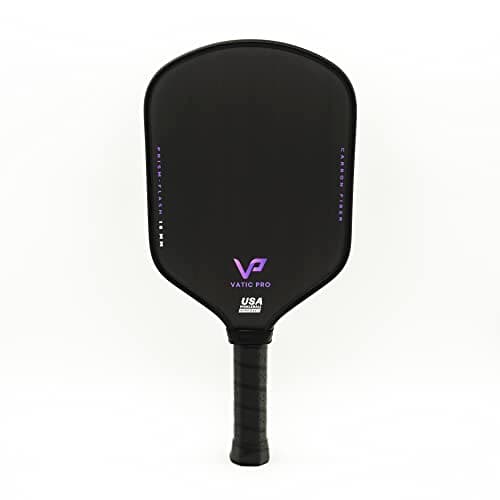
The value-shopper's spin paddle: raw T700 carbon and a thermoformed build that punches well above its price.
Vatic built a reputation on giving you 90% of a $250 paddle for around a hundred bucks. The Prism Flash's raw T700 face grips for spin and the elongated frame adds reach — the paddle we recommend when 'best spin under $100' is the search.
The Prism Flash is the value story of the spin category: a raw T700 carbon face that grips nearly as hard as paddles costing twice as much, in a real thermoformed elongated frame. You are paying for the brand elsewhere, not the spin. If your budget is tight and spin is the upgrade you want, this is the paddle to beat.
- Core
- 16 mm
- Shape
- Elongated
- Face
- Raw Toray T700 carbon fiber
- Weight
- ~8.0 oz
- Build
- Thermoformed
- Gen
- Prism
Manufacturer-listed as USA Pickleball approved. Approvals and delistings change — verify against the current USAP equipment list before tournament play (checked 2026-07).
Who it's for
The Vatic Pro Prism Flash 16mm is the answer to one very specific search: "best spin paddle under a hundred bucks." It is the value pick in our best spin paddles roundup, and it earns that slot by giving you the thing that actually matters for spin — a grippy, unpainted raw-carbon face — without the flagship price tag. If you are an upgrading player who wants more bite on your drives and drops but refuses to spend $220 to get it, this is the paddle built for you.
Vatic built its whole reputation on this trade: roughly 90% of a premium paddle's performance for around a hundred dollars. The Prism Flash is the elongated, spin-forward member of that family. It is not a compromise paddle you settle for — it is a genuinely good paddle that happens to be cheap, which is a different and much better thing.
How it plays
Spin
Spin is the whole point, and the Prism Flash delivers it. The face is raw Toray T700 carbon fiber — the same unpainted, textured carbon that anchors the top of the measured spin charts — and it grips the ball hard on topspin drives and dipping third-shot drops. Our editorial spin score sits at the top of our range for this paddle, and it is the reason we recommend it. Independent labs such as Pickleball Studio publish measured spin RPM across the raw-carbon field, and the value paddles like this one consistently land within striking distance of paddles costing far more — we cite their machine rather than run our own.
Power and pace
The Prism Flash is thermoformed, so there is real pop behind the spin. The elongated shape adds reach and a little leverage on drives, which suits an aggressive spin-and-drive game. It is not a dedicated power flagship — it will not out-hit the top of our power roundup — but there is more than enough pace here to finish points when a ball sits up, and the combination of grip and pop is exactly what a spin-forward player wants.
Control and forgiveness
The 16mm core keeps the paddle reasonably controllable and gives a sensible, mid-pack sweet spot — forgiving enough for most upgraders without being the most forgiving frame on the board. It is a spin-first paddle, so it leans a touch more toward bite and pace than plush touch, but it resets and dinks perfectly well. If your priority is a huge margin on mishits over spin, a control-tuned paddle will feel a little more secure; for a spin buyer, the balance here is right.
Specs and build
| Spec | Vatic Pro Prism Flash |
|---|---|
| Shape | Elongated |
| Core thickness | 16mm |
| Face | Raw Toray T700 carbon fiber |
| Construction | Thermoformed unibody |
| Generation | Prism |
| Listed weight | ~8.0 oz |
On paper the build sheet reads like a paddle that should cost twice as much: raw T700 carbon, a thermoformed unibody, an elongated frame. That is the point of Vatic. Our thermoformed paddles guide explains why that construction is what you are really paying for in a premium paddle — and why getting it at this price is the whole value story. If you are still weighing spin against power and control as your upgrade, how to choose a paddle is the place to start.
The value math: what the extra money buys
The honest question with any value paddle is what you give up by not spending flagship money. Step up from the Prism Flash to a paddle costing twice as much, like the JOOLA Perseus, and you are mostly paying for three things: a marginally grippier proprietary surface, a slightly hotter and more polished feel off the face, and the brand's pro pedigree and resale value. None of those is nothing — but none of them is the raw T700 grip that decides how much the ball bites, and that is the part the Prism Flash already has in full.
What you do not give up is just as important. The core spin surface, the thermoformed construction, the elongated reach and the USA Pickleball approval are all present here at a fraction of the flagship price. Reviewers who measure these paddles side by side consistently put the value frames within striking distance of the premium ones on the numbers that matter for spin — the gap is real but small, and it lives mostly in feel and finish rather than raw performance. For a player who wants the most spin per dollar and does not care about the badge, that math points straight at the Prism Flash. For a player who wants the last few percent of feel and pop and will happily pay for it, the flagship is the upgrade — and we would never pretend the value paddle is literally identical. It is close, at a fraction of the cost, and that is the whole point.
Where it fits vs the alternatives
The Prism Flash's natural rival is the Six Zero Double Black Diamond: the DBD costs a bit more and answers with a larger, more forgiving sweet spot, while the Prism Flash undercuts it on price and leans a shade more spin-first. Against the JOOLA Perseus Pro IV, the Vatic is the value play — the Perseus hits harder and carries flagship polish and a slightly grippier Charged surface, but it costs roughly double. If "most spin for the least money" is your brief, the Prism Flash wins; if you want a bigger sweet spot or flagship pace and will pay for it, the DBD and Perseus are the step-ups.
Pros
- Raw T700 carbon face that grips near the top of the spin field.
- Real thermoformed build at a value price.
- Elongated shape adds reach and drive.
- Outstanding performance-per-dollar — the value benchmark.
Cons
- Sweet spot is good, not the most forgiving in its class.
- Raw-carbon grit softens over time with heavy play.
- Not a flagship power paddle if pace is your top priority.
What we'd skip it for
If maximum forgiveness is your top priority, the Prism Flash is not the most forgiving paddle we cover — a control-tuned frame with a bigger sweet spot will feel more secure on off-center hits. If you want flagship power and the last few miles per hour on a drive, a dedicated power paddle will out-hit it. And like every raw-carbon face, the grit will gradually polish smooth with heavy daily play, so a high-volume player who hates re-buying paddles when the spin dies may want a purpose-built abrasion-resistant face instead. For everyone else — which is most upgraders — the value here is hard to argue with.
The verdict
The Vatic Pro Prism Flash is the value benchmark of the spin category, and it is the paddle we recommend without hesitation when the budget is tight and spin is the upgrade. You get a genuine raw T700 carbon face, a real thermoformed build and an elongated frame for around a hundred dollars — the same ingredients the flagships charge double for. It is not the most forgiving or the most powerful paddle on the board, but for spin-per-dollar nothing beats it. See where it ranks against the field in our spin roundup and our best carbon fiber paddles page, what that T700 label actually means in our T700 carbon fiber guide, and how we score without a lab in our methodology. If you want the same raw T700 face over a full foam core rather than foam-injected walls, Vatic's newer line is the step up — we cover it in the Vatic Pro V-Sol Pro review.
Is the Vatic Pro Prism Flash worth it?
For a value-focused spin buyer, absolutely. It delivers a raw T700 carbon face and a real thermoformed build for around a hundred dollars — much of what the flagships offer at roughly half the price. You give up a little forgiveness and top-end power versus premium paddles, but for spin-per-dollar it is the paddle to beat.
Does the Prism Flash have as much spin as a JOOLA Perseus?
It is close. Both use grippy raw-carbon-family faces that sit near the top of measured spin charts, and reviewers consistently place value paddles like the Prism Flash within striking distance of the flagships on spin. The Perseus's Charged surface may edge it slightly and hits harder, but you pay roughly double for that gap. Independent labs like Pickleball Studio publish the measured numbers if you want to compare directly.
How long does the Prism Flash's spin last?
Like all raw-carbon faces, its grit gradually polishes smooth with play — heavy daily players tend to notice a drop within a few months, while casual players get much longer. When the face starts to feel slick, the spin is telling you it is wearing. If grit durability is your top concern, a paddle built around an abrasion-resistant face holds its bite longer.
Is the Prism Flash good for beginners?
It is better suited to an upgrading player than a first-timer. The elongated, spin-first design rewards developing technique, and the sweet spot is good but not the most forgiving available. A true beginner may prefer a more forgiving all-court paddle first, then step into a spin-forward frame like this one as their stroke develops.
- Vatic Pro Prism Flash vs V7
- Best spin paddles under $100
- Vatic Pro vs Ronbus — the budget showdown
- Best Pickleball Paddles for Spin (2026)
- Six Zero Double Black Diamond — full review
- JOOLA Perseus Pro IV — full review
- Thermoformed paddles explained
- Vatic Pro Prism V7 — full review
- CRBN vs Vatic Pro — same face, different price
- Selkirk vs Vatic Pro — is the premium worth it?