Vatic Pro Prism Flash vs V7
Vatic sells the same recipe in two outlines at almost the same money. The shape is the whole decision — and most people get it backwards.
Disclosure: Drive Dink earns a commission from qualifying Amazon purchases at no extra cost to you. We accept no free products and no paid placements — commissions never change our picks. How this works.
Vatic Pro built its following on giving people flagship materials at value prices, and the Prism line is where that shows. The Flash and the V7 share a 16mm core, a raw Toray T700 carbon face and a thermoformed build. What separates them is the outline — and outline changes more about how a paddle plays than most spec sheets let on.
Live Amazon prices for both are above. We rank by fit rather than by a single overall score. Units we claim to have tested: 0.
| # | Paddle | Best for | Score | Price |
|---|---|---|---|---|
| 1 | 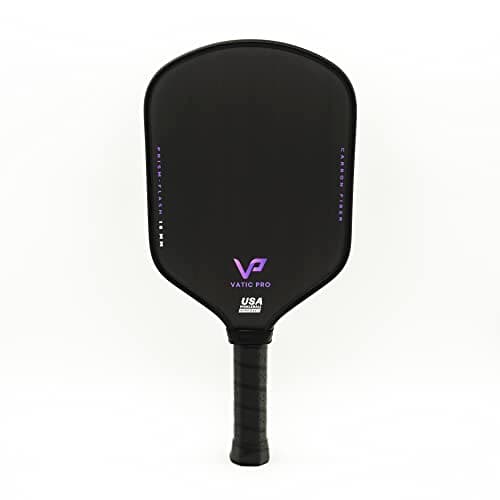 Vatic Pro Prism Flash 16mm The value spin champion (best under ~$110) | Best for reach and spin | 8.0 | $99.99 · View on Amazon #adPrice as of October 24, 2026 |
| 2 | 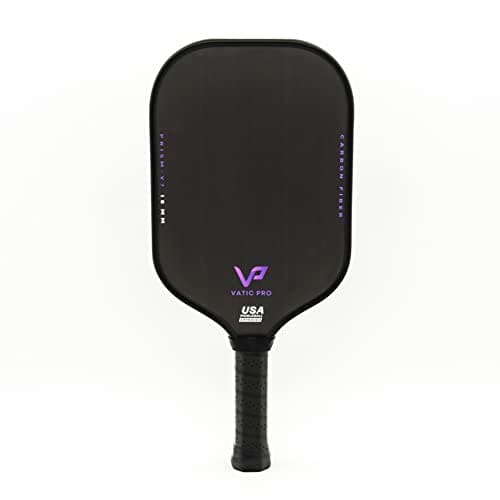 Vatic Pro Prism V7 16mm Value control in a standard shape | Best for hand speed and margin | 7.8 | $99.99 · View on Amazon #adPrice as of October 24, 2026 |
Tap any row to jump to the full write-up. Prices are pulled live from Amazon.
Vatic Pro Prism Flash 16mm
The value-shopper's spin paddle: raw T700 carbon and a thermoformed build that punches well above its price.
Vatic built a reputation on giving you 90% of a $250 paddle for around a hundred bucks. The Prism Flash's raw T700 face grips for spin and the elongated frame adds reach — the paddle we recommend when 'best spin under $100' is the search.
The Flash is the paddle that earned Vatic its reputation — an elongated frame with a raw T700 face that generates spin at a level normally reserved for paddles at twice the price. Length gives you leverage on drives and reach at full stretch. It costs you sweet-spot size and hand speed at the net, which is exactly what the V7 exists to fix.
- Core
- 16 mm
- Shape
- Elongated
- Face
- Raw Toray T700 carbon fiber
- Weight
- ~8.0 oz
- Build
- Thermoformed
- Gen
- Prism
Manufacturer-listed as USA Pickleball approved. Approvals and delistings change — verify against the current USAP equipment list before tournament play (checked 2026-07).
Vatic Pro Prism V7 16mm
The standard-shape Prism: the same value-carbon face in a more control-friendly, maneuverable body.
The V7 is the Prism for players who prefer a standard shape — a lower, wider sweet spot and quicker hands than the elongated Flash, at the same wallet-friendly price. A lot of paddle for the money on the control end.
The V7 keeps the same 16mm core and the same raw carbon face but wraps them in a standard outline, which pulls mass back towards your hand. The result is a quicker paddle at the kitchen line with a wider usable face and a softer touch on resets. You give up reach and a measure of drive power for it.
- Core
- 16 mm
- Shape
- Standard
- Face
- Raw Toray T700 carbon fiber
- Weight
- ~8.0 oz
- Build
- Thermoformed
- Gen
- Prism
Manufacturer-listed as USA Pickleball approved. Approvals and delistings change — verify against the current USAP equipment list before tournament play (checked 2026-07).
Side by side
| Spec | Prism Flash | Prism V7 |
|---|---|---|
| Shape | Elongated | Standard |
| Core thickness | 16 mm | 16 mm |
| Face | Raw Toray T700 carbon fiber | Raw Toray T700 carbon fiber |
| Build | Thermoformed | Thermoformed |
| Listed weight | ~8.0 oz | ~8.0 oz |
| Our spin score | 9 / 10 | 8 / 10 |
| Our power score | 8 / 10 | 7 / 10 |
| Our control score | 7 / 10 | 8 / 10 |
| Our forgiveness score | 8 / 10 | 8 / 10 |
What the outline actually changes
Both paddles must fit inside the same USA Pickleball dimension limit, so an elongated frame is not simply a bigger paddle. It is a redistribution: length is bought with width. The Flash is longer and narrower; the V7 is shorter and wider.
Length buys leverage and reach. A contact point further from your hand travels faster for the same arm speed, which is why elongated paddles drive harder. It also gets you to balls a shorter paddle does not reach, which matters most in singles and on stretched cross-court dinks.
Width buys margin and speed. A wider face puts more of the hitting surface near the middle, so mishits stay playable. And mass closer to your hand means a lower swing weight, so the paddle changes direction faster in a hands battle. Our elongated vs standard shape guide goes through the full trade, and our swing weight and twist weight guide explains why the numbers behave the way they do.
Why the Flash scores higher on spin
Both faces are the same material with the same texture, so the difference is not the surface. It is geometry: a longer frame lets you swing on a longer arc and brush across the ball with more head speed at contact, and head speed is one of the two inputs to spin — the other being how much the face grips.
That is a modest edge, not a transformation, and it only shows up if your technique already brushes. If you hit flatter, the two paddles will feel much closer on spin than our scores suggest. Our how paddle spin works guide covers what actually generates rotation, and our picks for serving with spin cover the shot where the gap is largest.
Who should buy which
Buy the Flash if you play singles, you hit a two-handed backhand, you drive from the baseline, or you are chasing spin above all else. It is our value spin pick and it appears in our best spin paddles under $100 list for that reason.
Buy the V7 if your points are won and lost at the kitchen line, you have come from a standard-shape paddle and do not want to relearn your contact point, or you have found long paddles slow in hands battles. It is our value control pick and sits in our control paddles for intermediate players list.
The backwards assumption worth naming: plenty of players buy the elongated version because it looks like the more serious paddle. Shape is a fit decision, not a tier. A standard frame in the right hands beats an elongated frame in the wrong ones every time.
Where these sit in the market
Both paddles cost a fraction of the flagship field while using recognizably the same materials — thermoformed build, raw T700 carbon, 16mm polymer core. What you give up against a Perseus or a CRBN is refinement rather than specification: consistency of feel across the face, the quality of the damping, and the sheer stability of the frame under a hard hit.
Whether that refinement is worth three times the money is a genuine question, and our guide to how much a pickleball paddle should cost works through it. Our Selkirk vs Vatic Pro comparison makes the same argument against a premium brand directly.
Verdict
Choose on where your points are decided. If you win them from the baseline and at full stretch, take the Flash — the reach and the extra spin are real, and it is one of the best-value spin paddles on the market. If you win them in the kitchen, take the V7, because hand speed and a wide margin are worth more there than any amount of leverage.
Full write-ups for each: Vatic Pro Prism Flash review and Vatic Pro Prism V7 review. Vatic now sells the same shape decision one generation on, with a full foam core and a widebody option the Prism never had — see the Vatic Pro V-Sol Pro review for how the three V-Sol outlines compare.
Both paddles here are the Prism generation. Vatic has since replaced the honeycomb core with foam in the V-Sol Pro line, and our V-Sol vs Prism comparison covers whether that step up is worth making.
What is the difference between the Vatic Prism Flash and the V7?
Shape. The Flash is elongated and the V7 is standard, and both use the same 16mm core, the same raw Toray T700 carbon face and the same thermoformed build. The Flash trades sweet-spot width and hand speed for reach, leverage and a little more spin; the V7 does the reverse.
Which Vatic paddle is better for a beginner-to-intermediate player upgrading?
The V7 for most players, because a standard shape is more forgiving of imperfect contact and quicker in hands battles. Choose the Flash instead if you play singles, hit a two-handed backhand, or are specifically upgrading to add spin and reach.
Do the Flash and V7 generate the same spin?
The face material and texture are identical, so the difference is geometry rather than grip. The Flash's longer frame produces more head speed at contact on a brushing stroke, which is why we score it a point higher. If you hit flatter, the two will feel very close.
Are these paddles good enough to replace a flagship?
They use the same headline specifications — thermoformed construction, raw T700 carbon, a 16mm polymer core — at a fraction of flagship money. What flagships add is refinement: more consistent feel across the face, better damping, and a more stable frame under a hard hit. Whether that is worth the difference depends on how often you play and how much you notice.