Vatic Pro V-Sol Pro Review
Vatic's first full foam core, under a raw Toray T700 face, at value-tier money — and the three shapes it comes in, which is the decision most buyers actually get wrong.
Disclosure: Drive Dink earns a commission from qualifying Amazon purchases at no extra cost to you. We accept no free products and no paid placements — commissions never change our picks. How this works.
Vatic Pro V-Sol Pro V7 16mm
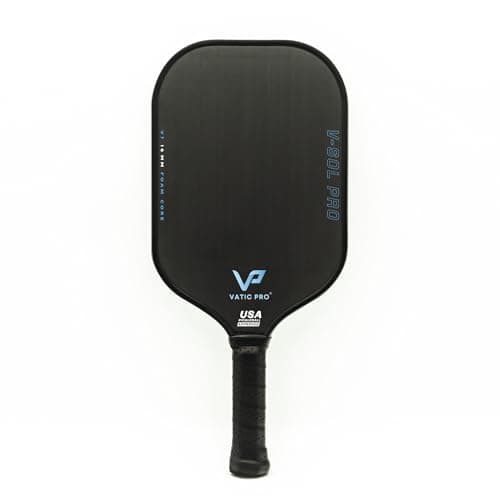
Vatic's foam-core answer to the Gen-4 flagships: a floating EPP core inside an EVA perimeter ring under a raw T700 face, in the 16.5in elongated V7 outline.
The V-Sol Pro is the generational step the Prism never took — out goes the honeycomb core with foam-injected walls, in comes a full EPP foam core ringed by firmer EVA. The V7 is the elongated shape of the three, so it carries the most reach and the most leverage on a drive. Pickleball Studio measured the standard-handle V7 at 8.09 oz static with a 114 swing weight, which is light for a 16mm foam paddle.
Buy this one if you are already on an elongated paddle — a Prism Flash, a DBD, anything with reach — because switching shape and switching core technology in the same purchase makes it impossible to tell which change you are feeling. It is also the shape Pickleball Studio put on the machine, so it is the version of this paddle with published measurements behind it rather than inference. The cost of the length is the usual one: the narrowest face in the line and the least room for a sloppy contact point.
- Core
- 16 mm
- Shape
- Elongated
- Face
- Raw Toray T700 carbon fiber (heat-compressed texturing)
- Weight
- ~8.0-8.3 oz (listed)
- Build
- Not published
- Gen
- V-Sol (Gen 4 foam core)
Manufacturer-listed as USA Pickleball approved. Approvals and delistings change — verify against the current USAP equipment list before tournament play (checked 2026-07).
Vatic Pro V-Sol Pro Flash 16mm
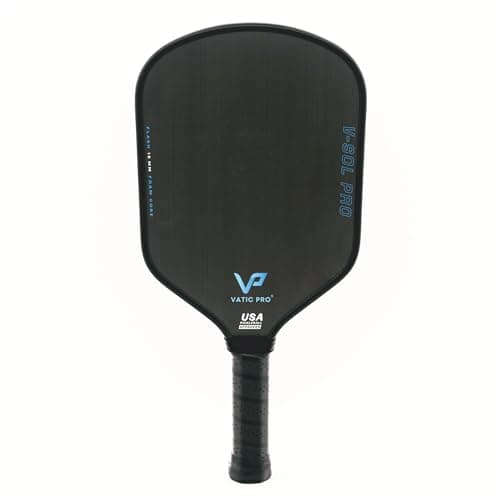
Same foam core and raw T700 face as the V7, in Vatic's 16.3 x 7.7in hybrid shape — a little less reach, a little more hand speed.
Flash is the middle shape of the V-Sol Pro range: shorter and wider than the elongated V7, which moves the sweet spot down and in and makes the paddle quicker to turn over at the net. If you have been playing a standard or hybrid frame and want a foam core without relearning where the paddle face is, this is the version to buy.
This is the shape to default to if you are unsure. An elongated frame only pays you back when you are genuinely reaching for balls or driving from the baseline; the rest of the time the length is just a narrower face. Flash keeps most of the V7's leverage without asking you to be that precise, and it is the one version of the V-Sol Pro that does not feel like a specialist tool. Note that Vatic offers it in both handle lengths, so a two-handed backhand does not force you into the widebody.
- Core
- 16 mm
- Shape
- Hybrid
- Face
- Raw Toray T700 carbon fiber (heat-compressed texturing)
- Weight
- ~8.0-8.3 oz (listed)
- Build
- Not published
- Gen
- V-Sol (Gen 4 foam core)
Manufacturer-listed as USA Pickleball approved. Approvals and delistings change — verify against the current USAP equipment list before tournament play (checked 2026-07).
Vatic Pro V-Sol Pro Bloom 16mm
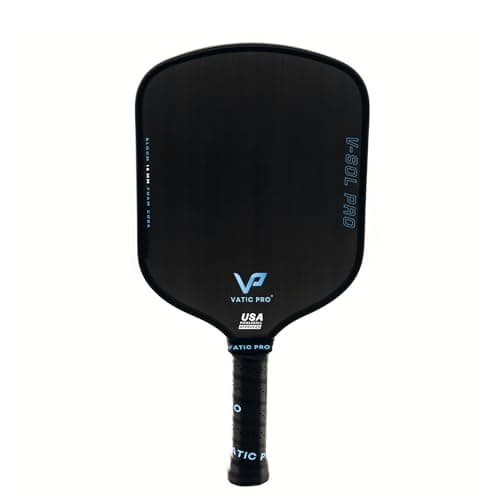
The widebody V-Sol Pro — 16 x 8in, long handle only. The widest, most forgiving face in the line and the one to buy if off-center contact is the weakness you are fixing.
Bloom trades the V7's reach for width: Vatic lists it at 16 x 8in against the V7's 16.5 x 7.5in, which spreads the sweet spot sideways and raises twist weight — the spec that decides how much a paddle turns in your hand on an off-center ball. It ships in the 5.6in long handle only, so two-handed backhand players lose nothing by choosing it.
Worth understanding what you are buying here, because widebody is the shape the power-paddle market mostly abandoned. Face width raises twist weight, and twist weight is the single spec that decides whether a ball struck an inch off-center still goes where you aimed. Choose Bloom if you know your misses are contact errors rather than decision errors — and accept that the half-inch of length you give up is real on a stretch volley. It is also the only V-Sol Pro without a short-handle option.
- Core
- 16 mm
- Shape
- Widebody
- Face
- Raw Toray T700 carbon fiber (heat-compressed texturing)
- Weight
- ~8.0-8.3 oz (listed)
- Build
- Not published
- Gen
- V-Sol (Gen 4 foam core)
Manufacturer-listed as USA Pickleball approved. Approvals and delistings change — verify against the current USAP equipment list before tournament play (checked 2026-07).
Who it's for
The Vatic Pro V-Sol Pro is for the player who already owns a decent thermoformed carbon paddle — very possibly a Vatic Prism Flash — and wants to find out what a full foam core actually does before spending flagship money to find out. It is the first Vatic line built around foam all the way through the paddle rather than foam packed into the walls, and it sells for roughly what the Prism has always sold for.
That makes it the cheapest honest answer to a question a lot of upgrading players are asking right now: is the Gen-4 foam thing worth it, or is it marketing? You can answer it here for value-tier money instead of flagship money. What you should not expect is a paddle that plays like a flagship in every respect — the specifics below are where it wins and where it plainly doesn't.
What actually changed from the Prism
This is the part worth being precise about, because "foam paddle" has become a label rather than a description. Vatic's own comparison table lists the Prism's core as an 8mm-celled polypropylene honeycomb — a conventional honeycomb with foam injected into the perimeter walls, which is the construction the industry calls Gen 3. The V-Sol line's core is listed as EPP foam with a perimeter EVA foam ring, and the V-Sol Pro product page describes it as a "floating EPP core with an EVA perimeter foam ring." There is no honeycomb in there at all.
So the difference is structural, not cosmetic. In a Gen-3 paddle the foam is a stiffening band around the edge of a honeycomb; in the V-Sol Pro the whole core is foam, with a firmer EVA ring around a softer EPP center. Two foams of different densities behave differently on contact, which is what Vatic means when it markets an expanded sweet spot. Our Gen 3 and Gen 4 foam paddles guide walks through why that distinction matters more than the generation number attached to it, and the thermoformed paddles roundup covers the builds the V-Sol is competing against.
The face did not change in kind: Vatic lists raw Toray T700 carbon fiber with heat-compressed texturing, the same family of surface that made the Prism a spin paddle worth buying. If you want to know what the T700 label does and does not promise, our T700 carbon fiber guide has the fiber manufacturer's published numbers — the short version is that it confirms a real carbon face from a named source and tells you nothing about how much spin the finish generates.
One thing Vatic does not publish for this line is a molding method. The brand states the core construction, the face material, the TPU edge guard and the certifications, but nowhere on the product page or the comparison table does it say whether the V-Sol is hot-molded or cold-pressed. We have left that field blank on the spec cards above rather than assert an answer, because a build method is exactly the sort of spec that gets repeated across the internet once one site guesses it.
How it plays
Power
Power is the reason this paddle exists. Vatic lists the V-Sol Pro as PBCoR .43 certified, which is the ceiling the certification allows and puts it in the same measured bracket as paddles costing two and three times as much. Foam cores generate pace differently from honeycomb: the ball sits on the face marginally longer and comes off with a sense of being pushed rather than struck, which is why reviewers describe foam paddles as having a bigger, later punch on drives.
The practical catch is that a foam core rewards a real swing. Multiple reviewers who have hit this paddle note that it will not manufacture pace from a lazy stroke — the energy you get back is proportional to the energy you put in. If your drive is a push rather than a swing, a springier honeycomb paddle will flatter you more.
Spin
The raw T700 face grips hard, as it does on every Vatic that has used it. We do not run a spin machine and will not pretend to; Pickleball Studio publishes measured RPM across the raw-carbon field and is the number we would go read. What we can say from the spec sheet is that this is the same surface family that anchors the top of those charts, and that our how paddle spin actually works guide explains why the face — not the foam underneath it — is the part that decides bite.
Control and forgiveness
Here is where the measured numbers are genuinely useful. Pickleball Studio measured the elongated V-Sol Pro with the standard 5.3in handle at a 114 swing weight, 6.32 twist weight, 233mm balance point and 8.09 oz static weight; the 5.6in long-handle version came in at the same 114 swing weight, a lower 5.97 twist weight and 7.98 oz. For context on what those two numbers do to a paddle, read our swing weight and twist weight guide — swing weight is how heavy the paddle feels in motion, twist weight is how much it resists turning in your hand when you miss the middle.
A 114 swing weight on a 16mm foam paddle is light. That is the source of the V-Sol Pro's best trait — it is fast to reset and fast at the net for something that hits this hard — and also the source of its most common criticism. Reviewers who have hit it consistently describe it as the lightest 16mm paddle they have used, and note that the light static weight means the ball can arrive before the paddle does on a hard drive until you adapt. Adding weight fixes that, and it is the single most-recommended modification for this paddle: our lead tape guide covers where to put it and what each placement changes.
Specs and build
| Spec | Vatic Pro V-Sol Pro (16mm) |
|---|---|
| Core | Floating EPP foam core with an EVA perimeter foam ring |
| Core thickness | 16mm |
| Face | Raw Toray T700 carbon fiber, heat-compressed texturing |
| Shapes | V7 elongated 16.5 x 7.5in · Flash hybrid 16.3 x 7.7in · Bloom widebody 16 x 8in |
| Handle | 5.3in standard or 5.6in long (Bloom is long-handle only) |
| Grip circumference | 4.125in |
| Listed weight | 8.0-8.3 oz |
| Edge guard | Anti-abrasion TPU |
| Certification | PBCoR .43; Vatic lists the line as USAP certified |
| Warranty | 1 year |
| Molding method | Not published by Vatic |
Every figure above is Vatic's own published number from the V-Sol Pro product page and the brand's paddle comparison table. The swing, twist and static weights quoted earlier are Pickleball Studio's measurements, not Vatic's, and we label them that way because the two frequently disagree. How we score a paddle we have not hit is set out in full on our methodology page.
Which of the three shapes should you buy?
This is the decision that matters most with the V-Sol Pro, because all three shapes share a core, a face, a grip and a price — the only thing you are choosing is the outline. The listed dimensions tell you almost everything:
- V7 (16.5 x 7.5in, elongated) — the longest and narrowest. Most reach, most leverage on a drive, smallest margin for error side to side. Buy it if you are coming off an elongated paddle and your drive is the shot you win with.
- Flash (16.3 x 7.7in, hybrid) — two-tenths of an inch shorter than the V7 and two-tenths wider. The sweet spot sits lower and more central. Buy it if you play a hands-first game at the net or you are coming from a standard-shape paddle.
- Bloom (16 x 8in, widebody) — the widest face and the shortest body, long handle only. The most margin on off-center contact, the least reach. Buy it if your misses are mishits.
Handle length is a separate choice on the V7 and Flash: 5.3in standard or 5.6in long. The measured twist weights above show the trade — the long-handle V7 lost roughly a third of a twist-weight point against the standard-handle version, because moving mass into the handle takes it out of the face. Our handle length guide covers when that trade is worth making; the short answer is that a two-handed backhand needs the 5.6in and most single-handed players don't.
If you want the same shape decision made across the whole market rather than inside one line, our paddle shape guide and the most forgiving paddles roundup are the two pages to read next.
What you can't buy through us
Vatic sells two siblings to the V-Sol Pro that we cannot link you to: the V-Sol Power, which replaces the floating core with a solid slab of EPP foam, and the V-Sol Tour, which pairs the same foam core with Vatic's Evergrit surface. Neither is listed on Amazon as we write this — they are direct-from-Vatic only, so we earn nothing on either, and we are telling you they exist anyway because one of them may be the better paddle for you.
The relevant published difference: Pickleball Studio measured the V-Sol Power at a higher 118 swing weight and 8.21 oz static weight against the Pro's 114 and 8.09 oz, and concluded that the Power series "feels like it has a tighter sweet spot than the Pro models." If you want the heavier, more demanding version of this paddle, go buy it from Vatic directly. If you want the more forgiving one that is easier to live with out of the box, that is the Pro — the one on this page.
Where it fits against the alternatives
The V-Sol Pro's most direct rival is Vatic's own Prism Flash, which remains the cheaper paddle and still has the raw T700 face that made it a value benchmark. The honest framing: the Prism buys you the spin surface, and the V-Sol Pro buys you the spin surface plus a foam core. If your paddle budget only stretches to one of them and spin is the upgrade you want, the Prism still does that job. If what you actually want is more pace and a larger, calmer sweet spot, the foam core is the thing you are paying the difference for. The Prism Flash vs V7 comparison covers the shape half of that decision inside the older line, and the Prism V7 review is the standard-shape equivalent.
Step up in price and the competition is the CRBN TruFoam Barrage, a more polished and considerably more expensive foam-core build, and the JOOLA Perseus Pro IV, which is not a full foam core but hits at least as hard with more finish and far more resale value. Against either, the V-Sol Pro's case is price and nothing else — and price is a perfectly good case. Step down and the Ronbus R1 Pulsar is the cheaper raw-carbon option without the foam core. See the whole value field ranked in best spin paddles under $100.
Pros
- A genuine full foam core — not foam-injected walls — at value-tier money.
- Raw Toray T700 face, the same surface family as the top of the spin field.
- PBCoR .43 certified, the ceiling the certification allows.
- Light for a 16mm foam paddle (8.09 oz measured, 114 swing weight), so it stays quick at the net.
- Three shapes and two handle lengths at one price — you can buy the outline your game needs instead of the one the brand made.
Cons
- Reviewers consistently report noticeable feedback on off-center hits; if you have a sensitive elbow this is not the paddle to experiment with.
- The light static weight means the ball can beat the paddle on hard drives until you add weight — budget for lead tape.
- The 4.125in grip is thin. Most players will want an overgrip, which changes the handle size you should be buying for.
- Vatic publishes no molding method for the line, so build comparisons against thermoformed rivals are incomplete.
- Foam cores are new enough that multi-season durability data does not exist yet for this paddle, at any price.
- Not a control-first paddle — resets are competent, not a strength.
What we'd skip it for
If your elbow or shoulder is the reason you are shopping, skip this and read best paddles for tennis elbow instead — a paddle that reviewers describe as giving clear feedback on mishits is the wrong experiment to run on a sore arm. If you want plush touch and a soft-game feel above all else, a cold-pressed control paddle will do that better. And if you want a paddle you can buy once and not think about for three seasons, the honest answer is that nobody knows yet how foam cores age; a mature honeycomb build is the lower-variance choice, and our delamination guide explains what to check on arrival either way.
The verdict
The Vatic Pro V-Sol Pro is the cheapest credible way to find out whether a full foam core suits your game. It has the core, the certified power ceiling and the raw T700 face, and it comes in three shapes so you can buy the one that fits rather than the one that was made. It is light, fast and genuinely powerful, and it asks for a real swing and probably some lead tape in return. It is not the most forgiving or the most comfortable paddle in its price range, and the feedback on mishits is a real thing that real reviewers keep mentioning.
Buy the V7 for reach, the Flash for hands, the Bloom for margin. If you are still deciding whether power, spin or control is the upgrade your game actually needs, start at how to choose a paddle, then see where the value tier lands in our power paddle roundup.
Is the Vatic Pro V-Sol Pro a Gen 4 paddle?
By the usual industry definition, yes. Vatic lists the core as EPP foam with a perimeter EVA foam ring — foam all the way through — rather than a honeycomb with foam injected into the walls, which is the Gen-3 construction the Vatic Prism uses. Vatic does not stamp a generation number on the product page, so we describe the construction rather than lean on the label.
What is the difference between the V-Sol Pro and the V-Sol Power?
The Pro uses a floating EPP core surrounded by an EVA perimeter ring; the Power drops the ring and uses a solid slab of EPP foam with indents. Pickleball Studio measured the Power heavier in both static weight (8.21 oz vs 8.09 oz) and swing weight (118 vs 114), and reported that the Power's sweet spot feels tighter than the Pro's. The Power is not sold on Amazon at the time of writing, only direct from Vatic.
Which V-Sol Pro shape should I buy?
V7 if you want reach and drive leverage (16.5 x 7.5in, the elongated option). Flash if you want hand speed and a more central sweet spot (16.3 x 7.7in). Bloom if forgiveness on off-center contact matters most (16 x 8in, the widest face, long handle only). All three share the same core, face, grip size and price, so the shape is the only real decision.
Is the V-Sol Pro USAP approved?
Vatic lists the V-Sol line as USAP certified and the paddle as PBCoR .43 certified. Approvals and delistings change, so check the current USA Pickleball equipment list before you play it in a sanctioned tournament — that rule applies to every paddle we cover, not just this one.
Do I need to add lead tape to the V-Sol Pro?
Many players will want to. At a measured 8.09 oz static and a 114 swing weight it is light for a 16mm foam paddle, and reviewers repeatedly note that the ball can arrive before the paddle does on hard drives until weight is added. A few grams at three and nine o'clock raises stability without making it slow; our lead tape guide covers the placements and what each one changes.
- Vatic Pro — V-Sol Pro (16mm) product page and specifications
- Vatic Pro — paddle comparison table (core, shapes, weights, certification)
- Pickleball Studio — Vatic Pro V-Sol Power & Pro first impressions (measured swing/twist weight)
- Pickleheads — Vatic Pro V-Sol Pro review
- USA Pickleball — approved paddle list
- Vatic Pro Prism Flash — full review
- Vatic Pro Prism V7 — full review
- Vatic Pro Prism Flash vs V7
- Gen 3 and Gen 4 foam paddles explained
- Best thermoformed pickleball paddles
- Best spin paddles under $100
- Swing weight & twist weight explained
- CRBN TruFoam Barrage — full review
- T700 carbon fiber paddles explained