Vatic Pro Prism V7 Review
A raw T700 carbon face and a thermoformed build in a standard body — the value paddle for players who lose hands battles, not power battles.
Disclosure: Drive Dink earns a commission from qualifying Amazon purchases at no extra cost to you. We accept no free products and no paid placements — commissions never change our picks. How this works.
Vatic Pro built its reputation on giving you flagship materials for value money, and the Prism line is where that reputation lives. Most of the attention goes to the elongated Flash. The V7 is the same idea in a standard body, and for a large share of the players who buy the Flash it is the better paddle. Everything below is read from published specifications and reviewer consensus — we have not hit this paddle ourselves.
Vatic Pro Prism V7 16mm
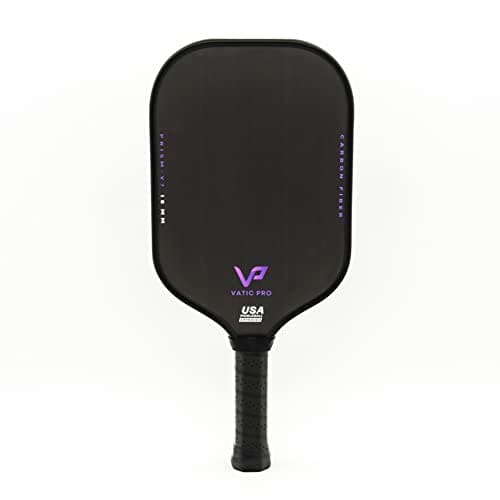
The standard-shape Prism: the same value-carbon face in a more control-friendly, maneuverable body.
The V7 is the Prism for players who prefer a standard shape — a lower, wider sweet spot and quicker hands than the elongated Flash, at the same wallet-friendly price. A lot of paddle for the money on the control end.
The V7 is the paddle most upgraders should be buying and almost nobody recommends, because value roundups rank on power and standard shapes never win that column. What it actually offers is the two things that separate a modern paddle from a starter frame — a raw Toray T700 face and genuine thermoformed construction — arranged in a body that is easy to defend with. If you are coming off a wide big-box paddle, this will feel like home immediately, where the elongated Flash will feel like a project.
- Core
- 16 mm
- Shape
- Standard
- Face
- Raw Toray T700 carbon fiber
- Weight
- ~8.0 oz
- Build
- Thermoformed
- Gen
- Prism
Manufacturer-listed as USA Pickleball approved. Approvals and delistings change — verify against the current USAP equipment list before tournament play (checked 2026-07).
Who it's for
The Vatic Pro Prism V7 16mm is for the player upgrading from a starter paddle who wants the modern spin surface without also signing up for a change in geometry. Big-box beginner paddles are wide and short. An elongated paddle is the opposite of that in every dimension, and the switch costs most players a few weeks of mishits before it starts paying off. The V7 changes the materials and leaves the shape familiar.
It is also the value answer for a specific complaint: losing hands battles at the kitchen line. A standard body puts less mass out at the tip, so the head comes around faster, and the sweet spot sits lower and wider — closer to where a rushed volley actually lands. If your points are decided in fast exchanges at 8 feet rather than from the baseline, that is worth more than reach. Our elongated vs standard shape guide covers the trade properly.
Who it is not for: anyone whose main problem is that they cannot end points, and anyone who plays singles. The V7 is the lowest-power paddle in our catalog by design. That is a deliberate tuning choice rather than a defect, but it does mean the elongated Prism Flash is the correct pick if pace is the weakness you are fixing.
How it plays
Spin
The face is raw Toray T700 carbon fiber — genuinely unpainted, genuinely textured, and the same material family used on paddles costing several times more. This is the whole argument for buying Vatic Pro. Spin is overwhelmingly a face property, and a raw T700 surface on a value paddle grips the ball in the same way a raw T700 surface on a flagship does. Our spin score for the V7 is strong, and our carbon fiber vs fiberglass guide explains why the surface dominates this conversation.
For measured RPM rather than adjectives, independent labs such as Pickleball Studio publish calibrated testing across the raw-carbon field. We cite their machine instead of inventing our own results. The standard raw-carbon caveat applies: the texture bites hardest when new and polishes smoother with play, faster on abrasive outdoor courts — our grit durability guide covers what wears and how to slow it down.
Control and forgiveness
This is where the V7 separates from its own sibling. The standard shape gives a lower, wider sweet spot and noticeably less twisting when you catch the ball toward the outside edge — the mass is closer to your hand, so off-axis contact has less leverage to rotate the paddle. Combined with the 16mm core, which flexes more at impact and absorbs incoming pace, you get a paddle that makes resets and dinks behave. Our control and forgiveness scores for the V7 sit comfortably above the Flash.
The honest limit is that this is still a value paddle. It has real forgiveness for its price, but it does not have the engineered sweet-spot width of something like the Six Zero Double Black Diamond, and it does not have the off-center stability a foam core buys. Those cost more, and they cost more for a reason.
Power
Modest, and the spec sheet tells you why before you swing it. A standard outline puts less mass at the tip, and a 16mm core absorbs energy a thinner one would return. The V7 is genuinely thermoformed, so it is far livelier than the composite starter paddle it is probably replacing — our thermoformed paddles guide covers that mechanism — but it is the lowest-power paddle we cover, and finishing points from the baseline takes real work.
There is a legitimate fix for that if you like everything else about the paddle: add weight at the tip. A few grams of tape at 10 and 2 o'clock raises swing weight and gives a standard paddle noticeably more drive, at the cost of some maneuverability. Our paddle weights and tuning tape page covers what to buy and the swing weight guide explains what you are actually changing.
Specs and build
Manufacturer-published specifications. The card above carries the live Amazon price and our editorial scores.
| Spec | Vatic Pro Prism V7 16mm |
|---|---|
| Shape | Standard |
| Core thickness | 16mm |
| Face | Raw Toray T700 carbon fiber |
| Construction | Thermoformed |
| Generation | Prism |
| Listed weight | ~8.0 oz |
The striking thing about that table is how little it gives away to paddles at three times the price. Same face material family. Same construction method. Same weight class. Same forgiving side of the 14mm vs 16mm split. What you pay more for elsewhere is manufacturing consistency, sweet-spot engineering, finish quality and brand support — real things, but not spec-sheet things.
Vatic Pro lists the Prism as USA Pickleball approved. Approvals and delistings change and apply to specific model revisions, so verify against the current USAP approved paddle list before sanctioned play — see our USAP-approved paddles guide.
V7 vs Flash: the only question that matters
These two paddles share a face, a core thickness, a construction method and a price bracket. The single variable is shape, and it decides everything else.
Take the Flash if you play singles, drive with a full swing, get stretched wide often, or your losses come from not being able to put the ball away. The elongated frame buys reach, leverage and a slightly higher spin ceiling because of where the mass sits.
Take the V7 if you play doubles, lose fast exchanges at the net, mishit toward the throat, or you are stepping up from a wide starter paddle and do not want to relearn where the face is. The standard frame buys a lower and wider sweet spot, faster head rotation and less twisting on off-center contact.
Neither is the better paddle. The mistake is buying the elongated one because it scores higher on power in a roundup and then blaming yourself for six months of shape mismatch.
How it compares to the wider field
Against the Ronbus R1 Pulsar, the V7 is more forgiving and better supported; the R1 is cheaper and elongated. We put the two brands head to head in Vatic vs Ronbus. Against the mid-tier, the Six Zero Double Black Diamond is the paddle that justifies spending more: same raw-carbon family, but a markedly larger engineered sweet spot.
Against a flagship standard shape like the JOOLA Scorpeus Pro IV, the V7 gives up power, refinement, consistency and warranty support — but not the grip on the ball, which is the part most buyers assume they are paying for. We compare the premium and value ends directly in CRBN vs Vatic Pro.
Pros
- Raw Toray T700 face — flagship-family spin material.
- Genuinely thermoformed, not a rebadged composite.
- Standard shape: lower, wider sweet spot and faster hands.
- 16mm core keeps resets and dinks predictable.
- Value pricing with a real Amazon listing.
Cons
- The lowest-power paddle in our catalog.
- No reach — a real loss if you get stretched wide.
- Forgiveness is good for the money, not close to a foam-core flagship.
- Direct-focused brand: limited retail presence, so demoing is unlikely.
- Raw carbon polishes smooth with play at any price.
What we'd skip it for
Skip the V7 if you need pace. Weighting the head helps, but it will not turn a standard 16mm value paddle into a put-away weapon; the paddles in our power paddles under $200 list will. Skip it if reach is what you are missing — that is the Flash's job, or an elongated frame from our spin paddle roundup.
And skip it if you already own a decent thermoformed raw-carbon paddle. This is not an upgrade from that; it is a lateral move to a standard-shape version of what you have.
The verdict
The Prism V7 is the value paddle we recommend to more people than actually buy it. It delivers the two changes that genuinely separate a modern paddle from a starter frame — raw carbon and thermoforming — in the shape most recreational doubles players should be using, at a price that leaves room in the budget for court shoes and a decent grip.
Buy it if you are stepping up from a big-box paddle and want more bite on rolls and drops without relearning where the sweet spot is. Buy the Flash instead if reach and pace are what you are missing. Either way, read the best spin paddles under $100 for the full value shortlist and our methodology for how we score without running a lab. Vatic has since moved to a full foam core in a separate line, including a widebody shape the Prism never offered — the Vatic Pro V-Sol Pro review covers what that changes and what it costs.
What is the difference between the Vatic Pro Prism V7 and the Prism Flash?
Shape. Both use the same raw Toray T700 carbon face, the same 16mm core and the same thermoformed construction at the same price bracket. The Flash is elongated, which buys reach, leverage and a slightly higher spin ceiling. The V7 is a standard shape, which buys a lower and wider sweet spot, faster head rotation in hands battles, and less twisting on off-center hits.
Is the Vatic Pro Prism V7 powerful enough?
It is the lowest-power paddle we cover, and that is by design — a standard outline plus a 16mm core absorbs energy that an elongated 14mm frame would return. It is still far livelier than the composite starter paddle it usually replaces. If you need more, a few grams of tuning tape at the tip raises swing weight and adds drive, at the cost of some maneuverability.
Is the Prism V7 good for spin?
Yes. Its raw Toray T700 carbon face is genuinely unpainted textured carbon — the same material family that anchors the top of measured spin charts, not a painted imitation. Independent testers such as Pickleball Studio publish comparative RPM figures. As with every raw-carbon face, grit is a consumable that polishes smoother with heavy play.
Is the V7 a good first upgrade from a beginner paddle?
It is one of the best, specifically because it does not change two things at once. You get the raw carbon face and thermoformed build that transform how the ball comes off the paddle, while keeping a standard shape that feels familiar coming from a wide big-box frame. That makes the improvement obvious instead of confusing.