JOOLA Scorpeus Pro IV Review
JOOLA's Gen-4 tech in a standard shape — the Perseus paddle for players whose hands are faster than their arms.
Disclosure: Drive Dink earns a commission from qualifying Amazon purchases at no extra cost to you. We accept no free products and no paid placements — commissions never change our picks. How this works.
Most buyers arrive at the Scorpeus by process of elimination: they wanted the Perseus Pro IV, picked one up, and found the handle-heavy elongated frame awkward in fast exchanges. The Scorpeus is JOOLA's answer to that — the same generation of technology in a standard body, endorsed by a player whose entire reputation is built on soft hands rather than put-aways. Everything below is read from published specifications and the wider reviewer consensus; we have not hit this paddle ourselves.
JOOLA Collin Johns Scorpeus Pro IV 16mm
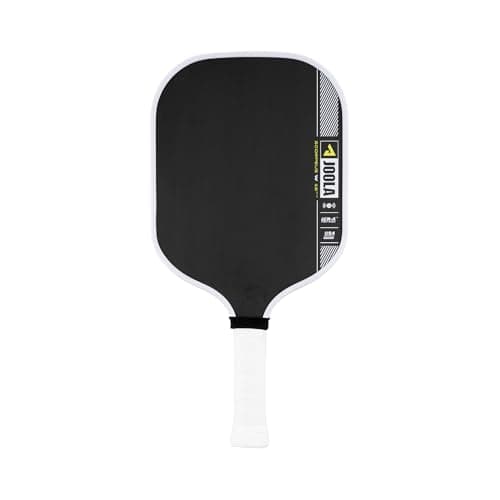
The standard-shape Perseus. A more balanced, control-leaning face for players who don't get on with elongated handles — and now the previous generation to JOOLA's Scorpeus Pro V.
Same Gen-4 tech as the Perseus in a standard shape, which brings the sweet spot lower and wider and makes hands battles easier to win. If you want JOOLA's power tech but prefer an all-court, control-first feel, this is the one. JOOLA launched a Scorpeus Pro V in its 2026 Pro V collection at roughly twice the Pro IV's current price; the change is a KineticFrame throat and a raw carbon face rather than a new spec sheet.
The Scorpeus is what happens when a flagship power platform gets rebuilt around hands rather than reach. Everything that makes the Perseus Pro IV a top-tier paddle is here — thermoformed construction, the Charged carbon surface, the 16mm core — but the mass sits closer to your hand, the sweet spot drops and widens, and the head turns faster in a firefight. You give up the leverage and the extra inches of coverage the elongated frame buys. For a doubles player who lives at the kitchen line, that is a trade worth making.
- Core
- 16 mm
- Shape
- Standard
- Face
- Charged carbon-fiber surface
- Weight
- ~8.0 oz
- Build
- Thermoformed
- Gen
- Pro IV (Gen 4)
Manufacturer-listed as USA Pickleball approved. Approvals and delistings change — verify against the current USAP equipment list before tournament play (checked 2026-07).
Who it's for
The JOOLA Collin Johns Scorpeus Pro IV 16mm is for the doubles player who wins points at the net and wants a flagship-tier paddle that does not fight them there. If your game is dinks, resets, speed-ups and hands battles — and the deciding factor in most of your rallies is who can get their paddle to the ball first — a standard shape is the correct choice, and this is the best-equipped standard shape JOOLA sells.
It is also the paddle we point people to when the Perseus almost worked. A lot of intermediate players buy an elongated flagship because that is what the reviews rank highest, then quietly struggle with mishits toward the throat and with getting the head around in time at 6 feet. Nothing is wrong with those players or with the Perseus; the shape was simply the wrong choice. Our elongated vs standard shape guide explains the trade in full, and it is the single most under-considered decision in paddle buying.
Who it is not for: singles players, former tennis players who want leverage on drives, and anyone whose main complaint is that they cannot end points. The Scorpeus hits hard for a standard paddle, but it does not hit as hard as the elongated frames in our most powerful paddles list, and no amount of Gen-4 marketing changes the physics of where the mass sits.
How it plays
Power
The Scorpeus is a thermoformed Gen-4 build, which is the mechanism behind the whole modern power era — a heat-molded unibody shell with a foam-filled perimeter returns more energy to the ball than a glued, cold-pressed frame does. Our thermoformed paddles guide covers how that works. Our power score for the Scorpeus is strong but deliberately a step below the Perseus: same engine, shorter lever.
In practice that means the Scorpeus is a paddle that finishes points with placement and hand speed rather than with brute pace from the baseline. Counters and speed-ups come off it fast. Full-swing drives from two feet behind the line are where you will notice the missing reach. If put-away power from deep is the weakness you are shopping to fix, the honest recommendation is the elongated route — start with the elongated power paddles list instead.
Spin
The face is JOOLA's Charged carbon-fiber surface, the same textured hitting surface used across the Pro IV line. It is a genuinely high-grit face and it is the reason the Pro IV generation ranks where it does on spin. Our spin score for the Scorpeus matches the rest of the family, because spin lives almost entirely in the surface and both paddles use the same one — our how paddle spin works guide explains why the face dominates that conversation.
For measured RPM figures rather than adjectives, independent labs such as Pickleball Studio publish calibrated spin testing across the field. We cite their machine instead of inventing our own numbers. One caveat applies to every textured face at every price: grit is a consumable. It bites hardest when new and polishes smoother with play, faster on abrasive outdoor courts — our grit durability guide covers what actually wears and how to slow it down.
Control and feel
This is where the Scorpeus earns its place in the range. The standard shape puts the sweet spot lower and wider — closer to where a rushed volley actually makes contact — and reduces the twisting you feel when the ball catches the outside of the face. Our control and forgiveness scores for the Scorpeus are both a notch above the elongated Perseus, and the gap is not a rounding error; it is the entire reason to buy this paddle.
The 16mm core reinforces the same character. A thicker core flexes more at impact, absorbs incoming pace, and makes resets and third-shot drops land where you aimed them rather than floating long. The trade is a little top-end pop against a 14mm build. Our 14mm vs 16mm guide covers the decision properly, and for a control-leaning paddle the 16mm is unambiguously the right side of it.
Specs and build
These are the manufacturer-published specifications. The card above carries the live Amazon price and our editorial scores — we never type a price into the copy.
| Spec | JOOLA Scorpeus Pro IV 16mm |
|---|---|
| Shape | Standard |
| Core thickness | 16mm |
| Face | Charged carbon-fiber surface |
| Construction | Thermoformed |
| Generation | Pro IV (Gen 4) |
| Listed weight | ~8.0 oz |
Read that alongside the Perseus spec sheet and the only line that differs is shape. That is the point, and it is also why the two paddles are so often mis-shopped against each other: they are not competitors on quality, they are alternatives on geometry. JOOLA lists the Scorpeus as USA Pickleball approved; approvals and delistings change and apply to specific revisions, so verify against the current USAP approved paddle list before sanctioned play, as our USAP-approved paddles guide explains.
Scorpeus vs Perseus: the actual decision
Nearly everyone considering the Scorpeus is really deciding between it and the Perseus, so here is the short version. Pick the Perseus if you play singles, came from tennis, hit with a full swing, or your losses come from not being able to put the ball away. Pick the Scorpeus if you play doubles, lose hands battles, mishit toward the throat, or your losses come from being late rather than being soft.
The mistake to avoid is buying the elongated paddle because it scores higher on power in a review and then spending six months blaming yourself for a shape mismatch. Reach is not free; it costs you maneuverability and a lower sweet spot, and those costs are paid at the net where most recreational doubles points are decided. We put the whole JOOLA line side by side in Perseus vs Scorpeus.
How it compares to the wider field
Outside JOOLA, the Scorpeus's closest competition is the Six Zero Double Black Diamond, which sits at a lower price with one of the most forgiving sweet spots in the category — the DBD is a 16.3-inch hybrid, though, so it only half-solves the shape problem. If it is the standard shape you are after and the budget is tighter, the Vatic Pro Prism V7 offers the same geometry with a raw T700 face at a fraction of the cost; what you give up is refinement, power ceiling and brand support rather than grip.
Going the other direction, a Gen-4 foam paddle like the CRBN TruFoam Barrage buys stability on off-center contact through a different mechanism — foam in the core rather than a different outline. If forgiveness is the specific weakness you are upgrading, read our foam-core paddles guide before deciding shape is the answer.
Pros
- Flagship Gen-4 build and Charged face in a standard outline.
- Lower, wider sweet spot than the elongated Pro IV frames.
- 16mm core makes resets and drops predictable.
- Faster head rotation in hands battles at the kitchen.
- Full JOOLA support, retail availability and resale market.
Cons
- Less reach and leverage than the Perseus — real coverage loss.
- Lower power ceiling on full-swing drives from the baseline.
- Flagship pricing; the value field is close on face material.
- Charged grit, like every textured surface, wears smoother with heavy outdoor play.
What we'd skip it for
Skip the Scorpeus if you want maximum pace. It is not a bomb-thrower and was never meant to be one; the paddles in our power paddle roundup will end points more easily. Skip it if reach is what you are missing — a standard outline gives away several inches of coverage on stretch volleys and that shows up immediately in singles.
And skip it if the budget is the binding constraint. The Scorpeus is priced as a flagship, and the honest read of the current market is that the gap in spin between a flagship and a good raw-carbon value paddle is small. The gap in forgiveness, consistency and finish is real, but only you can decide whether it is worth the difference. Our paddle price guide breaks down what each price tier actually buys.
There is now a Scorpeus Pro V
JOOLA's 2026 Pro V collection includes a Scorpeus Pro Vin 14mm and 16mm, listed at $299.95 on joola.com against the Pro IV's own marked-down listing there. JOOLA describes it as the widest and most forgiving shape in the Pro V line, built on the same patent-pending KineticFrame throat as the Perseus Pro V— a slimmer throat designed to flex on contact — with the line's raw carbon surface in place of the Pro IV's treated Charged face.
That makes the paddle on this page the previous generation, and we are leaving it where it is on purpose. Our Perseus Pro IV vs Pro V comparison works through the same generation change on the Perseus side of the line and finds it comes down to feel rather than a measurable spec gap — and the Pro IV is the cheaper of the two by a wide margin while JOOLA discounts it. We do not link a Scorpeus Pro V because we have not verified an Amazon listing that identifies the shape rather than selling a generic "Pro V" paddle; if you want it, buy it direct from JOOLA, where we earn nothing on the sale.
The verdict
The Scorpeus Pro IV is the most under-recommended paddle in JOOLA's range, and the reason is structural: reviews rank paddles on power, and standard shapes never win that column. Judge it on the thing it was built for — being the paddle in your hand when four players are trading balls at the kitchen line from eight feet apart — and it is excellent. Same technology as the Pro IV flagship everyone recommends, arranged for a completely different player — and now, like the Perseus Pro IV, a generation behind JOOLA's own current line at a fraction of its price.
Buy it if you play doubles and your losses come from being late rather than being soft. Buy the Perseus if you need reach and pace. If you are not sure which of those describes you, start with how to choose a pickleball paddle and read our methodology for how we score without running a lab.
What is the difference between the JOOLA Scorpeus and the Perseus?
Shape, and almost nothing else. Both Pro IV paddles use the same thermoformed Gen-4 construction, the same Charged carbon-fiber surface and the same 16mm core option. The Perseus is a hybrid/elongated frame that trades maneuverability for reach and leverage; the Scorpeus is a standard shape with a lower, wider sweet spot and a head that turns faster in fast exchanges. Doubles players who live at the net usually prefer the Scorpeus.
Is there a Scorpeus Pro V?
Yes. JOOLA's 2026 Pro V collection includes a Scorpeus Pro V in 14mm and 16mm at $299.95, on the same KineticFrame platform as the Perseus Pro V and with a raw carbon surface rather than the Pro IV's treated Charged face. That makes the Pro IV reviewed here the previous generation, which is also why JOOLA has it marked down. We keep recommending the Pro IV because our Perseus Pro IV vs Pro V comparison finds the generation change is a feel difference rather than a measurable spec gap, and the Pro IV costs far less. We do not link a Scorpeus Pro V because we have not verified an Amazon listing that names the shape — buy it direct from JOOLA if you want it.
Is the Scorpeus Pro IV good for spin?
Yes. It uses the same Charged carbon-fiber surface as the rest of the Pro IV line, and spin is overwhelmingly a face property rather than a shape property. Independent labs such as Pickleball Studio publish measured RPM figures if you want comparative numbers. As with any textured face, the grit grips hardest when new and polishes smoother with heavy outdoor play.
Is a standard-shape paddle worse than an elongated one?
No — it is a different tool. Elongated frames buy reach and leverage at the cost of maneuverability and a higher, narrower sweet spot. Standard frames do the reverse. If your points are decided at the kitchen line in doubles, a standard shape usually wins you more of them; if you play singles or drive with a full swing, elongated usually does.
Should I get the 16mm or a thinner core?
For the Scorpeus, 16mm suits the paddle's purpose. A thicker core absorbs more incoming pace and makes dinks, drops and resets more predictable, which is exactly what a control-leaning standard shape is for. A thinner core would add pop at the cost of the forgiveness that makes this paddle worth choosing over its elongated sibling.
- JOOLA — Scorpeus Pro IV product specifications
- JOOLA — Scorpeus Pro V product page (14mm/16mm, KineticFrame throat, $299.95; checked 2026-10-15)
- JOOLA — pickleball paddle collection (Pro V line listed alongside Pro IV; checked 2026-10-15)
- Pickleball Studio — measured spin & paddle performance data
- USA Pickleball — approved paddle list