JOOLA Perseus vs Scorpeus
Identical technology, opposite geometry. The Pro IV decision comes down to one question — do you lose points from being late, or from being short?
Disclosure: Drive Dink earns a commission from qualifying Amazon purchases at no extra cost to you. We accept no free products and no paid placements — commissions never change our picks. How this works.
This is the cleanest comparison on the site, because almost every variable is held constant. Both paddles are Pro IV. Both are thermoformed. Both run the Charged carbon-fiber surface. Both come in a 16mm core. The only meaningful difference is the outline — and that one difference changes which player each paddle suits completely.
Live Amazon prices for both are above. We compile manufacturer-published specifications, cite the independent labs that measure spin, and rank by fit rather than by a single overall score. Units we claim to have tested: 0.
| # | Paddle | Best for | Score | Price |
|---|---|---|---|---|
| 1 | 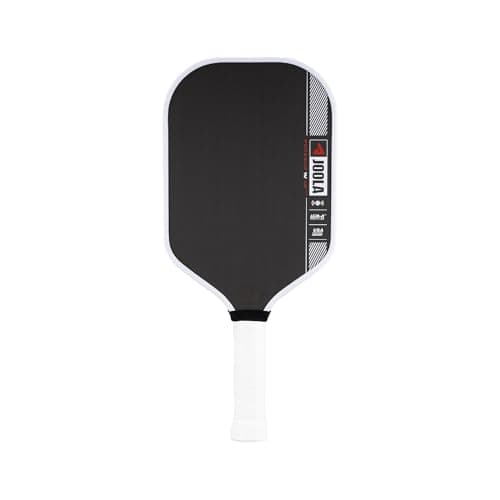 JOOLA Ben Johns Perseus Pro IV 16mm All-court power with a big sweet spot | Pick this for reach and pace | 8.3 | |
| 2 | 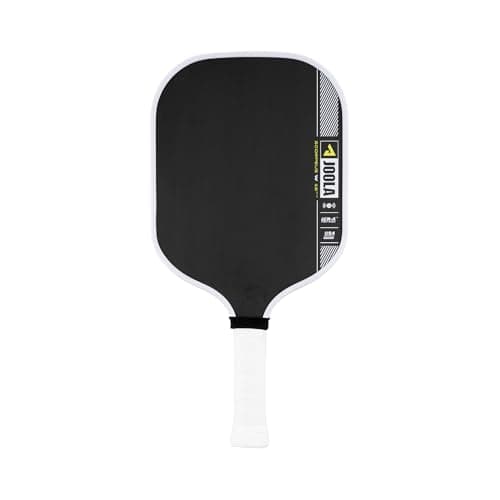 JOOLA Collin Johns Scorpeus Pro IV 16mm Standard-shape all-court control + spin | Pick this for hands and forgiveness | 8.0 |
Tap any row to jump to the full write-up. Prices are pulled live from Amazon.
JOOLA Ben Johns Perseus Pro IV 16mm
JOOLA's Gen-4 Perseus: thermoformed power and a grippy Charged surface, with the 16mm core adding forgiveness the 14mm gives up. Now the previous generation to the Pro V.
The Perseus Pro IV set the benchmark the rest of the power field chased, and JOOLA's March 2026 Pro V refines that formula rather than replacing it. The 16mm version trades a little raw pop for a larger, more forgiving sweet spot — the sensible pick if you want top-tier power without punishing off-center hits. Charged Surface Technology keeps spin high.
The Perseus is the paddle JOOLA is known for and the one most reviews rank highest, because reach and leverage translate directly into the power numbers roundups measure. It is the right choice for singles, for former tennis players, and for anyone whose losses come from not being able to finish.
- Core
- 16 mm
- Shape
- Hybrid
- Face
- Charged carbon-fiber surface (Tech-Flex)
- Weight
- ~8.0 oz
- Build
- Thermoformed
- Gen
- Pro IV (Gen 4)
Manufacturer-listed as USA Pickleball approved. Approvals and delistings change — verify against the current USAP equipment list before tournament play (checked 2026-07).
JOOLA Collin Johns Scorpeus Pro IV 16mm
The standard-shape Perseus. A more balanced, control-leaning face for players who don't get on with elongated handles — and now the previous generation to JOOLA's Scorpeus Pro V.
Same Gen-4 tech as the Perseus in a standard shape, which brings the sweet spot lower and wider and makes hands battles easier to win. If you want JOOLA's power tech but prefer an all-court, control-first feel, this is the one. JOOLA launched a Scorpeus Pro V in its 2026 Pro V collection at roughly twice the Pro IV's current price; the change is a KineticFrame throat and a raw carbon face rather than a new spec sheet.
The Scorpeus takes the identical Gen-4 platform and rearranges it around a standard outline: lower and wider sweet spot, faster head rotation, less twisting on off-center contact. It is the right choice for doubles players whose points are decided in fast exchanges at the kitchen line.
- Core
- 16 mm
- Shape
- Standard
- Face
- Charged carbon-fiber surface
- Weight
- ~8.0 oz
- Build
- Thermoformed
- Gen
- Pro IV (Gen 4)
Manufacturer-listed as USA Pickleball approved. Approvals and delistings change — verify against the current USAP equipment list before tournament play (checked 2026-07).
Side by side
| Spec | Perseus Pro IV 16mm | Scorpeus Pro IV 16mm |
|---|---|---|
| Shape | Hybrid (long) | Standard |
| Core thickness | 16mm | 16mm |
| Face | Charged carbon-fiber surface | Charged carbon-fiber surface |
| Construction | Thermoformed | Thermoformed |
| Generation | Pro IV (Gen 4) | Pro IV (Gen 4) |
| Listed weight | ~8.0 oz | ~8.0 oz |
| Our power score | Higher | Lower |
| Our forgiveness score | Lower | Higher |
One row differs on the manufacturer's sheet, and two differ on ours. That is the entire comparison, and it is worth sitting with — these paddles cost roughly the same, are built to the same standard, and will feel dramatically different in your hand.
What shape actually changes
A paddle's outline moves mass around within a fixed legal length-plus-width budget. Making a paddle longer and narrower pushes mass away from your hand; making it shorter and wider brings mass back toward it. Four things follow from that, and they are the whole story.
Reach. The Perseus covers more court. On a stretch volley or a ball at your feet on the run, inches decide whether you make contact at all. This is the most underrated advantage of an elongated frame and the reason singles players insist on them.
Leverage. Mass further from your hand means more speed at the tip for the same arm speed, which is why the Perseus drives harder. Physics, not marketing.
Sweet spot position and width.The Scorpeus's sweet spot sits lower and spreads wider. A rushed volley — the shot you hit when you are late and reaching — makes contact low and toward the edge far more often than it makes contact in the geometric center. A standard shape forgives that; an elongated one punishes it.
Rotational speed.The Scorpeus's head comes around faster because there is less mass at the end of the lever. In a hands battle at 8 feet, this is the difference between blocking a speed-up and wearing it. Our elongated vs standard shape guide goes deeper, and our swing weight and twist weight guide covers the numbers behind it.
What shape does not change
Spin, mostly. Both paddles carry the same Charged carbon-fiber face, and spin is overwhelmingly a surface property — the texture grabs the ball and the ball rotates. Our spin scores for the two paddles are the same for that reason. The Perseus has a marginal theoretical edge from tip speed on a full brush, but it is small relative to the face effect, and we would not choose between these paddles on spin. Our how paddle spin works guide explains the mechanism, and independent labs such as Pickleball Studio publish calibrated RPM figures if you want measured comparisons.
Build quality, warranty, resale value and USAP status are also identical — same manufacturer, same line, same generation. Both are listed by JOOLA as USA Pickleball approved; verify against the current USAP approved paddle list before tournament play, as our USAP-approved paddles guide explains.
The diagnostic: which mistakes are costing you?
Forget the paddles for a moment and think about the last five points you lost on a shot rather than a decision. Sort them into two buckets.
Bucket one — you were late or off-center. The ball was past you before the paddle arrived. You got a piece of it near the edge and it died. Someone sped it up at your hip and you could not get the face around. These are maneuverability losses, and the Scorpeus addresses them.
Bucket two — you were short or soft. You could not reach the ball. Your drive was clean but got counter-attacked because it was not hot enough. You had the put-away and it came back. These are reach and pace losses, and the Perseus addresses them.
Most club doubles players fill bucket one and buy for bucket two, because reviews are written around pace. That is the single most common mis-purchase in this category, and it is why the Scorpeus deserves more attention than it gets.
By player type
- Recreational doubles, 3.0-4.0: Scorpeus. Your points are decided at the kitchen and your mishits are frequent enough that sweet-spot width matters more than reach.
- Singles, any level: Perseus. Court coverage is the whole game and inches are points.
- Former tennis player: Perseus. You already swing long, you want leverage, and the elongated handle suits a two-handed backhand. See our power paddles for former tennis players page.
- Two-handed backhand: Perseus, for handle length. Our two-handed backhand paddles page covers what to look for.
- Fast hands, soft game, net-first: Scorpeus, without hesitation.
- Coming from a wide big-box paddle: Scorpeus. The Perseus will feel like a different sport for several weeks.
A note on the 14mm option
Both paddles are also sold in a 14mm core, which adds pop and speed and subtracts forgiveness. That decision is orthogonal to the shape decision, and stacking two aggressive choices — elongated plus 14mm — produces a genuinely demanding paddle that punishes anything but clean contact. Our 14mm vs 16mm guide covers it, and our general advice is to make one aggressive choice, not two.
If flagship money is the sticking point
The same shape decision exists at every price. In the value bracket, the Vatic Pro Prism Flash (elongated) and the Vatic Pro Prism V7 (standard) are the same pairing with a raw T700 face at a fraction of the cost. What you give up is power, refinement and support rather than grip — our paddle price guide breaks down what each tier buys.
If forgiveness specifically is what you are chasing and neither JOOLA shape is quite doing it, a Gen-4 foam paddle attacks the problem from a different direction — foam in the core rather than a different outline. Our foam-core paddles guide and the CRBN TruFoam Barrage review cover that route.
What a month with each one feels like
Spec tables do not capture the part that actually determines whether you keep a paddle, so here is the honest version of the adjustment period for each.
Moving to the Perseus from a shorter paddle takes a few weeks. The first sessions produce a specific pattern: drives that feel enormous, and volleys where you are consistently a fraction late. The reach shows up immediately on stretch balls and the leverage shows up on anything you get a full swing at, so the early impression is overwhelmingly positive. The cost surfaces later, in fast exchanges, and it surfaces as a feeling that the paddle is arriving after the ball rather than as an obvious mishit. Most players who abandon an elongated paddle do it in month two, not week one.
Moving to the Scorpeus from a longer paddle is the opposite curve. The first session feels like a downgrade — you notice the missing inches on every ball you have to stretch for, and drives feel less imposing. What you notice over the following weeks is a quieter improvement: fewer dead balls off the throat, more blocks that stay low, and hands battles you used to lose. It is a harder paddle to fall in love with and an easier one to keep.
That asymmetry is worth knowing before you buy, because it means the first-impression test most players run — hitting a few balls in a demo — systematically favors the elongated paddle. The properties the Scorpeus is built around only show up under time pressure.
Closing the gap with weight
Neither paddle has to stay exactly as it arrives, and a few grams of tape moves each one toward the other more than most players expect.
If you like the Scorpeusbut want more pace on drives, weight at 10 and 2 o'clock raises swing weight and puts more mass behind the ball. You will not turn a standard shape into a long one — the reach is geometry, not mass — but you can recover a meaningful part of the power difference.
If you like the Perseusbut find it slow at the net, weight at the butt cap adds stability while lowering swing weight, which makes the head feel quicker without making the paddle feel flimsy. And weight at 3 and 9 o'clock raises twist weight on either paddle, which is the most direct answer to mishits dying. Our swing weight and twist weight guide explains the properties, and our paddle weights page covers what to buy. All of it is reversible, which makes it a better first experiment than switching paddles.
The verdict
There is no winner here, and any review that declares one is measuring the wrong thing. These are two correct answers to two different questions, sold at the same price by the same company.
Buy the Perseus Pro IV if you need reach and pace: you play singles, you came from tennis, you swing full, or your losses come from not being able to finish points. Buy the Scorpeus Pro IV if you need hands and forgiveness: you play doubles at the net, you lose fast exchanges, you mishit toward the throat, or you are stepping up from a wide starter paddle.
If you genuinely cannot tell which bucket you are in, take the Scorpeus. A wider sweet spot helps every player some of the time; extra reach only helps the players who were already going to get there.
Is the Perseus or the Scorpeus better?
Neither — they are the same paddle in two shapes. The Perseus is a longer hybrid frame with more reach and leverage, which suits singles, former tennis players and anyone who needs more pace. The Scorpeus is a standard shape with a lower, wider sweet spot and faster head rotation, which suits doubles players who lose points in hands battles at the kitchen line.
Do the Perseus and Scorpeus have the same spin?
Essentially yes. Both use the same Charged carbon-fiber surface, and spin is overwhelmingly a face property rather than a shape property. The Perseus has a marginal theoretical edge from higher tip speed on a full brush, but it is small next to the face effect and not a reason to choose between them. Independent labs such as Pickleball Studio publish calibrated RPM figures.
Which is more forgiving on off-center hits?
The Scorpeus, clearly. A standard outline keeps mass closer to your hand, so off-axis contact has less leverage to twist the paddle, and the sweet spot sits lower and spreads wider — closer to where a rushed volley actually makes contact. That is the main practical reason to choose it over the Perseus.
Should I get the 14mm or 16mm version?
The core decision is separate from the shape decision. A 14mm core adds pop and speed and subtracts forgiveness; 16mm does the reverse. Our general advice is to make one aggressive choice rather than two — an elongated 14mm paddle is genuinely demanding and punishes anything but clean contact.