Best Paddle Weights & Tuning Tape
A few grams of tape changes a paddle more than most upgrades do — and unlike an upgrade, you can take it back off.
Disclosure: Drive Dink earns a commission from qualifying Amazon purchases at no extra cost to you. We accept no free products and no paid placements — commissions never change our picks. How this works.
Almost nothing in pickleball gives you as much change per dollar as weight tape. A few grams in the right place turns a paddle that feels light and vague into one that drives, or turns one that twists on mishits into one that holds its line. It costs the price of a coffee, it takes ten minutes, and — unlike buying a new paddle — you can peel it off if you were wrong.
Units we claim to have tested: 0. We rank on manufacturer-published product specifications and explain the physics rather than inventing measured results. Prices move; the live Amazon price above is the only one to trust.
| # | Paddle | Best for | Score | Price |
|---|---|---|---|---|
| 1 | 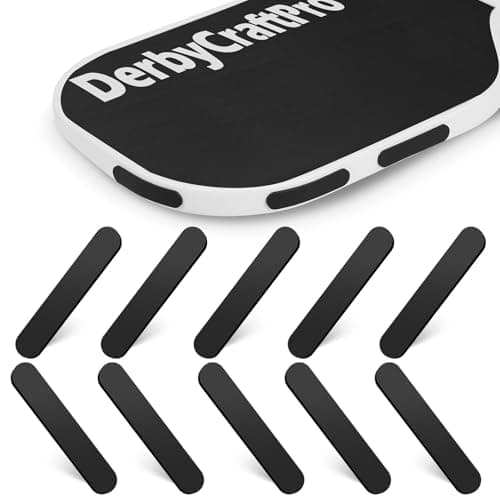 DerbyCraftPro Tungsten Paddle Weight Strips (10 x 3g) Best pre-cut strips for repeatable tuning | Best for repeatable tuning | — | |
| 2 | 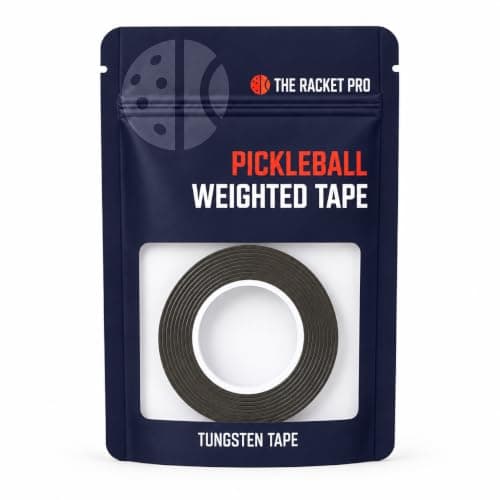 The Racket Pro Weighted Tungsten Tape (1g/inch) Best lead-free roll for heavier tuning | Best roll for heavier tuning | — | $24.99 · View on Amazon #adPrice as of October 24, 2026 |
| 3 | 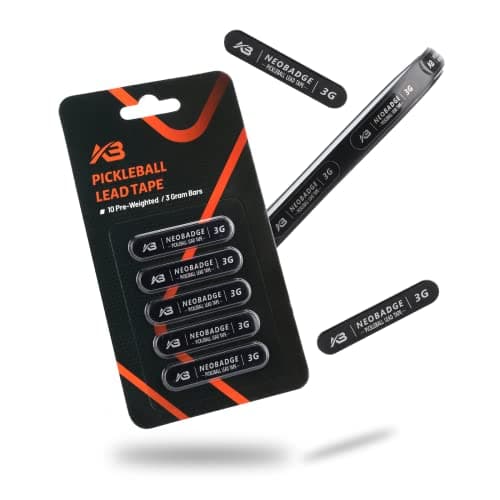 Neobadge Lead Tape for Pickleball Paddles Cheapest way to start tuning | Cheapest way to start | — | $7.21 · View on Amazon #adPrice as of October 24, 2026 |
| 4 | 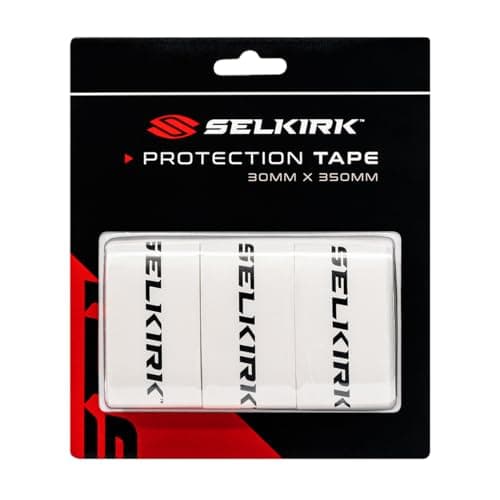 Selkirk Pickleball Edge Guard Tape Covering tuning tape and protecting the edge | The finishing layer | — | $9.84 · View on Amazon #adPrice as of October 24, 2026 |
Tap any row to jump to the full write-up. Prices are pulled live from Amazon.
DerbyCraftPro Tungsten Paddle Weight Strips (10 x 3g)
Pre-cut 3-gram tungsten strips — the option if you would rather count strips than measure and cut tape.
Ten identical three-gram strips take the guesswork out of paddle tuning: two at 3 and 9 o'clock is a known six grams, and you can undo it exactly. Less flexible than a roll if you want fractional adjustments, considerably easier if you are experimenting and want to be able to repeat what you did.
Ten identical three-gram tungsten strips take the guesswork out of the whole exercise: one at 3 and one at 9 o'clock is a known six grams, and you can undo it exactly. Being able to repeat and reverse a change is what turns tuning from fiddling into experimenting, and lead-free means nothing unpleasant against your hand. The con is granularity — if you want two grams rather than three, a roll you cut yourself is more flexible.
- Spec 1
- Ten pre-cut 3g strips
- Spec 2
- Tungsten — lead-free
- Spec 3
- Repeatable, reversible
The Racket Pro Weighted Tungsten Tape (1g/inch)
Tungsten instead of lead, sold by the roll at a full gram per inch — the option when you want real mass without handling lead.
Tungsten tape does the same job as lead tape without the material most people would rather not stick to something they hold. At a gram per inch this is the denser of the tungsten options we found, which matters if you are adding meaningful weight to the head rather than fine-tuning a few grams.
A full gram per inch makes this the densest tungsten option here, which matters when you are adding meaningful mass to the head rather than fine-tuning a couple of grams. Sold by the roll, so you cut exactly what you want, and lead-free. The con is price: it is by a distance the most expensive product on this page, and if you only ever add a few grams you will not use most of it.
- Spec 1
- Tungsten — lead-free
- Spec 2
- 1 gram per inch
- Spec 3
- Sold as a roll, cut to length
Neobadge Lead Tape for Pickleball Paddles
Traditional adhesive lead tape — the least expensive and most adjustable way to change how a paddle swings.
Lead tape is the original paddle-tuning tool: a thin adhesive strip you cut to length and stick where you want mass. It is cheap, endlessly adjustable, and the reason most pros' paddles do not weigh what the box said. Handle it sensibly — wash your hands after applying, and cover it with edge tape so it is not against skin in play.
Traditional adhesive lead tape is the original tuning tool and still the least expensive route into it — cut to length, stick where you want mass, adjust as often as you like. If you are experimenting for the first time and do not want to spend on tungsten, start here. The cons are material rather than performance: it is lead, so wash your hands after applying, and cover it with edge tape rather than leaving it exposed against skin.
- Spec 1
- Adhesive lead strip
- Spec 2
- Cut to length
- Spec 3
- Lowest cost per gram
Selkirk Pickleball Edge Guard Tape
The finishing layer: seals weight tape under a clean edge wrap and protects the paddle's edge from court scrapes.
Any weight you add to the perimeter should be covered, both so it stays put and so nothing abrasive or unpleasant is exposed. Selkirk's edge guard tape does that job and doubles as ordinary edge protection for a paddle that keeps meeting the court on low dinks.
Any weight you add to the perimeter should be covered — so it stays put through a season and so nothing abrasive or unpleasant is exposed. Selkirk's edge guard tape does that job and doubles as ordinary edge protection for a paddle that keeps meeting the court on low dinks. The con to be aware of is that it adds a gram or two itself, which you should count as part of your tuning rather than as free.
- Spec 1
- Covers and seals weight tape
- Spec 2
- Protects paddle edge
- Spec 3
- Adds a gram or two itself
Where you put it decides what changes
This is the whole subject in one section. The same three grams does completely different things depending on where it sits, because what you are changing is not the paddle's weight so much as how that weight is distributed relative to your hand.
10 and 2 o'clock (upper corners of the face) — more power. Weight far from your hand raises swing weight, the effective mass you accelerate through a stroke. More mass behind the ball at the same arm speed means more pace. The cost is that the head is slower to move, so fast exchanges at the net get harder and your arm works more over a long session.
3 and 9 o'clock (the widest points) — more stability. Weight at the sides raises twist weight, the property that resists the paddle rotating when you strike the ball off-center. This is the single most useful change for a player who mishits: it widens the effectively usable face without changing how the paddle swings much. If you only ever do one thing from this page, do this one.
The handle or butt cap — a faster head. Weight close to your hand adds total mass while lowering swing weight, which makes the paddle feel quicker and more stable without feeling heavier to swing. The move for players who bought an elongated paddle and found it sluggish at the kitchen line.
Our swing weight and twist weight guide explains both properties properly, and it is worth reading before you stick anything to anything.
Lead versus tungsten
Both do the same job — add dense mass in a thin adhesive strip — and the choice is mostly about the material rather than the performance.
Lead tape is the traditional option, cheapest per gram, and available everywhere because golf and tennis have used it for decades. It is also lead, which means sensible handling: wash your hands after applying it, do not leave it exposed where your palm sits, and cover perimeter applications with edge tape.
Tungsten tape is the lead-free alternative and is dense enough to be a genuine substitute rather than a compromise. It costs more per gram. For most players adding four to eight grams to a paddle, the total difference in spend is small enough that tungsten is the easier decision.
There is no performance argument between them at the weights players actually use. Choose on material preference and price.
How we picked
Four products covering the three ways people actually tune — pre-cut strips for repeatability, a dense roll for larger changes, cheap lead tape for first experiments — plus the edge tape that finishes the job properly. Every product is a real, currently-listed item with a first-party Amazon listing, and we prioritized identifiable brands over the large number of unbranded generics in this category.
We do not claim to have applied and measured these, and we will not publish invented gram-by-gram performance figures. What we can do honestly is explain the physics of weight placement, which is well understood, and tell you which product suits which way of working. Our approach is documented on the methodology page.
How much to add
Less than you think, and one change at a time. The most common mistake is adding eight grams at once, discovering the paddle feels different, and having no idea which part of the change caused which part of the difference.
A sensible process: start with two to four grams total split evenly across two symmetrical positions. Play a full session with it. If the change went the right direction, add the same again. If it did not, peel it off. Symmetry matters — weight on one side only makes the paddle handle differently on forehand and backhand, which is almost never what you want.
Be aware of the ceiling. Total paddle weight has a practical limit set by your arm rather than by the rules, and a paddle that is too heavy will tire you into worse technique long before it helps. If you are managing an aching elbow, add weight extremely conservatively — our paddles for tennis elbow page covers why weight cuts both ways there.
What to add for what problem
- "My drives lack pace." Two to four grams at 10 and 2. Expect the head to feel slower at the net.
- "Mishits die on me." Two to four grams at 3 and 9. The highest-value change on this page for most players.
- "My elongated paddle is too slow in hands battles." Weight at the butt cap. Adds mass without adding swing weight.
- "The paddle feels light and flimsy." A few grams anywhere adds solidity, but start at 3 and 9 for the stability benefit.
- "The face has gone smooth." Weight will not fix this. See when a paddle is actually done.
Is adding weight legal?
Adding weight tape to a paddle is a normal and widespread practice, but USA Pickleball's equipment rules do govern what modifications are permitted — they address alterations to the playing surface, and there are limits on what can be added and where. Edge tape and weight applied to the edge guard area is the conventional approach for a reason.
If you play sanctioned tournaments, read the current equipment standards yourself rather than relying on a summary — the authoritative source is USA Pickleball's equipment standards, and the approved paddle list covers the paddles themselves. Our USAP-approved paddles guide explains how the approval process works. For recreational play this is a non-issue.
Applying it without regretting it
Clean the surface first. Adhesive does not bond to court dust and hand oil. A wipe with isopropyl alcohol on the area, left to dry, makes the difference between tape that lasts a season and tape that peels in a week.
Mark before you stick. Weight tape is much easier to place accurately than to reposition. Work out your positions, mark them lightly, then apply.
Cover perimeter weight with edge tape. This keeps it adhered through temperature swings, stops it catching, and — for lead specifically — keeps it out of contact with skin.
Write down what you did. Two grams at 3 and 9, added on a date. It sounds excessive until the third time you cannot remember whether the paddle you like has four grams on it or six.
Do not put weight on the hitting surface. Beyond the rules question, tape on the face changes how the ball comes off it and interferes with the texture that produces spin — our how paddle spin works guide explains why the surface matters so much.
The bottom line
Buy the pre-cut tungsten strips if you want to experiment systematically, the tungsten roll if you already know you are adding real mass, or cheap lead tape if you just want to try the idea. Add edge tape either way, because uncovered perimeter weight is a job half done.
Then start at 3 and 9 with two to four grams. It is the change that helps the most players, it is nearly free, and it is completely reversible — which makes it a much better first move than replacing a paddle you have not finished learning. If you do decide the paddle itself is the problem, our how to choose a pickleball paddle guide and the power paddles under $200 list are the right next stops.
Where should I add weight to a pickleball paddle?
It depends what you want. Weight at 10 and 2 o'clock raises swing weight and adds power, at the cost of a slower head. Weight at 3 and 9 raises twist weight, which resists the paddle rotating on off-center contact and effectively widens the usable face — the most useful change for most players. Weight at the butt cap adds mass while making the head feel quicker.
How much lead tape should I add to a paddle?
Start with two to four grams total, split symmetrically across two positions, and play a full session before adding more. Adding a lot at once makes it impossible to tell which part of the change caused which part of the difference. Symmetry matters — weight on one side only makes the paddle behave differently on forehand and backhand.
Is tungsten tape better than lead tape for pickleball paddles?
There is no meaningful performance difference at the weights players actually use — both add dense mass in a thin adhesive strip. Tungsten is lead-free, which most people prefer for something they hold; lead is cheaper per gram. For a typical four-to-eight-gram application the total cost difference is small enough that tungsten is the easier call.
Is adding weight to a pickleball paddle legal?
It is a normal and widespread practice, but USA Pickleball's equipment standards do govern permitted modifications, including alterations to the playing surface. Weight applied around the edge guard area and covered with edge tape is the conventional approach. If you compete in sanctioned events, read the current USA Pickleball equipment standards directly rather than relying on a summary.