How to Add Lead Tape to a Paddle
Two dollars of tape changes more about how a paddle plays than most upgrades costing a hundred times that. It also makes it worse if you put it in the wrong place.
Disclosure: Drive Dink earns a commission from qualifying Amazon purchases at no extra cost to you. We accept no free products and no paid placements — commissions never change our picks. How this works.
The Racket Pro Weighted Tungsten Tape (1g/inch)
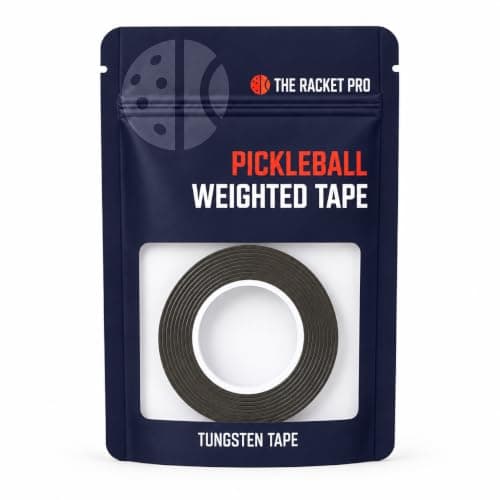
Tungsten instead of lead, sold by the roll at a full gram per inch — the option when you want real mass without handling lead.
Tungsten tape does the same job as lead tape without the material most people would rather not stick to something they hold. At a gram per inch this is the denser of the tungsten options we found, which matters if you are adding meaningful weight to the head rather than fine-tuning a few grams.
Tungsten is denser than lead, which means the same added mass takes up less strip — useful when you are working inside an edge guard channel or trying to keep tape off the hitting surface. It is also the choice if you would rather not handle lead at all. Buy this one if you only buy one.
- Spec 1
- Tungsten — lead-free
- Spec 2
- 1 gram per inch
- Spec 3
- Sold as a roll, cut to length
Neobadge Lead Tape for Pickleball Paddles
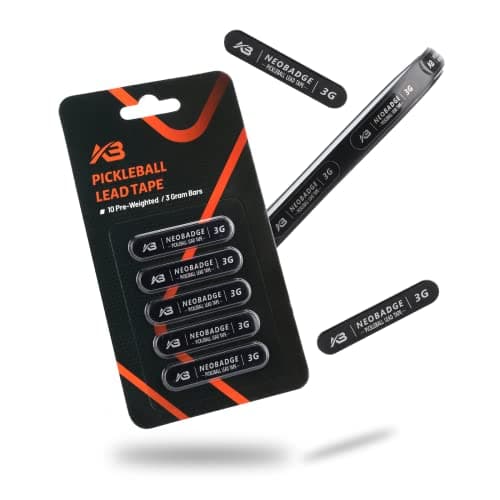
Traditional adhesive lead tape — the least expensive and most adjustable way to change how a paddle swings.
Lead tape is the original paddle-tuning tool: a thin adhesive strip you cut to length and stick where you want mass. It is cheap, endlessly adjustable, and the reason most pros' paddles do not weigh what the box said. Handle it sensibly — wash your hands after applying, and cover it with edge tape so it is not against skin in play.
Conventional lead tape on a roll, pre-scored into strips so you can add mass in repeatable increments rather than guessing. The pre-scoring matters more than it sounds — tuning is an iterative process and you want each change to be a known quantity you can undo.
- Spec 1
- Adhesive lead strip
- Spec 2
- Cut to length
- Spec 3
- Lowest cost per gram
Lead tape is the cheapest meaningful modification in pickleball and the one most likely to be applied badly. The tape itself does nothing interesting; where you put it does everything, because the same few grams produce completely different results at different points on the frame.
This guide covers what each position does, how much to use, and the rules and safety notes worth knowing before you start.
The three things tape can change
Twist weight — resistance to the paddle rotating when you hit off-center. Raising it widens the usable face. This is the highest-value change for most players and it is bought with tape at the sides.
Swing weight — how heavy the paddle feels to accelerate. Raising it adds plow-through on drives; lowering it makes the head quicker. Tape at the top raises it; tape at the handle lowers it.
Static weight — the total. Raising it adds stability against a hard-hit ball regardless of where the mass sits.
Our swing weight and twist weight guide explains the first two properly, and our paddle weight guide covers how they relate to the number on the listing.
Where to put it
Think of the paddle as a clock face, with 12 at the tip and 6 at the handle.
3 and 9 o'clock — the default. Tape at the widest points of the face raises twist weight the most for the least mass, and it barely affects swing weight. This is the fix for mishits dying, for a paddle that feels unstable, and for a thin-core or elongated frame that punishes off-center contact. If you do not know what you want, do this.
10 and 2 o'clock — the compromise. Higher up the sides. Still raises twist weight, and adds more swing weight than 3 and 9 do. Use this if you want a little more drive power along with the stability.
12 o'clock — power. Tape at the tip raises swing weight sharply, which adds plow-through on drives and serves. It also makes the paddle noticeably slower in hands battles. Use it deliberately, not by default. Our most powerful legal paddles page covers the paddles that already do this without tape.
The butt cap — counter-intuitive and useful. Weight at the handle raises static weight while lowering effective swing weight, because it pulls the balance point back towards your hand. The result is a paddle that is heavier overall and quicker to move. This is the fix for an elongated paddle that feels sluggish at the net, and it is the one people most often do not know about.
How much to use
Less than you think, and in increments you can measure. A few grams is a noticeable change; ten grams is a substantial one. The failure mode here is adding too much at once and concluding that tape does not work.
A workable process:
- Add symmetrically. Whatever goes on one side goes on the other, in the same length and position. An asymmetric paddle twists on its own.
- Change one thing at a time. Sides or tip or handle, not two at once, or you will not know what did what.
- Play a full session before deciding. The first ten minutes of any change feel wrong. Judge it at the end.
- Write down what you did. Position and length. Tuning is iterative and you will want to go back a step.
The method
Clean the surface first. Isopropyl alcohol on a cloth, let it dry. Tape does not stick to a dusty frame and a strip that peels mid-rally is a hazard. Our paddle cleaning guide covers what else to use and what to avoid.
Work on the edge guard where possible. Tape on the guard rather than on the face keeps the hitting surface clear and is easier to remove cleanly. Many guards have a channel that takes a strip neatly. If your paddle is edgeless, see our edge guard guide — you will be taping onto the rim itself and should be more careful about removal.
Press it down properly. Firm pressure along the whole strip, and a thumbnail along the edges. Air under the tape is where peeling starts.
Cover it if it is on the face. A layer of clear tape over the top protects the strip from ball contact and stops the edges lifting.
Removing it later. Warm the strip gently with a hair dryer and peel slowly. Adhesive residue comes off with isopropyl alcohol. Do not use a solvent stronger than that on a paddle face.
The legality rule people get wrong
Adding weight to a paddle is permitted under the current rules — this is a normal, accepted modification, not a gray area. What matters is that the modification does not change the paddle's surface properties in a way that alters how it grips the ball, and that the paddle continues to comply with the dimension and surface requirements.
In practice: tape on the edge guard is uncontroversial. Tape on the hitting surface is where you need to be careful, because it changes the surface — cover it, keep it well away from the middle, and if you play sanctioned events, check the current rulebook rather than relying on this paragraph. Our USAP approved paddles guide covers how equipment rules are enforced and how often they change.
A note on lead
Lead tape is lead. Handling it occasionally is a very different exposure from working with it daily, but sensible precautions cost nothing: wash your hands after applying it, do not cut it with something you also use for food, cover any strip that sits on the hitting surface, and keep the roll away from children.
Tungsten tape is the straightforward alternative — denser, so it takes less strip for the same mass, and it avoids the question entirely. Our paddle weights picks cover both.
What tape cannot fix
A dead core or a smooth face. Tuning a worn-out paddle is money spent on the wrong problem — our guide to when a paddle is done gives you a five-minute check.
The wrong shape. Tape moves mass around; it does not make an elongated paddle short. If your issue is reach or hand speed at a structural level, that is a different paddle. Our shape guide covers it.
A grip that does not fit. Fix that first — it is cheaper and it changes more. Our grip size guide explains how to check.
The bottom line
Start with two short, symmetrical strips at 3 and 9 o'clock on the edge guard. That single change widens the sweet spot on almost any paddle and it is entirely reversible. Play a session, decide, and only then consider the tip or the butt cap.
If you are tuning because your paddle is not doing what you want at a more fundamental level, the roundups are the better answer: spin, power and control.
Where should I put lead tape on a pickleball paddle?
Start at 3 and 9 o'clock — the widest points of the face. That position raises twist weight the most for the least mass, which widens the usable face, and it barely affects swing weight. Tape at 12 o'clock adds drive power but slows the head; tape at the butt cap lowers effective swing weight and makes the paddle feel quicker.
How much lead tape should I add?
Less than you expect. A few grams is a noticeable change and ten grams is substantial. Add symmetrically, change one position at a time, play a full session before judging, and write down what you did so you can go back a step. Pre-scored tape makes the increments repeatable.
Is adding lead tape to a paddle legal?
Adding weight is a permitted modification under the current rules. The care point is surface: tape on the edge guard is uncontroversial, while tape on the hitting surface changes the surface and should be covered and kept away from the middle. If you play sanctioned events, check the current rulebook rather than any article.
Is tungsten tape better than lead tape?
It is denser, so the same added mass takes up less strip — useful when you are working inside an edge guard channel or trying to keep tape off the face. It also avoids handling lead. Conventional lead tape is cheaper and more widely available; either works.