T700 Carbon Fiber Paddles, Explained
T700 is on half the paddle listings you will read this year. It is a real material specification from a real manufacturer — and it tells you less about how a paddle spins than the brands quoting it would like.
Disclosure: Drive Dink earns a commission from qualifying Amazon purchases at no extra cost to you. We accept no free products and no paid placements — commissions never change our picks. How this works.
Search for a carbon fiber paddle and you will meet the same four characters over and over: T700. Six Zero, Vatic Pro, Ronbus and Volair all specify it on paddles we cover, and a long tail of listings at every price quote it as if it were a performance claim. It is not. It is a material grade from a specific manufacturer, it is a genuinely useful thing to know, and it answers a narrower question than most buyers think they are asking. This guide explains what the grade is, what it tells you, what it does not, and then names the T700 paddles we cover. Our carbon fiber vs fiberglass guide covers why the face material matters at all; best carbon fiber paddles ranks the whole carbon field, including the treated and foam-core faces this page leaves out.
What T700 tells you, and what it does not
What it is.T700 — formally T700S — is a grade of carbon fiber made by Toray, the Japanese materials company. Toray classifies it as a standard-modulus fiber and describes it as "an industry standard fiber for high strength and standard modulus, with outstanding processing characteristics for filament winding, weaving and prepregging." Toray's published figures are a tensile strength of 4,900 MPa and a tensile modulus of 230 GPa. It is used in pressure vessels, gas storage tanks and a long list of industrial and recreational products; pickleball is a small customer.
What it tells you.That the face is real carbon fiber from a named source. A brand quoting T700 is naming the material it bought rather than writing "carbon" and hoping you do not ask. That is a genuine signal on a market where "carbon fiber" on a listing can mean a fiberglass face with a carbon-look print, and it is why the value brands lean on it — it is the cheapest honest way to prove the face is what they say.
What it does not tell you.How the paddle spins. Spin comes from the surface texture — the peaks and valleys of the weave, whether the sheet is left raw or treated, how coarse the weave is, and what finish is applied — and none of that is in the grade. Two paddles with identical T700 sheets can spin very differently depending on how each brand finishes the face, and a treated surface like JOOLA's Charged carbon scores as high on our spin axis as the best raw T700 face. Our how paddle spin works guide covers the mechanism. The grade also says nothing about the core, the shell or the foam under it, which decide most of how the paddle plays.
How it compares to other grades.Toray's T300 is an older standard-modulus fiber with lower tensile strength; T700S is stronger at similar stiffness. T800S is an intermediate-modulus fiber with higher strength and greater modulus still. Higher grades are stiffer and stronger per unit — which matters enormously in an aircraft wing and very little in a paddle face, where the sheet is thin, bonded to a polymer core, and doing a texture job rather than a structural one. A T800 face is not a spin upgrade. A brand quoting it is quoting a more expensive material, not a grippier one.
So: treat T700 as a floor, not a rating. It rules out a fake carbon face. It does not rank the real ones. The four paddles below all pass the floor, and they are ranked on everything the grade leaves out — finish, construction, core and price. Live Amazon prices are on each card.
Six Zero Double Black Diamond 16mm
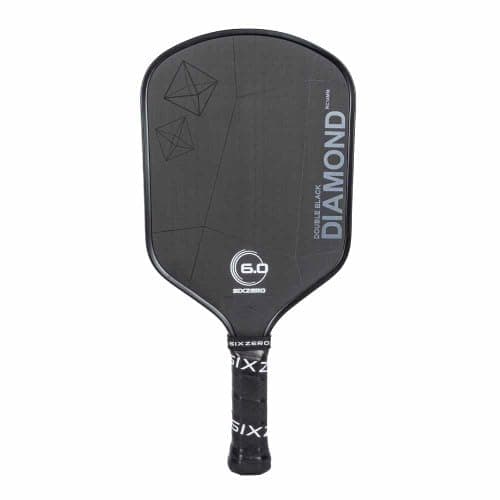
The internet's default 'do-it-all' recommendation: thermoformed power, a raw-carbon spin face, and a famously forgiving sweet spot at a fair price.
The DBD earned its reputation honestly. The 16mm Control build blends thermoformed pop with one of the most forgiving sweet spots in its class, and the raw T700 face grabs the ball for spin. It's the paddle we point undecided upgraders to first.
The paddle that made raw Toray T700 the face to have. The Double Black Diamond 16mm exposes the natural weave over a thermoformed unibody shell, and the finish and weave coarseness — the parts the grade does not specify — are the reason it scores an 8 on spin alongside a 9 on control and forgiveness, the best spread we publish. If the section above has convinced you that T700 is a floor rather than a rating, this is the paddle that shows what a well-finished T700 face can do. The con is the same one every raw face carries: the texture that grips is a consumable, and heavy outdoor topspin polishes it smooth.
- Core
- 16 mm
- Shape
- Elongated
- Face
- Raw Toray T700 carbon fiber
- Weight
- ~8.0 oz
- Build
- Thermoformed
- Gen
- Control (Gen 2 thermoformed)
Manufacturer-listed as USA Pickleball approved. Approvals and delistings change — verify against the current USAP equipment list before tournament play (checked 2026-07).
Vatic Pro Prism Flash 16mm
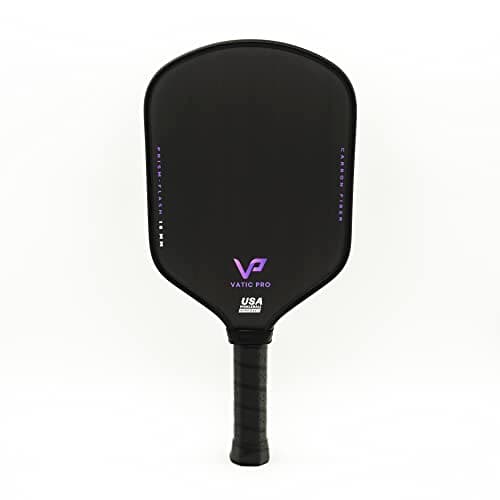
The value-shopper's spin paddle: raw T700 carbon and a thermoformed build that punches well above its price.
Vatic built a reputation on giving you 90% of a $250 paddle for around a hundred bucks. The Prism Flash's raw T700 face grips for spin and the elongated frame adds reach — the paddle we recommend when 'best spin under $100' is the search.
The proof that the grade itself is not expensive. The Prism Flash is a genuine thermoformed unibody with a raw Toray T700 face and a 16mm core at value money, and our spin score — a 9 — matches the flagships. The same material on a cheaper paddle is the whole point of this page: the T700 sheet is not what separates a value paddle from a flagship. The cons are value-tier refinement — feel is less consistent across the face than the Six Zero build — and the build variance that has historically shown up at this money, so check the edges on arrival.
- Core
- 16 mm
- Shape
- Elongated
- Face
- Raw Toray T700 carbon fiber
- Weight
- ~8.0 oz
- Build
- Thermoformed
- Gen
- Prism
Manufacturer-listed as USA Pickleball approved. Approvals and delistings change — verify against the current USAP equipment list before tournament play (checked 2026-07).
Ronbus R1 Pulsar
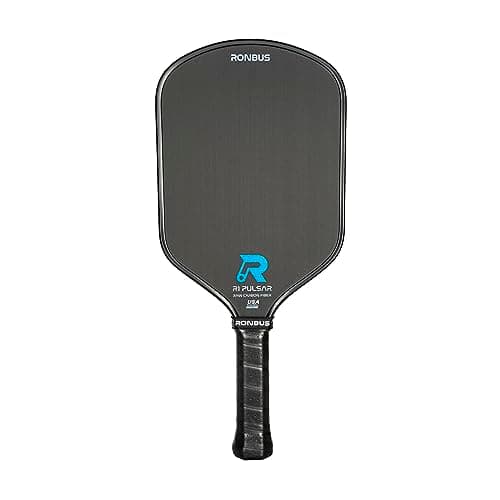
The budget thermoformed pick: raw T700 carbon and a real thermoformed build at a price that undercuts almost everyone.
Ronbus is the value-brand's value brand. The R1 Pulsar gets you a raw-carbon, thermoformed paddle for the least money of anything we cover — a smart first 'real' upgrade from a big-box starter paddle before you commit to a $200 frame.
The lowest-cost way to put a real Toray T700 face in your hand. The R1 Pulsar is a genuine thermoformed 16mm elongated frame with a raw T700 sheet on it for the least money of anything we cover, and our scores — an 8 on spin and power — say the grip is real. It is the sensible first carbon paddle for a player upgrading from a fiberglass or composite big-box face, and the paddle we point to when someone asks whether T700 on a cheap listing means anything. It does. The cons are 7s on control and forgiveness — it is the least refined paddle on this page — and thinner documentation than the brands above it.
- Core
- 16 mm
- Shape
- Elongated
- Face
- Raw Toray T700 carbon fiber
- Weight
- ~8.0 oz
- Build
- Thermoformed
- Gen
- Pulsar
Manufacturer-listed as USA Pickleball approved. Approvals and delistings change — verify against the current USAP equipment list before tournament play (checked 2026-07).
Volair Mach 1 Forza 16mm
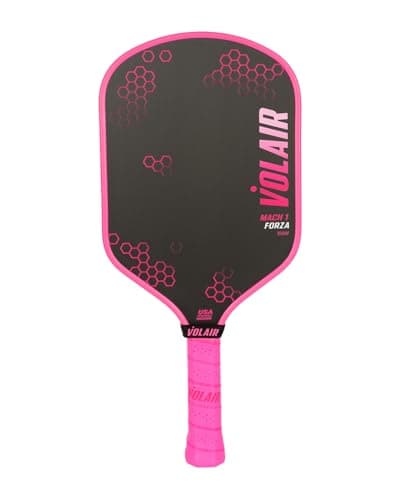
A thermoformed unibody frame with foam-injected edge walls and a long 5.5in handle — flagship construction at roughly half flagship money.
The Mach 1 Forza is the cheapest way we know to buy the full modern power recipe: hot-molded unibody build, raw T700 carbon face, and foam packed into the perimeter walls to widen the sweet spot. At 16.5in long with a 5.5in handle it is a genuine elongated frame, and the listed 8.2oz average weight tells you it is not a light paddle to swing.
A raw Toray T700 face on the fullest modern construction the value tier offers: a hot-molded unibody frame with foam injected into the perimeter walls, in a 16.5in elongated outline with a 5.5in handle. Our spin score is a 9 and our power score is a 9, which is flagship territory at roughly half flagship money. The cons are the listed 8.2oz average — this is the heaviest paddle we cover to swing, and you will feel the mass in a fast hands exchange — and a smaller brand with thinner documentation than Six Zero or Vatic.
- Core
- 16 mm
- Shape
- Elongated
- Face
- Toray T700 raw carbon fiber
- Weight
- ~8.2 oz
- Build
- Thermoformed
- Gen
- Foam-injected edge walls (Gen 3)
Manufacturer-listed as USA Pickleball approved. Approvals and delistings change — verify against the current USAP equipment list before tournament play (checked 2026-07).
Why "raw" matters more than "T700"
The word next to T700 on a listing is usually "raw," and it is the more important of the two. Raw means the carbon is left unpainted, so the natural over-under texture of the weave is the hitting surface. Painted or coated carbon faces let the ball skid; exposed weave bites. Every paddle on this page is a raw T700 face for that reason. The trade is that texture is a consumable: the same abrasion that grabs the ball polishes the peaks of the weave down over a season, and a raw face that has gone glassy spins measurably less than it did new. Our grit durability guide treats that as the real cost of a raw carbon paddle, and our paddle cleaning guide covers the half of "lost grit" that is actually residue in the weave.
T700 vs unidirectional carbon vs everything else
Not every carbon face is a woven T700 sheet. Paddletek's Bantam TKO-CX uses PT-700 unidirectional raw carbon — fibers running one way rather than woven — over glass-epoxy plies, which produces a different surface texture and a different feel from a woven face on the same nominal grade. CRBN's TruFoam Barrage and X-Series Powerspecify raw carbon without naming a Toray grade. JOOLA's Perseus Pro IV uses a treated Charged surface, and the Pro Vmoved to a raw carbon texture. Six Zero's Ruby Pro is built around an abrasion-resistant face that is not a plain T700 sheet at all. All of them are real carbon paddles; only four of the paddles we cover specifically quote raw Toray T700, and those four are the picks above. The absence of the label is not a warning. It is just a different way of describing the material.
Does T700 on a budget paddle mean anything?
Yes, more than most people expect. The T700 sheet is a small part of a paddle's cost, and a value brand quoting it is usually telling the truth — the Ronbus R1 Pulsar is the proof, and it is why it is on this page. What a cheap T700 paddle gives up is not the face. It is the refinement of the construction under it: consistency of feel across the face, build quality at the edges and throat, documentation and warranty support. Our paddle price guide works through what each tier actually buys, and our Vatic vs Ronbus comparison puts the two value T700 paddles on this page side by side. The caveat is the one we attach to every value-tier thermoformed paddle: build variance has historically shown up here, so inspect the paddle on arrival with the two-minute check in our delamination guide.
Who should buy which
You want the reference raw T700 paddle: the Six Zero Double Black Diamond 16mm — our full review and the 14mm vs 16mm comparison cover the two cores.
You want the same grade of face for under $100: the Vatic Pro Prism Flash. Our Prism Flash review and the Six Zero vs Vatic Pro comparison explain what the extra money for the DBD buys.
You want to find out what raw carbon does for the least money: the Ronbus R1 Pulsar — see our R1 Pulsar review.
You want foam-edge construction under the T700 at value money and do not mind the weight: the Volair Mach 1 Forza; our Forza review is honest about the 8.2oz.
The bottom line
T700 is Toray's standard-modulus, high-strength carbon fiber, and on a paddle listing it means one useful thing: the face is real carbon from a named source. It does not rank spin, it does not predict durability, and a higher Toray grade would not make the paddle better. Use it to rule out fakes, then choose on finish, core, construction and price — which is what the four picks above are ranked on.
What is T700 carbon fiber on a pickleball paddle?
T700 (formally T700S) is a grade of carbon fiber made by Toray, classified by Toray as a standard-modulus, high-strength fiber with a published tensile strength of 4,900 MPa and a tensile modulus of 230 GPa. On a paddle, a brand quoting it is naming the material it actually used rather than just saying carbon. It signals a genuine carbon face; it is not a spin rating.
Is T700 carbon fiber good for pickleball paddles?
Yes — it is the industry-standard grade for raw carbon paddle faces, and the paddles that built the raw-carbon reputation (Six Zero's Double Black Diamond, Vatic Pro's Prism line) use it. But the grade is a floor rather than a differentiator: how the sheet is finished, how coarse the weave is left, and what core and shell sit under it decide how the paddle actually plays.
Is T800 carbon fiber better than T700 for a paddle?
Not in any way you would feel. T800S is an intermediate-modulus Toray fiber that is stiffer and stronger per unit than T700S, which matters in structural applications and very little in a thin paddle face bonded to a polymer core. A T800 face is a more expensive material, not a grippier one. Spin comes from the surface texture, not the grade.
Which pickleball paddles use T700 carbon fiber?
Among the paddles we cover, Six Zero's Double Black Diamond (14mm and 16mm), Vatic Pro's Prism Flash and Prism V7, the Ronbus R1 Pulsar and the Volair Mach 1 Forza all specify a raw Toray T700 face. Many other real carbon paddles — CRBN, JOOLA, Paddletek — describe their faces differently without being any less carbon.
Does a cheap T700 paddle spin as well as an expensive one?
Often close to it on day one — the T700 sheet is a small part of a paddle's cost, and the Vatic Pro Prism Flash matches the flagships on our spin score. What the extra money buys is consistency of feel across the face, build quality at the edges and throat, and documentation. Inspect a value-tier thermoformed paddle on arrival, because build variance has historically shown up there.