Six Zero DBD: 14mm vs 16mm
The Double Black Diamond is one paddle sold as two, and the two behave less alike than the Perseus pair do. On a frame this forgiving, core thickness carries more weight.
Disclosure: Drive Dink earns a commission from qualifying Amazon purchases at no extra cost to you. We accept no free products and no paid placements — commissions never change our picks. How this works.
Six Zero sells the Double Black Diamond in two core thicknesses at the same price, with the same raw Toray T700 face, the same thermoformed unibody build and the same 16.3 x 7.7in hybrid outline. The listing does not tell you which to buy, and the difference between them is larger than the two millimeters suggest.
Live Amazon prices for both are above. We compile manufacturer-published specifications and rank by fit rather than by a single overall score. Units we claim to have tested: 0.
| # | Paddle | Best for | Score | Price |
|---|---|---|---|---|
| 1 | 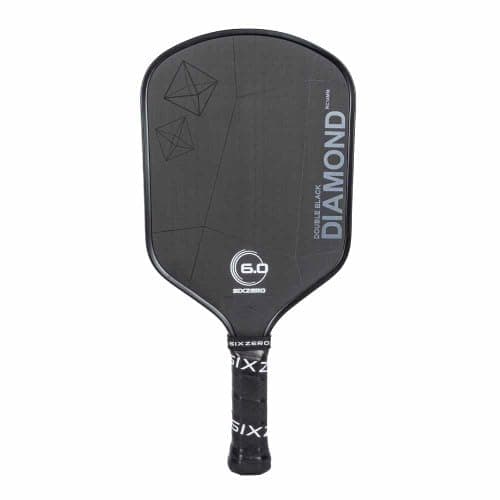 Six Zero Double Black Diamond 16mm All-court value with a huge sweet spot | Best for almost everyone | 8.5 | $180.00 · View on Amazon #adPrice as of October 24, 2026 |
| 2 | 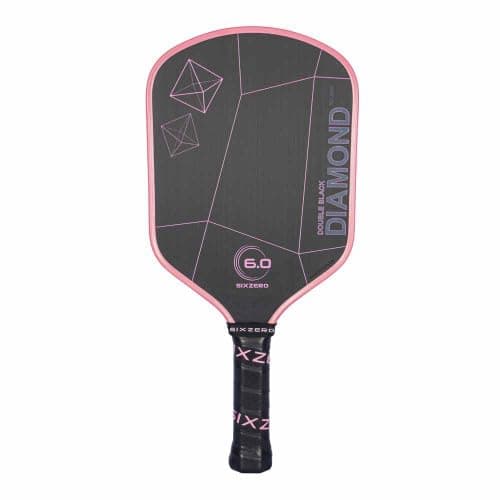 Six Zero Double Black Diamond 14mm More pop and speed than the 16mm | For pace over margin | 7.8 | $180.00 · View on Amazon #adPrice as of October 24, 2026 |
Tap any row to jump to the full write-up. Prices are pulled live from Amazon.
Six Zero Double Black Diamond 16mm
The internet's default 'do-it-all' recommendation: thermoformed power, a raw-carbon spin face, and a famously forgiving sweet spot at a fair price.
The DBD earned its reputation honestly. The 16mm Control build blends thermoformed pop with one of the most forgiving sweet spots in its class, and the raw T700 face grabs the ball for spin. It's the paddle we point undecided upgraders to first.
The 16mm DBD is the paddle that built Six Zero's reputation, and the reason is on our scorecard: control and forgiveness both sit at the top of our range, on a frame that still returns thermoformed pace. On a 16.3-inch hybrid outline, that forgiveness is not a nicety — it is what keeps a longer-than-standard paddle usable when you catch the ball high on the face.
- Core
- 16 mm
- Shape
- Hybrid
- Face
- Raw Toray T700 carbon fiber
- Weight
- ~8.0 oz
- Build
- Thermoformed
- Gen
- Control (Gen 2 thermoformed)
Manufacturer-listed as USA Pickleball approved. Approvals and delistings change — verify against the current USAP equipment list before tournament play (checked 2026-07).
Six Zero Double Black Diamond 14mm
The 14mm DBD trades some of the 16mm's plush forgiveness for extra pace and a quicker, poppier response.
If you loved the DBD's spin and value but wanted more pop, the 14mm delivers it — faster through the air and livelier off the face, with a slightly smaller margin on off-center hits. A strong pick for aggressive all-court players.
The 14mm trades the widest sweet spot in the Six Zero line for a faster, poppier response. It is the version to buy if you already know you like thin cores, or if you are coming from a 14mm paddle and do not want to relearn your resets. The cost is real: our control and forgiveness scores both fall by two points against the 16mm.
- Core
- 14 mm
- Shape
- Hybrid
- Face
- Raw Toray T700 carbon fiber
- Weight
- ~8.0 oz
- Build
- Thermoformed
- Gen
- Control (Gen 2 thermoformed)
Manufacturer-listed as USA Pickleball approved. Approvals and delistings change — verify against the current USAP equipment list before tournament play (checked 2026-07).
Side by side
| Spec | DBD 16mm | DBD 14mm |
|---|---|---|
| Core thickness | 16 mm | 14 mm |
| Shape | Hybrid (16.3 x 7.7in) | Hybrid (16.3 x 7.7in) |
| Face | Raw Toray T700 carbon fiber | Raw Toray T700 carbon fiber |
| Build | Thermoformed unibody | Thermoformed unibody |
| Listed weight | ~8.0 oz | ~8.0 oz |
| Our spin score | 8 / 10 | 8 / 10 |
| Our power score | 8 / 10 | 9 / 10 |
| Our control score | 9 / 10 | 7 / 10 |
| Our forgiveness score | 9 / 10 | 7 / 10 |
Why this is a bigger decision than it is on the Perseus pair
The same two-millimeter change does not have the same consequence on every frame, and our own scorecard says so. Going from the 16mm Perseus Pro IV to the 14mm costs a point of control and a point of forgiveness. Going from the 16mm DBD to the 14mm costs two points on each. All four of those paddles are hybrids within two tenths of an inch of each other, so the difference is not shape — it is what each paddle is for.
The 16mm DBD carries our joint-highest control and forgiveness scores in the catalog. That margin is the whole reason the paddle gets recommended the way it does, and a thinner core is precisely the change that spends it. The Perseus is a power paddle in both thicknesses, so a thin core takes a smaller slice off a property that was never its headline. Our elongated vs standard shape guide sets out what the outline itself buys, and our Perseus 14mm vs 16mm comparison shows the same question answered on the other hybrid.
What the 16mm does better
Resets and drops. A thicker core compresses more and holds the ball fractionally longer, which is the entire mechanism behind a paddle that is easy to take pace off with. If you are trying to land a third-shot drop or absorb a hard drive into the kitchen, dwell time is your friend.
Off-center contact. Our forgiveness score for the 16mm DBD is the joint-highest in our catalog. On a long paddle that is worth more than it sounds — the shots you catch high towards the tip are the ones that die or fly, and a wider effective face turns some of those into playable balls.
Arm comfort. More polymer between the faces means more of the impact absorbed before it reaches your hand. If you play four times a week, or your elbow has opinions, that is a real consideration — our paddles for tennis elbow page covers the wider picture.
What the 14mm does better
Speed off the face. Less compression means the ball leaves sooner. In counter-attacks and hands battles, where you are not shaping the shot so much as redirecting pace, that immediacy is a genuine advantage.
Drives. Our power score is a point higher on the 14mm. Combined with the leverage a 16.3-inch frame already gives you, it is the more aggressive of the two builds on a topspin drive from the baseline.
Familiarity. This is underrated. If your current paddle is 14mm and it fits, changing core thickness at the same time as changing brands means two variables moving at once — and you will not know which one is responsible for what you feel.
Spin is identical, and it will wear
Both versions use the same raw Toray T700 face, so both generate spin the same way and we score them identically. What that face does over time is worth knowing before you buy either: raw carbon grips aggressively when new and loses bite as the peaks polish down. Our guide to paddle grit and durability covers the timeline and what actually slows it, and our Six Zero Ruby Pro review covers the model Six Zero built specifically to address it.
Who should buy which
Buy the 16mm if this is your first longer frame, if you play doubles, if the soft game is where your points are won or lost, or if you are not certain. It is the version we rank in our best control paddles roundup despite being a power-capable frame, which tells you how unusual its balance is.
Buy the 14mm if you are an established thin-core player, you play a lot of singles, or your game is built on driving and counter-driving rather than on resetting. Our best elongated power paddles page puts it in the wider context of long-frame power options.
If you buy the 14mm and want some margin back
Tape at 3 and 9 o'clock raises twist weight, the property that resists the paddle rotating when you miss the middle, and it widens the usable face without changing how the core behaves. On a longer frame like this one it is the single most effective modification available, because the failure mode you are fixing — twist on off-center contact — is the one long frames are most prone to. Our guide to adding lead tape covers placement and quantities, and swing weight and twist weight explained covers why it works.
Verdict
Buy the 16mm. It is the version that made this paddle's reputation, it is the one with the widest usable face in our catalog, and it still drives hard enough that most players will never feel short of power. The only reason to choose the 14mm is that you already know you prefer thin cores — and if you knew that, you would not be reading this page.
For the full write-up including how the DBD sits against the flagship field, see our Six Zero Double Black Diamond review, or our CRBN vs Six Zero comparison for the cross-brand version of this argument.
Which Six Zero DBD should a first-time buyer get?
The 16mm. It carries the widest sweet spot in our catalog and the best control score in the Six Zero line, while still hitting hard enough for aggressive doubles. The 14mm narrows the usable face on a frame that is already long, which is the wrong direction for someone who has not settled on a thin core.
Is the 14mm DBD noticeably more powerful?
A little. We score it one point higher for power, and less core compression does send the ball away faster. It is a real difference on drives, but it is smaller than the two-point drop in control and forgiveness that comes with it.
Does the DBD's core thickness change its spin?
No. Both versions use the same raw Toray T700 carbon face, and spin is generated by surface texture rather than core thickness. We score both identically for spin. What will change spin over time is face wear, which affects both versions equally.
Is the 16mm DBD a control paddle or a power paddle?
Both, which is unusual. It is thermoformed, so it returns real pace, but the 16mm core and the wide sweet spot give it control and forgiveness scores at the top of our range. That combination is why it appears in both our control and power roundups.