Six Zero Ruby Pro Review
The paddle aimed at the sport's most common complaint — spin that dies as the face wears smooth. Six Zero's Ruby Pro, read from its published specs.
Disclosure: Drive Dink earns a commission from qualifying Amazon purchases at no extra cost to you. We accept no free products and no paid placements — commissions never change our picks. How this works.
Ask a high-volume player what actually kills a paddle and almost nobody says the core cracked — they say the spin stopped working. The Ruby Pro is Six Zero building a paddle around that complaint: an abrasion-resistant face on a 14mm thermoformed frame, aimed at holding its bite longer than conventional raw carbon. Everything below is read from published specs; we have not hit this paddle ourselves, and we will not put a lifespan number on it that nobody has measured.
Six Zero Ruby Pro 14mm
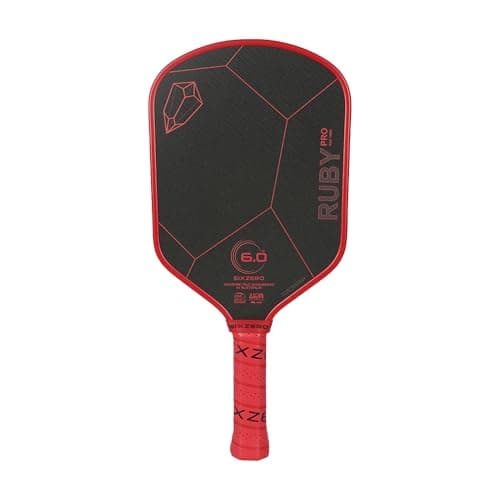
Six Zero's answer to the industry's biggest spin complaint — a tougher face built to hold its grit longer than typical raw carbon.
Raw-carbon spin is great until the grit wears smooth. The Ruby's abrasion-resistant face is designed to keep biting longer, which matters most to the high-volume player who replaces paddles when the spin dies. Premium price, but the durability angle is real.
Raw-carbon spin is fantastic right up until the texture polishes smooth, and the Ruby Pro is the first paddle in our lineup built specifically to slow that down. The abrasion-resistant face pairs with a 14mm thermoformed elongated frame, so you keep the pop and the spin ceiling while targeting the one failure mode that sends players shopping again. It costs premium money, and the durability case only pays off if you actually play enough to wear a face out.
- Core
- 14 mm
- Shape
- Elongated
- Face
- Diamond-tough abrasion-resistant face
- Weight
- ~8.0 oz
- Build
- Thermoformed
- Gen
- Ruby
Manufacturer-listed as USA Pickleball approved. Approvals and delistings change — verify against the current USAP equipment list before tournament play (checked 2026-07).
Who it's for
The Six Zero Ruby Pro 14mm is built for one specific player: the high-volume spin player who has already worn out a paddle. If you have owned a raw-carbon frame, loved how it bit the ball for the first few months, and then quietly noticed your topspin drives sitting up and your third-shot drops floating, you are the buyer Six Zero designed this for. The Ruby Pro exists because the single most common complaint in the modern paddle market is not power, weight or shape — it is that the grit stops working.
Everyone else should think harder. If you play twice a week, a conventional raw-carbon paddle will keep its bite for a long time, and the money the Ruby Pro asks over something like the Double Black Diamond buys durability you may never cash in. The Ruby Pro is a paddle you buy on your usage pattern, not on your rating. Four-plus sessions a week, tournament play, drilling volume, an abrasive outdoor court surface — those are the signals that make it worth the premium. If you are not sure where you sit, our paddle grit and durability guide explains what actually wears a face down and how to tell when yours has gone.
Level-wise, the 14mm core and the elongated shape point at a confident 3.5-and-up player. This is not a forgiving beginner frame, and it is not pretending to be — the spec sheet is aggressive and the paddle expects you to catch the ball reasonably clean.
How it plays
Spin
Spin is the entire point. The Ruby Pro's face is a diamond-tough abrasion-resistant surface, which is Six Zero's way of saying they went after texture retention without giving up the aggressive bite that makes raw carbon work. Our editorial spin score sits at the top of our range, and the published positioning backs a paddle that grabs the ball hard for topspin drives, dipping drops and heavy serves.
The important nuance is that a durability-focused face is a different engineering problem than a maximum-spin face. Every paddle maker can build a surface that grips ferociously for a month; the hard part is keeping that number stable. Independent labs such as Pickleball Studio publish measured spin RPM across the field and are the right place to look for comparative figures — we cite their machine rather than invent our own numbers, and we will not put a lifespan figure on this face that nobody has published. What we can say is that the design intent is explicitly texture retention, and that is a genuinely different pitch from every other paddle in our spin roundup.
Power
The Ruby Pro is a thermoformed build, which is the construction that made the modern power era possible — a heat-molded unibody shell with a foam-filled perimeter that returns more energy to the ball than a cold-pressed paddle. Our thermoformed paddles guide explains why that adds pace. Pair that shell with a 14mm core and you get a lively, quick paddle: thinner cores are poppier and faster through the air than thicker ones. Our power score is strong but not maximal, which reflects a paddle that is built to spin first and drive second — a dedicated bomb-thrower like the Gearbox GBX Power will hit flatter and harder.
Control and feel
This is the honest weak point of the spec sheet. A 14mm core in an elongated frame is a combination that prioritizes speed and reach over forgiveness — the sweet spot sits higher up the face and there is less core material to damp a mishit. Our control and forgiveness scores are mid-pack for that reason, and they should be. The Ruby Pro is perfectly capable at the kitchen, but it is a sharper, less cushioned instrument than a 16mm all-court paddle. If you want the same brand's forgiveness-first character, the 16mm Double Black Diamond is the softer landing, and our 14mm vs 16mm guide lays out exactly what you trade.
Specs and build
These are the manufacturer-published specs. The card above carries the live price and our editorial scores.
| Spec | Six Zero Ruby Pro 14mm |
|---|---|
| Shape | Elongated |
| Core thickness | 14mm |
| Face | Diamond-tough abrasion-resistant face |
| Construction | Thermoformed |
| Generation | Ruby |
| Listed weight | ~8.0 oz |
The elongated shape adds reach and leverage at the cost of a narrower sweet spot and a slower turn in hands battles — the classic trade covered in our elongated vs standard shape guide. Combined with the 14mm core, the Ruby Pro reads as a paddle for a player who generates their own spin and wants the surface to keep up with them, rather than one looking for help.
Six Zero lists the Ruby line as USA Pickleball approved. Approvals and delistings change, so check the current USAP approved paddle list before tournament play — see our guide to USAP-approved paddles for how to verify quickly.
The durability case, honestly stated
Here is where we have to be careful, because this is the exact claim the paddle is sold on. Every textured face loses bite with use. The mechanism is abrasion: court grit, ball surface and repeated brushing contact gradually polish the peaks off the texture until the face measures smoother. A face engineered to resist abrasion should hold its number longer than one that is not. That is the Ruby Pro's pitch, and it is a coherent one.
What we will not do is tell you how many hours, months or sessions it lasts. Nobody has published a controlled figure we would stand behind, and inventing one would be exactly the kind of number that gets repeated forever. If you want data, watch the independent labs — they are the ones with the equipment to measure texture decay over time, and they publish openly. What we are comfortable saying is that the Ruby Pro is the only paddle in our lineup where grit retention is the design brief, and that the brief targets a real, widely reported problem.
There is a second-order argument that matters more than the physics: cost per season. If a durability-focused face means one paddle where you would otherwise have bought two, the premium price flips from expensive to cheap. If you play recreationally and would never have worn out the first one, it does not.
How it compares
Against its own stablemate, the Six Zero Double Black Diamond 16mm, the Ruby Pro is the sharper, spinnier, faster paddle and the DBD is the far more forgiving one — a bigger sweet spot, a thicker core, a friendlier all-court character, and a lower price. For most players the DBD is still the smarter first Six Zero. The Ruby is what you buy second, when you know what you wear out.
Against the Vatic Pro Prism Flash, the comparison is value versus longevity. The Vatic runs a raw Toray T700 face for a fraction of the outlay and grips brilliantly when new; the Ruby Pro asks premium money and argues it will still grip later. Two entirely defensible ways to spend, and we break the brands down in Six Zero vs Vatic Pro. Against CRBN's current lineup — the TruFoam Barrage in particular — the Ruby is a spin-durability play while CRBN is chasing foam-core stability, which is a different problem entirely; see CRBN vs Six Zero.
Pros
- An abrasion-resistant face aimed squarely at the sport's biggest gripe — spin that fades.
- Top-of-range spin character with a genuinely aggressive bite.
- Thermoformed 14mm build keeps the paddle fast and lively in hands battles.
- Elongated reach for drives, serves and stretch volleys.
Cons
- Premium price for a benefit you only cash in with high volume.
- 14mm elongated build is less forgiving than a 16mm all-court frame.
- No published, independently controlled lifespan figure to point at yet.
- Not the flattest, hardest-hitting power option in its price band.
What we'd skip it for
Skip the Ruby Pro if you play casually. The durability premium is only worth paying if you would otherwise wear a face smooth, and a twice-a-week player mostly will not — the Double Black Diamond or a value raw-carbon paddle is the better use of the money, and our best spin paddles under $100 list exists for exactly that buyer.
Skip it if forgiveness is the weakness you are trying to fix. A 14mm elongated paddle is a demanding combination, and if your mishits are already costing you points, a thicker all-court frame from our control roundup will do more for your results than any face material. And skip it if you want maximum flat power — the Ruby spins first, and a dedicated drive paddle from the power roundup hits harder.
The verdict
The Six Zero Ruby Pro is the most interesting paddle in Six Zero's lineup because it is the only one solving a problem nobody else has centered on. Spin is the shot that wins modern points, texture is what creates spin, and texture wears out — a paddle engineered around that chain is a smart product, not a marketing angle. Combine it with a thermoformed 14mm elongated frame and you get a genuinely aggressive paddle that happens to be built to stay aggressive.
The catch is that you have to be the right buyer. Play a lot, spin a lot, replace paddles more often than you would like, and the Ruby Pro is an easy recommendation. Play twice a week and the DBD does nearly everything for less. See the whole field ranked in our spin paddles roundup, and read our methodology for how we score without a lab.
How long does the Six Zero Ruby Pro's grit last?
Nobody has published a controlled figure we would stand behind, so we will not invent one. What is documented is the design intent: the Ruby's face is an abrasion-resistant surface built to retain texture longer than conventional raw carbon. Independent labs such as Pickleball Studio are the right place to watch for measured texture and spin data over time.
Is the Ruby Pro better than the Double Black Diamond?
Different jobs. The Ruby Pro is a sharper 14mm spin paddle with a durability-focused face; the 16mm Double Black Diamond is the more forgiving, more affordable all-court paddle with a bigger sweet spot. Most players should start with the DBD. Buy the Ruby if you play high volume and have already worn a face smooth.
Is the Six Zero Ruby Pro good for intermediate players?
It suits a confident 3.5-and-up player who generates their own spin. The 14mm core and elongated shape favor speed and reach over forgiveness, so a developing player who mishits often will get more out of a thicker 16mm all-court frame. It is a specialist paddle, not a first upgrade.
Does the Ruby Pro have enough power?
Yes for most games. It is a thermoformed build with a 14mm core, which is a lively, poppy combination, and it drives the ball well. It is tuned spin-first though, so a dedicated flat-power paddle such as the Gearbox GBX Power or a Gen-4 foam flagship will hit harder off the middle.