Six Zero DBD vs Ruby Pro
Six Zero's two headline paddles answer different complaints. One is about how the paddle plays; the other is about how long it keeps playing that way.
Disclosure: Drive Dink earns a commission from qualifying Amazon purchases at no extra cost to you. We accept no free products and no paid placements — commissions never change our picks. How this works.
Six Zero is unusual among value-tier brands in that its two best-known paddles are not tiers of the same thing. The Double Black Diamond is a balance argument; the Ruby Pro is a durability argument. Buying the wrong one means solving a problem you do not have.
Live Amazon prices for both are above. We compile manufacturer-published specifications and rank by fit rather than by a single overall score. Units we claim to have tested: 0.
| # | Paddle | Best for | Score | Price |
|---|---|---|---|---|
| 1 | 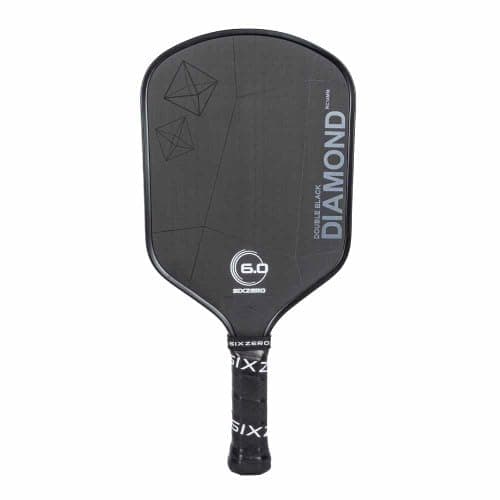 Six Zero Double Black Diamond 16mm All-court value with a huge sweet spot | Best all-court balance | 8.5 | $180.00 · View on Amazon #adPrice as of October 24, 2026 |
| 2 | 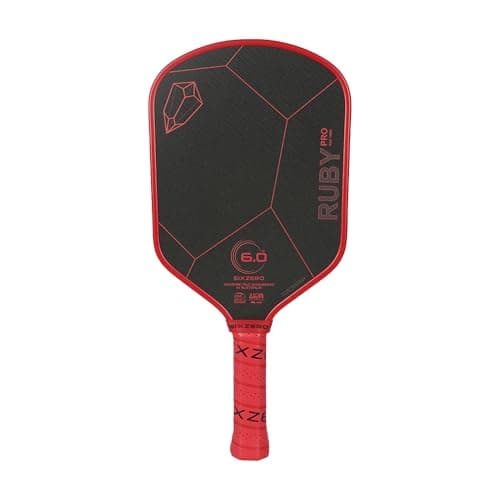 Six Zero Ruby Pro 14mm Spin durability (grit that lasts) | Best for grit that lasts | 7.8 | $225.00 · View on Amazon #adPrice as of October 24, 2026 |
Tap any row to jump to the full write-up. Prices are pulled live from Amazon.
Six Zero Double Black Diamond 16mm
The internet's default 'do-it-all' recommendation: thermoformed power, a raw-carbon spin face, and a famously forgiving sweet spot at a fair price.
The DBD earned its reputation honestly. The 16mm Control build blends thermoformed pop with one of the most forgiving sweet spots in its class, and the raw T700 face grabs the ball for spin. It's the paddle we point undecided upgraders to first.
The 16mm DBD is the most complete paddle Six Zero makes: control and forgiveness at the top of our range on a thermoformed frame that still drives. If you want one paddle that does not have a weakness, this is it — and the wide sweet spot is what most players notice first.
- Core
- 16 mm
- Shape
- Hybrid
- Face
- Raw Toray T700 carbon fiber
- Weight
- ~8.0 oz
- Build
- Thermoformed
- Gen
- Control (Gen 2 thermoformed)
Manufacturer-listed as USA Pickleball approved. Approvals and delistings change — verify against the current USAP equipment list before tournament play (checked 2026-07).
Six Zero Ruby Pro 14mm
Six Zero's answer to the industry's biggest spin complaint — a tougher face built to hold its grit longer than typical raw carbon.
Raw-carbon spin is great until the grit wears smooth. The Ruby's abrasion-resistant face is designed to keep biting longer, which matters most to the high-volume player who replaces paddles when the spin dies. Premium price, but the durability angle is real.
The Ruby Pro exists because raw carbon faces go smooth. Its abrasion-resistant surface is built to keep biting the ball for longer, which is a different kind of value than a lower purchase price. It is also a thinner, quicker 14mm frame, so you give up the DBD's margin on off-center contact to get it.
- Core
- 14 mm
- Shape
- Elongated
- Face
- Diamond-tough abrasion-resistant face
- Weight
- ~8.0 oz
- Build
- Thermoformed
- Gen
- Ruby
Manufacturer-listed as USA Pickleball approved. Approvals and delistings change — verify against the current USAP equipment list before tournament play (checked 2026-07).
Side by side
| Spec | Double Black Diamond 16mm | Ruby Pro |
|---|---|---|
| Shape | Hybrid (16.3 x 7.7in) | Elongated |
| Core thickness | 16 mm | 14 mm |
| Face | Raw Toray T700 carbon fiber | Diamond-tough abrasion-resistant face |
| Listed weight | ~8.0 oz | ~8.0 oz |
| Our spin score | 8 / 10 | 9 / 10 |
| Our power score | 8 / 10 | 8 / 10 |
| Our control score | 9 / 10 | 7 / 10 |
| Our forgiveness score | 9 / 10 | 7 / 10 |
The problem each paddle solves
The DBD solves the trade-off problem. Most paddles make you choose: pace or touch, bite or forgiveness. The 16mm DBD is thermoformed enough to drive and thick enough to reset, with the widest effective face in our catalog. Its appeal is that you stop thinking about the paddle.
The Ruby Pro solves the wear problem. Raw carbon faces grip hard when new and lose bite as the surface polishes down, which is why a paddle that felt electric in month one can feel ordinary by month six. Six Zero built the Ruby around an abrasion-resistant surface intended to slow that decline. Our guide to paddle grit and durability explains the mechanism and what actually accelerates it.
Why grit durability is a real cost, not a marketing angle
Think in cost per session rather than sticker price. A paddle whose face stops biting is not broken — it is still perfectly playable — but the specific property you paid a premium for has gone. If you play four times a week, the difference between a face that holds its texture and one that does not is the difference between replacing a paddle annually and replacing it more often.
Two honest caveats. First, nobody publishes a durability figure you can check, so this is a design intent rather than a measured lifespan, and we will not invent a number for it. Second, how you treat the face matters at least as much as what it is made of — dragging the paddle on court and skipping cleaning will polish any surface. Our paddle cleaning guide covers the routine, and our guide to when a paddle is done gives you a five-minute check for whether yours is finished.
The 14mm versus 16mm layer
The two paddles do not only differ in face — the Ruby Pro is a 14mm frame and the DBD we compare here is 16mm. That is the more immediately noticeable difference in play: the Ruby is quicker and punchier off the face, the DBD holds the ball longer and forgives more.
If you want the Ruby's face but the DBD's margin, that combination is not available in one paddle, and it is worth being clear about which property you would rather have. Our DBD 14mm vs 16mm comparison isolates the core question, and our 14mm vs 16mm guide covers the physics.
Spin, new versus later
Our spin scores say Ruby Pro by a point, and that is a judgment about the face design rather than a claim about a single session. A fresh raw carbon face like the DBD's grips very well indeed; the argument for the Ruby is about where the two sit several months in.
If maximum spin from day one is the priority regardless of how it ages, our highest-spin paddles page ranks the whole field, and our main spin roundup covers the balanced picks.
Who should buy which
Buy the DBD 16mm if you want one paddle without a weak spot, you play doubles, or the soft game is where your matches are decided. It is the paddle we rank in both our control roundup and our power roundup, which is not something we can say about many frames.
Buy the Ruby Pro ifyou play often, you have watched a previous paddle's face go slick, and spin is central to how you win points. You are buying the second half of the paddle's life, and you are paying for it with sweet-spot width.
Verdict
For most players, the DBD 16mm. It is the more complete paddle, the more forgiving one, and the easier one to play well on a bad day.
For the high-volume spin player who has been through a face already, the Ruby Pro is the more thoughtful purchase — and it is a rare example of a brand competing on how long a paddle stays good rather than on how good it is out of the box. Full write-ups: Six Zero Double Black Diamond review and Six Zero Ruby Pro review.
What is the difference between the Six Zero DBD and the Ruby Pro?
The DBD is an all-court paddle built around balance — our highest control and forgiveness scores on a thermoformed frame that still drives. The Ruby Pro is built around face durability, using an abrasion-resistant surface intended to keep gripping the ball for longer, on a thinner and quicker 14mm frame.
Does the Ruby Pro really keep its spin longer?
That is its design intent, and the abrasion-resistant face is a real material difference rather than a paint job. No manufacturer publishes a verifiable lifespan figure, so we will not quote one. How you treat the face — cleaning it, not dragging it on court — affects the outcome at least as much as the material does.
Which one is better for doubles?
The DBD 16mm. Doubles is decided by resets, drops and dinks, and those shots reward the longer dwell time and wider sweet spot a 16mm core provides. The Ruby Pro's thinner core is quicker but less forgiving, which costs you more in the soft game than it gains you in hands battles.
Can I get the Ruby Pro's face on a 16mm core?
Not in this pairing — the Ruby Pro is a 14mm frame. If forgiveness matters more to you than face longevity, take the 16mm DBD and plan on cleaning the face regularly to slow its wear, which is the cheapest way to get some of the same benefit.