Volair Mach 1 Forza Review
Foam edge walls, a hot-molded unibody frame and a long handle, at roughly half of what the same recipe costs from a flagship brand. The catch is what it weighs to swing.
Disclosure: Drive Dink earns a commission from qualifying Amazon purchases at no extra cost to you. We accept no free products and no paid placements — commissions never change our picks. How this works.
Volair sits in the part of the market that has grown fastest over the last two years: brands that skip the endorsement budget and put the money into construction. The Mach 1 Forza is their power-and-spin frame, and on paper it reads like a paddle that should cost twice as much.
Everything below is read from published specifications and the wider reviewer record; we have not hit this paddle ourselves. The live Amazon price is above.
Volair Mach 1 Forza 16mm
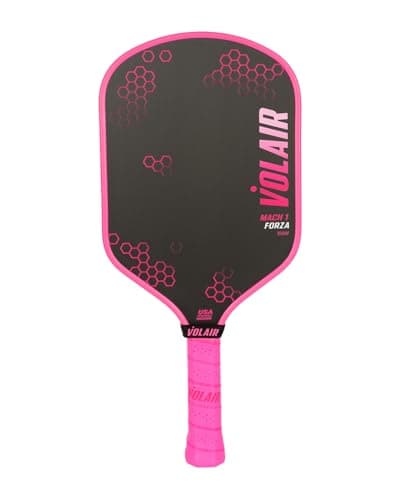
A thermoformed unibody frame with foam-injected edge walls and a long 5.5in handle — flagship construction at roughly half flagship money.
The Mach 1 Forza is the cheapest way we know to buy the full modern power recipe: hot-molded unibody build, raw T700 carbon face, and foam packed into the perimeter walls to widen the sweet spot. At 16.5in long with a 5.5in handle it is a genuine elongated frame, and the listed 8.2oz average weight tells you it is not a light paddle to swing.
The Forza is what happens when a smaller brand builds to the flagship specification and prices to the value tier. You get the hot-molded unibody frame, foam packed into the perimeter walls, a raw Toray T700 face and a genuinely long 5.5in handle. What you do not get is the flagship field's fine-tuning of weight and balance, and at a listed 8.2oz average this is not a light paddle to swing for two hours.
- Core
- 16 mm
- Shape
- Elongated
- Face
- Toray T700 raw carbon fiber
- Weight
- ~8.2 oz
- Build
- Thermoformed
- Gen
- Foam-injected edge walls (Gen 3)
Manufacturer-listed as USA Pickleball approved. Approvals and delistings change — verify against the current USAP equipment list before tournament play (checked 2026-07).
Who it's for
The Volair Mach 1 Forza is for the player who has decided they want a modern foam-wall power paddle and does not want to pay flagship money to find out whether they like it. It suits a strong hitter with a long swing — someone driving from the baseline, serving with intent, and comfortable carrying a slightly heavier frame through a session.
It is not the paddle for a player who has been struggling with hand speed at the kitchen line, and it is not a first step out of an entry-level paddle. The combination of an elongated outline and an above average listed weight makes it a demanding frame to move quickly.
The published specification
Volair lists the Mach 1 Forza at 16.5 inches long and 7.5 inches wide, with a 5.5-inch handle and a listed grip circumference of 4.125 inches. The core is available at 14mm and 16mm; the version we link is the 16mm.
The construction is the interesting part. The frame is hot-molded as a unibody — the same thermoforming process the flagship field uses, which stiffens the perimeter so it returns energy to the ball rather than absorbing it into flex. On top of that, Volair injects foam into the edge walls around the core, which is the construction our Gen 3 and Gen 4 foam paddles guide describes as the Gen 3 recipe: foam at the perimeter rather than through the core itself.
The face is raw Toray T700 carbon fiber — the same material designation used by Six Zero, Vatic Pro and Ronbus among others. It is the industry's workhorse spin surface, and our carbon fiber vs fiberglass guide covers why it dominates.
What the specification implies about how it plays
Power. A thermoformed unibody plus foam walls is the recipe that produced the current power era. Expect real pace on drives and serves, and expect it to arrive with a firm, unified feel rather than a soft one.
Spin. A raw T700 face on a 16.5-inch frame is a strong spin combination: the surface grips, and the length gives you more head speed at contact on a brushing stroke. We score it at the top of our range. What raw carbon does not do is stay that way forever — see our guide to paddle grit and durability for how the decline works.
Sweet spot. Foam in the edge walls raises resistance to twisting, which is what widens the usable face on an elongated paddle. This is the single most valuable thing the foam does, and it is why Gen-3 frames feel more forgiving than their thin-core predecessors.
Feel. Hot-molded frames are firm. If you are coming from a cold-pressed paddle, the response will feel more immediate and more vibration will reach your hand. Whether you read that as feedback or harshness is personal.
The specification worth taking seriously
Retailer spec sheets list an average weight around 8.2 oz, which is above the middle of the market, and the paddle is elongated. Those two facts compound: length moves mass away from your hand, and extra mass makes that worse. The result is a frame that takes more effort to accelerate and to stop.
That is not a flaw — high swing weight is how you get plow-through on a drive — but it is a fit question, and it is the one most likely to make someone dislike this paddle. If you have found long paddles slow in hands battles before, this will not fix that. Our swing weight and twist weight guide explains the property, and our paddle weight guide covers how static weight and swing weight differ.
There is a partial remedy: weight added at the butt cap lowers effective swing weight by moving the balance point back towards your hand. It makes the paddle heavier overall and quicker to move, which sounds contradictory and is not. Our lead tape guide covers it.
The handle
At 5.5 inches, the handle is long enough for a two-handed backhand without your top hand riding up onto the face. Combined with the 16.5in length, this is a paddle built for players who came to pickleball from tennis. Our paddles for tennis players and two-handed backhand picks cover that crossover in full.
How it compares
Against the Vatic Prism Flash, the Forza adds foam edge walls that the Flash does not have, at a similar position in the market — the Vatic is the lighter, quicker frame, the Volair the more planted one.
Against the Six Zero Double Black Diamond, the DBD is the more forgiving all-court paddle and the better-known quantity; the Forza is the more aggressive one.
Against the flagship field — the JOOLA Perseus Pro IV or the CRBN X Power — what you give up is refinement: consistency across the face, the quality of the damping, and tighter weight tolerances. Our guide to how much a paddle should cost works through whether that gap is worth the money.
The verdict
The Mach 1 Forza is one of the best specification-per-dollar buys currently available: genuine thermoformed construction, genuine foam edge walls, a genuine T700 face, at value-tier money. For a strong hitter with a long swing who wants to add pace and spin, it is an easy recommendation.
Go in aware of the weight. This is a paddle that rewards a full swing and punishes a late one, and the listed 8.2oz average is the number that will decide whether you keep it. If hand speed at the net is your priority rather than drive power, our control paddles roundup is the better starting point; if pace is the goal, it belongs on your shortlist alongside our best power paddles under $200.
Is the Volair Mach 1 Forza thermoformed?
Yes. Volair hot-molds the frame as a unibody, which is the same process the flagship field uses, and injects foam into the edge walls around the core. That combination is what the market calls a Gen 3 build — foam at the perimeter rather than through the core itself.
Is the Mach 1 Forza heavy?
Retailer spec sheets list an average around 8.2 oz, which is above the middle of the market, and the paddle is a 16.5-inch elongated frame. Those combine into a high swing weight, so it takes more effort to accelerate and to stop than a standard-shape paddle of the same static weight.
Does it have a long enough handle for a two-handed backhand?
Yes. The handle is listed at 5.5 inches, which is long enough for both hands without your top hand riding onto the face. That plus the 16.5-inch length makes it a natural fit for players crossing over from tennis.
How does it compare with a flagship power paddle?
It uses the same headline construction — thermoformed unibody, foam edge walls, raw T700 carbon — at a fraction of flagship money. What the flagships add is refinement: more consistent response across the face, better damping and tighter weight tolerances. Whether that is worth the difference depends on how often you play.