Paddletek Bantam TKO-CX Review
Everyone else went thermoformed. Paddletek stayed with a honeycomb core and layered plies — and got most of the pop anyway, without the failure modes.
Disclosure: Drive Dink earns a commission from qualifying Amazon purchases at no extra cost to you. We accept no free products and no paid placements — commissions never change our picks. How this works.
Paddletek is one of the oldest names in the sport, and for the last two years it has been conspicuously absent from the conversation that dominates paddle reviews — thermoforming, foam walls, generation numbers. The Bantam TKO-CX is the company's answer, and it is a more interesting paddle than its spec sheet first suggests.
Everything below is read from published specifications and the wider reviewer record; we have not hit this paddle ourselves. The live Amazon price is above.
Paddletek Bantam TKO-CX 14.3mm
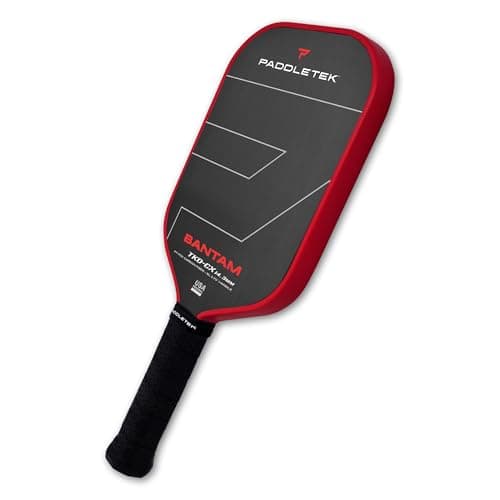
Paddletek gets flagship pop out of a classic honeycomb core and layered carbon plies — no thermoform shell, and none of the core-crush failure mode that comes with one.
The Bantam TKO-CX is the counter-argument to the thermoformed arms race. A 14.3mm Bantam polymer honeycomb core sits under glass-epoxy plies and an outer layer of PT-700 unidirectional raw carbon, which produces pop and bite comparable to hot-molded rivals from a construction that has no foam-filled walls to crush and no shell to delaminate. Elongated, with a long 5.75in handle.
The TKO-CX is the strongest argument that the thermoform arms race was not the only way forward. Stiff unidirectional carbon over glass epoxy over a 14.3mm Bantam honeycomb core produces pop and bite in the same neighborhood as hot-molded rivals, from a construction that has no foam walls to settle and no shell to separate. Add a 5.75in handle and you have a specific, well-argued paddle rather than a me-too flagship.
- Core
- 14.3 mm
- Shape
- Elongated
- Face
- PT-700 unidirectional raw carbon fiber over glass-epoxy plies
- Weight
- ~7.9 oz (7.7-8.1 oz range)
- Build
- Cold-pressed
- Gen
- Bantam polymer honeycomb (non-thermoformed)
Manufacturer-listed as USA Pickleball approved. Approvals and delistings change — verify against the current USAP equipment list before tournament play (checked 2026-07).
Who it's for
The Paddletek Bantam TKO-CX is for two players in particular. The first hits a two-handed backhand and needs a handle that accommodates it — this one is listed at 5.75 inches. The second has owned a thermoformed paddle that went soft or came apart, and would rather not repeat the experience.
It also suits anyone who prefers a paddle that talks back. Layered construction gives more localized feedback than a hot-molded unibody, which some players find informative and others find busy.
The published specification
Retailer spec sheets list the TKO-CX 14.3mm at 16.45 inches long and 7.5 inches wide, with a 5.8-inch handle (Amazon's listing states 5.75) and a grip circumference of 4.25 inches. Average weight is listed at 7.9 oz within a 7.7-8.1 oz range, and it is USA Pickleball approved.
The layup is the story. A 14.3mm Bantam polymer honeycomb core sits under a base layer of glass epoxy on each side, with an outer ply of PT-700 unidirectional raw carbon fiber. Paddletek also markets a torsional weighting arrangement intended to stabilize the frame against twisting.
What is not in that description matters as much as what is: there is no thermoformed unibody shell and no foam injected into the edge walls. Our thermoformed paddles guide covers what that construction adds, and our foam paddles guide covers the foam layer this paddle deliberately skips.
What the specification implies about how it plays
Power.Stiff plies over a honeycomb core produce a lively face. A relatively thin 14.3mm core compresses less at impact, which sends the ball away sooner. The result is more pop than "polymer honeycomb core" suggests to anyone who last read those words in 2021 — though on our scoring it still sits a point below the thermoformed flagships.
Spin. Unidirectional raw carbon is a genuine spin surface, and the elongated frame adds head speed on a brushing stroke. We score it strongly but not at the very top; the most aggressive faces in our catalog belong to paddles engineered around spin specifically — see our highest-spin paddles page.
Feel and control. This is where the construction pays off. A cold-pressed layup flexes a little more than a molded shell, which lengthens dwell and makes resets easier to judge. Our control score is a point above the Perseus for exactly this reason.
Forgiveness.The weak spot. A 14.3mm core on a 16.45in elongated frame is not a recipe for a huge sweet spot, and there is no foam in the walls doing the stabilizing work. Paddletek's torsional weighting is aimed at this, but if wide margins are your priority, our control roundup has more forgiving options.
The case Paddletek is actually making
Thermoformed paddles brought a new set of failure modes with them: foam settling in the edge walls, core cells crushing behind the hitting area under repeated hard contact, and separation between the face and the layers beneath. None are universal, and none are immediate — but they are specific to that construction, and heavy hitters see them first.
A layered honeycomb paddle cannot fail in those particular ways. It still ages: the raw carbon face polishes down like every raw carbon face, and honeycomb cores soften across years of hard play. But the structural risk profile is different, and for a five-days-a-week player that is worth something concrete. Our delamination and core crush guide sets out the symptoms and what warranties typically cover.
The handle is the headline fit feature
A 5.75-inch handle is long. If you hit a two-handed backhand, that is the specification that decides whether a paddle works for you — a short handle pushes your top hand onto the face and compromises both the grip and the stroke. Our handle length guide explains how to work out what you need, and our two-handed backhand picks cover the alternatives.
If you hit a one-handed backhand, a long handle is simply less hitting surface for the same overall length. That is a real cost, and it is the main reason not to buy this paddle.
How it compares
Against the JOOLA Perseus Pro IV, the Perseus wins on power, spin and sweet-spot width; the Paddletek wins on control, handle length and construction risk. Our Paddletek vs JOOLA comparison works through it properly.
Against the Engage Pursuit Pro MX, both are non-thermoformed elongated paddles with a more damped feel than the flagship field; the Engage is the plusher one, the Paddletek the stiffer and poppier.
The verdict
The Bantam TKO-CX is a good paddle with a specific argument, and the argument holds. You get most of the modern power era's pop, better touch than the flagships it competes with, a handle long enough for a two-hander, and none of the structural failure modes that have made paddle warranties a live topic — which is why it is the construction pick on our most durable paddles page.
What you give up is margin. This is a thin core on a long frame with no foam walls, and it will punish off-center contact more than a 16mm thermoformed paddle does. Buy it for the handle, the feel and the build. Do not buy it expecting the widest sweet spot in the class — for that, our Six Zero DBD review points at the better option.
Is the Paddletek Bantam TKO-CX thermoformed?
No. It uses a 14.3mm Bantam polymer honeycomb core with a base layer of glass epoxy on each side and an outer ply of PT-700 unidirectional raw carbon fiber. There is no hot-molded unibody shell and no foam in the edge walls.
Does the TKO-CX hit as hard as a thermoformed flagship?
Close, but not quite. Stiff carbon and glass-epoxy plies over a relatively thin honeycomb core produce genuine pop, and it hits harder than its construction suggests. On our scoring it sits a point below the thermoformed flagships for power, and a point above the Perseus for control.
How long is the handle?
Amazon's listing states 5.75 inches and retailer spec sheets list 5.8 inches. Either way it is a long handle, which makes it one of the better options for a two-handed backhand. The trade is less hitting surface for the same overall paddle length.
Is it worth buying a non-thermoformed paddle in 2026?
It can be. Thermoforming raises the power ceiling, but it also introduced core crush, foam settling and face separation as failure modes. If you hit hard, play several times a week, and value touch and a long handle over the last increment of pace, a well-built honeycomb paddle is a defensible choice rather than a compromise.