Vatic V-Sol vs Prism: Same Face, New Core
Vatic kept the face, the price bracket and the reputation, and threw away the core. This is the cleanest look anyone gets at what a foam core actually changes — because everything else is held constant.
Disclosure: Drive Dink earns a commission from qualifying Amazon purchases at no extra cost to you. We accept no free products and no paid placements — commissions never change our picks. How this works.
Verdict first: buy the V-Sol Pro V7 if you want the better paddle on paper and can live with a construction nobody has owned for three seasons — it beats the Prism Flash by a point on power with everything else level. Buy the Prism Flash if you want the cheaper paddle with a known record, which is the sensible answer for anyone who would be annoyed rather than curious if a new core aged badly. If you want the standard outline, the choice is made for you: no standard-shape V-Sol exists, so it is the Prism V7.
One piece of housekeeping before the specs, because it confuses everyone. Vatic's shape names do not carry across the two generations. In the Prism line the elongated paddle is the Flash and the standard-shape paddle is the V7. In the V-Sol Pro line the elongated paddle is the V7, the hybrid is the Flash, and the widebody is the Bloom. So "V7 vs V7" is not a like-for-like comparison and "V-Sol V7 vs Prism Flash" is — which is why that is the pairing this page leads with.
| # | Paddle | Best for | Score | Price |
|---|---|---|---|---|
| 1 | 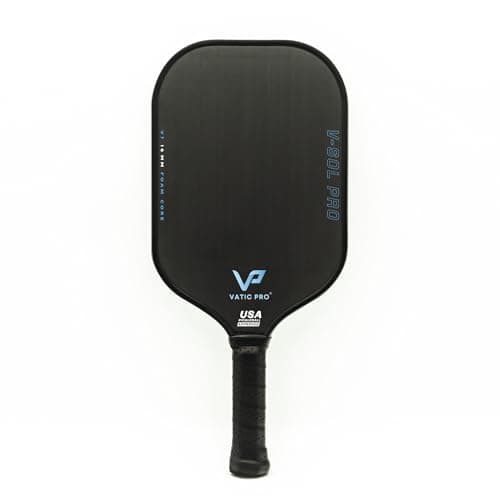 Vatic Pro V-Sol Pro V7 16mm A full foam core at value-tier money | Wins on construction and power | 8.3 | $109.99 · View on Amazon #adPrice as of October 5, 2026 |
| 2 | 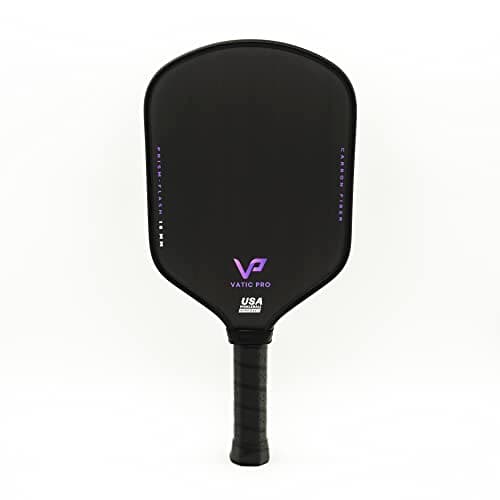 Vatic Pro Prism Flash 16mm The value spin champion (best under ~$110) | Wins on record and price | 8.0 | $99.99 · View on Amazon #adPrice as of October 5, 2026 |
| 3 | 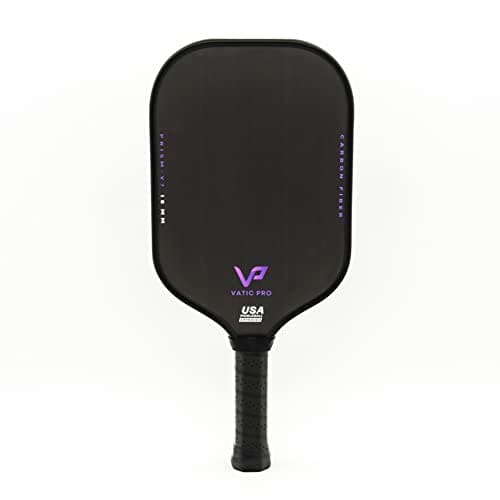 Vatic Pro Prism V7 16mm Value control in a standard shape | The one to buy if you want a standard shape | 7.8 | $99.99 · View on Amazon #adPrice as of October 5, 2026 |
Tap any row to jump to the full write-up. Prices are pulled live from Amazon.
Vatic Pro V-Sol Pro V7 16mm
Vatic's foam-core answer to the Gen-4 flagships: a floating EPP core inside an EVA perimeter ring under a raw T700 face, in the 16.5in elongated V7 outline.
The V-Sol Pro is the generational step the Prism never took — out goes the honeycomb core with foam-injected walls, in comes a full EPP foam core ringed by firmer EVA. The V7 is the elongated shape of the three, so it carries the most reach and the most leverage on a drive. Pickleball Studio measured the standard-handle V7 at 8.09 oz static with a 114 swing weight, which is light for a 16mm foam paddle.
The newer generation, and the one we rank first. Vatic lists the V-Sol Pro as a floating EPP core inside an EVA perimeter ring - no honeycomb at all - under the same raw Toray T700 face with heat-compressed texturing that the Prism uses. Our scores are a 9 on spin and a 9 on power with a 7 on control and an 8 on forgiveness, which is one power point ahead of the Prism Flash on an otherwise matching card. Pickleball Studio measured the standard-handle V7 at 8.09 oz static with a 114 swing weight and 6.32 twist weight. The cons are the ones that come with being first: Vatic publishes no molding method for the line, no foam core anywhere has a multi-season durability record, and the 4.125in grip is thin enough that most players build it up.
- Core
- 16 mm
- Shape
- Elongated
- Face
- Raw Toray T700 carbon fiber (heat-compressed texturing)
- Weight
- ~8.0-8.3 oz (listed)
- Build
- Not published
- Gen
- V-Sol (Gen 4 foam core)
Manufacturer-listed as USA Pickleball approved. Approvals and delistings change — verify against the current USAP equipment list before tournament play (checked 2026-07).
Vatic Pro Prism Flash 16mm
The value-shopper's spin paddle: raw T700 carbon and a thermoformed build that punches well above its price.
Vatic built a reputation on giving you 90% of a $250 paddle for around a hundred bucks. The Prism Flash's raw T700 face grips for spin and the elongated frame adds reach — the paddle we recommend when 'best spin under $100' is the search.
The paddle that built the brand, and the lower-risk half of this comparison. The Prism Flash is a thermoformed unibody with foam injected into the perimeter walls around a polypropylene honeycomb core, in the same 16mm thickness and the same elongated outline as the V-Sol Pro V7, under the same raw Toray T700 face. Our scores are a 9 on spin with an 8 on power, a 7 on control and an 8 on forgiveness - level with the V-Sol everywhere except power. It is the cheaper of the two and it has three seasons of reviewer and owner record behind it. The cons are value-tier consistency across the face, build variance that has historically shown up at this money, and the plain fact that it is now the previous generation.
- Core
- 16 mm
- Shape
- Elongated
- Face
- Raw Toray T700 carbon fiber
- Weight
- ~8.0 oz
- Build
- Thermoformed
- Gen
- Prism
Manufacturer-listed as USA Pickleball approved. Approvals and delistings change — verify against the current USAP equipment list before tournament play (checked 2026-07).
Vatic Pro Prism V7 16mm
The standard-shape Prism: the same value-carbon face in a more control-friendly, maneuverable body.
The V7 is the Prism for players who prefer a standard shape — a lower, wider sweet spot and quicker hands than the elongated Flash, at the same wallet-friendly price. A lot of paddle for the money on the control end.
The third paddle, here because the shape names across these two generations do not line up and a lot of readers want the standard outline rather than the elongated one. The Prism V7 is the same 16mm honeycomb core and the same raw T700 face as the Flash in a standard shape, which pulls mass back toward your hand for quicker hands and a wider usable face. Our scores are an 8 on spin, control and forgiveness with a 7 on power. It is the pick if you play doubles at the kitchen and elongated frames feel slow - see our paddles for hand speed page for why head length dominates that decision. The cons are that 7 on power, which means constructing points rather than ending them, and that no standard-shape V-Sol exists, so choosing this outline means choosing the older core.
- Core
- 16 mm
- Shape
- Standard
- Face
- Raw Toray T700 carbon fiber
- Weight
- ~8.0 oz
- Build
- Thermoformed
- Gen
- Prism
Manufacturer-listed as USA Pickleball approved. Approvals and delistings change — verify against the current USAP equipment list before tournament play (checked 2026-07).
Side by side
Vatic-published figures, with Pickleball Studio's measurements labelled as theirs. The two rows that differ are the only two rows that differ.
| Spec | V-Sol Pro V7 16mm | Prism Flash 16mm |
|---|---|---|
| Core material | Floating EPP foam + EVA perimeter ring | Polypropylene honeycomb, foam-injected walls |
| Core thickness | 16mm | 16mm |
| Face | Raw Toray T700, heat-compressed texturing | Raw Toray T700 |
| Shape | Elongated 16.5 x 7.5in | Elongated |
| Listed weight | 8.0-8.3 oz | ~8.0 oz |
| Molding method | Not published by Vatic | Thermoformed (unibody) |
| Measured static / swing / twist | 8.09 oz / 114 / 6.32 (Pickleball Studio, standard handle) | Not published |
| Our scores (spin/power/control/forgiveness) | 9 / 9 / 7 / 8 | 9 / 8 / 7 / 8 |
Why this is the most useful foam comparison on the site
Almost every foam-versus-honeycomb comparison you can read changes three things at once: a different brand, a different face, a different price bracket. This one changes one. Same maker, same face material, same thickness, same outline, same value pricing, same texturing process. The core is the variable. So whatever difference you feel between these two paddles is the difference a foam core makes, which almost no other pairing can claim.
Our best foam core paddles roundup ranks the wider field, and our Gen 3 and Gen 4 foam guide covers the generation labels. This page is the controlled experiment.
What swapping the core actually does
The face flattens out.A polymer honeycomb core is a grid: stiff where a cell wall sits, softer where a cell is hollow. Foam is continuous. Replacing the grid with a moulded block makes the response more uniform from the middle of the face outward — the middle is marginally less lively, the area around it noticeably more so. That is the mechanism behind the Prism's reputation for a sweet spot you have to find and the V-Sol's for one you do not. Our sweet spot guide covers the four specs that decide where that region sits.
Power goes up, not down. This surprises people who expect foam to be soft. The EPP core compresses and returns energy across a wider area, and the EVA ring stiffens the perimeter, so the paddle hits harder on contacts that are not perfectly centred — which is most contacts. That is the one score where we separate these two.
Spin does not change. Spin comes from the face, and the face is the same raw T700 weave on both paddles. Our how spin works guide explains why the core barely participates, and our T700 guide covers what the grade means. Both paddles score a 9; neither is a tier above the other on grip.
The sound changes. A foam core is quieter and duller than a honeycomb one — relevant if you play somewhere with noise complaints, though not a certification; see quiet pickleball paddles for why no paddle can honestly be sold as quiet on its own.
What the new core costs you
One thing, and it is not performance: certainty. The Prism has been on courts since 2023 and its failure modes are known — the honeycomb family's characteristic problem is the face separating from the core, which you can hear before you can see; our delamination guide covers how to check. A compressed EPP core has no documented multi-season behaviour at any price, from any brand. Whether it softens, sets, or holds up indefinitely is genuinely unknown, and anyone who gives you a confident answer is guessing.
Vatic also publishes no molding method for the V-Sol line, so our spec card reads "not published" rather than asserting thermoformed or cold-pressed. The Prism line is published as a thermoformed unibody. That is a documentation gap rather than a quality claim, but it is the kind of gap worth knowing about before you spend money.
If you already own a Prism
The honest answer is that this is not an upgrade worth making for one power point. If your Prism's face has polished smooth — which raw weaves do, and our grit durability guide explains why — then you are replacing a worn paddle anyway and the V-Sol is the obvious replacement. If your Prism still grips and your complaint is that off-centre balls die, the V-Sol addresses exactly that and is worth the move. If your complaint is hand speed, neither of the elongated paddles here fixes it; see our paddles for hand speed page and consider the Prism V7 or the V-Sol Pro Flash instead. And if your complaint is that the paddle feels too light, you need lead tape, not a new paddle.
The rest of each line
The V-Sol Pro comes in three outlines — the elongated V7, the hybrid Flash and the widebody Bloom — all at one price, which makes shape a fit decision rather than a tier. Our V-Sol Pro review covers all three, and names the two siblings Vatic does not sell on Amazon. The Prism line is the Flash and the V7, compared directly in Prism Flash vs Prism V7. To see Vatic against other brands, we have JOOLA vs Vatic Pro, Six Zero vs Vatic Pro, CRBN vs Vatic Pro and Vatic vs Ronbus.
Verdict
The V-Sol Pro V7 is the better paddle by our scorecard and the Prism Flash is the safer purchase, and the gap between those two statements is one power point and an unknown. If you buy paddles every season, buy the V-Sol — you will have replaced it before durability becomes a question, and you get the better construction in the meantime. If you buy a paddle and expect it to last, the Prism Flash is cheaper, proven and loses almost nothing. Either way, buy the elongated-or-standard decision first: shape changes more about how a paddle plays than the core does, and our shape guide is the place to settle it.
What is the difference between the Vatic V-Sol and the Prism?
The core, and only the core. Both use a raw Toray T700 carbon face and a 16mm thickness, and the elongated versions share an outline. The Prism is a thermoformed polypropylene honeycomb core with foam injected into the perimeter walls; the V-Sol Pro replaces the honeycomb entirely with a floating EPP foam core inside an EVA ring.
Is the Vatic V-Sol Pro better than the Prism Flash?
On our scorecard, by one point. Both score 9 on spin, 7 on control and 8 on forgiveness; the V-Sol scores 9 on power against the Prism's 8, because the foam core returns energy across a wider area of the face. The Prism Flash is cheaper and has three seasons of owner record behind it, which is the trade.
Which Vatic paddle is the elongated one?
It depends on the generation, which is the single most confusing thing about Vatic's range. In the Prism line the Flash is elongated and the V7 is standard shape. In the V-Sol Pro line the V7 is elongated, the Flash is hybrid and the Bloom is widebody. The like-for-like comparison across generations is V-Sol Pro V7 against Prism Flash.
Should I upgrade from a Prism to a V-Sol?
Not for one power point. Upgrade if your Prism's raw face has polished smooth and you are replacing it anyway, or if your specific complaint is that off-center balls die — the foam core is a direct fix for that. Do not upgrade if your complaint is hand speed or paddle weight; a different shape or a few grams of tape is the cheaper answer.
Is there a standard shape V-Sol Pro?
No. The V-Sol Pro line is elongated (V7), hybrid (Flash) and widebody (Bloom). If you want Vatic's raw T700 face in a standard outline, the Prism V7 is the only option, which means choosing the honeycomb core.