Pickleball Paddle Sweet Spot, Explained
Every paddle has one, no listing tells you where it is, and the four specifications that move it are printed on every spec sheet. Here is how to read them — and how to find the spot on the paddle you already own.
Disclosure: Drive Dink earns a commission from qualifying Amazon purchases at no extra cost to you. We accept no free products and no paid placements — commissions never change our picks. How this works.
The sweet spot is the region of the face where the ball comes off cleanest — the most energy returned, the least vibration into your hand, the least twist in the frame. Every paddle has one. No listing tells you where it is or how big it is. And yet the four specifications that decide both are printed on every spec sheet, which means you can predict a paddle's sweet spot before you hit a ball with it. This guide explains the four, then names the paddles that win on them. If your question is simply "which paddle forgives a miss most," our most forgiving paddles page ranks the field; this page explains why.
The four things that decide where it is and how big it is
1. Core thickness sets the size. A thicker polymer core compresses more at impact, which spreads energy further from the contact point — so the region of the face that returns the ball cleanly gets larger. A 16mm core has a bigger sweet spot than the same paddle in 14mm; a 20mm core has a bigger one still. Our 14mm vs 16mm guide covers the physics.
2. Shape sets the location. Total paddle dimensions are capped by the rules, so length is bought with width. An elongated frame pushes the sweet spot higher on the face and makes it narrower; a standard frame keeps it lower, wider and closer to the hand; a hybrid sits between. This is the lever most people forget. Our paddle shape guide covers the trade in full.
3. Twist weight sets the edges.Twist weight is the paddle's resistance to rotating around the handle axis when you hit off-center. The higher it is, the further from the middle a contact can be before the frame turns in your hand — so a high twist weight does not move the sweet spot, it widens the usable face around it. It rises with width and with mass at the edges. Our swing weight and twist weight guide explains the number.
4. Foam and construction set the fall-off. A thermoformed shell with foam in the perimeter walls holds its shape on off-center contact better than a hollow-edged build, and the newest foam-core paddles push that further. The sweet spot is not larger, exactly; the cliff at its edge is gentler. Our Gen 3 and Gen 4 foam guide covers the labels.
Put those together and the paddle with the biggest, most usable sweet spot is a thick-core, foam-walled frame in a standard or hybrid shape. Almost nobody sells exactly that, because the power buyer wants an elongated frame — so the three paddles below are the ones that win on the most levers at once. Live Amazon prices are on each card.
Six Zero Double Black Diamond 16mm
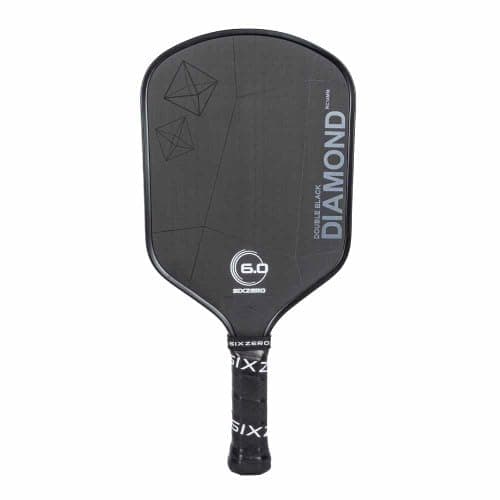
The internet's default 'do-it-all' recommendation: thermoformed power, a raw-carbon spin face, and a famously forgiving sweet spot at a fair price.
The DBD earned its reputation honestly. The 16mm Control build blends thermoformed pop with one of the most forgiving sweet spots in its class, and the raw T700 face grabs the ball for spin. It's the paddle we point undecided upgraders to first.
If the section above describes your miss — late, low or off-center rather than misjudged — this is the paddle built for it. The Double Black Diamond 16mm carries our joint-highest forgiveness score in the catalog: a 16mm core for dwell and damping, foam in the perimeter walls for twist resistance, and a thermoformed shell that stays stable well out toward the edges. It scores an 8 on spin and power and a 9 on control and forgiveness, so the big face costs you nothing else. The con is a long outline — the sweet spot sits higher than on a standard shape and the paddle swings heavier than the Scorpeus below.
- Core
- 16 mm
- Shape
- Elongated
- Face
- Raw Toray T700 carbon fiber
- Weight
- ~8.0 oz
- Build
- Thermoformed
- Gen
- Control (Gen 2 thermoformed)
Manufacturer-listed as USA Pickleball approved. Approvals and delistings change — verify against the current USAP equipment list before tournament play (checked 2026-07).
Selkirk LUXX Control Air Invikta
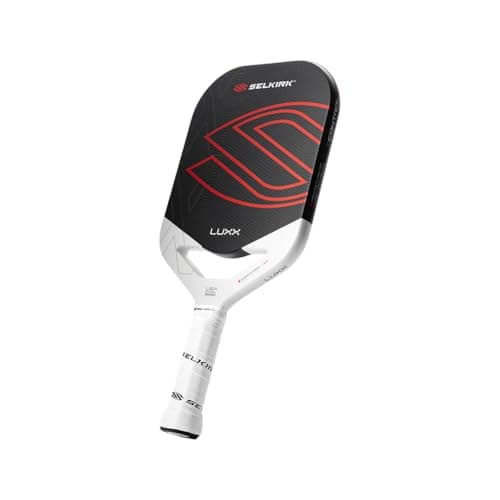
A thick-core, control-first paddle: a plush, soft-hands feel for dinking and resets, not a bomb-thrower.
The LUXX Control leans hard into touch — a thicker core and a muted face make the third-shot drop and the reset the strengths here. If your game wins on placement and hands speed rather than raw pace, this is the control end of the Selkirk line.
The other paddle with our top forgiveness score, and the one that wins on the first lever above by the widest margin: a 20mm core, four millimeters thicker than the rest of the market, cold-pressed under a Florek carbon face. The extra polymer lengthens dwell time and spreads energy further from the contact point than any 16mm frame can, which is why it is also the pick on our tennis elbow page. The cons are a power score of 7 — this is a touch paddle — and a genuine elongated Invikta outline, so the sweet spot sits high and hand speed is average.
- Core
- 20 mm
- Shape
- Elongated
- Face
- Florek carbon face
- Weight
- ~8.0 oz
- Build
- Cold-pressed
- Gen
- LUXX
Manufacturer-listed as USA Pickleball approved. Approvals and delistings change — verify against the current USAP equipment list before tournament play (checked 2026-07).
JOOLA Collin Johns Scorpeus Pro IV 16mm
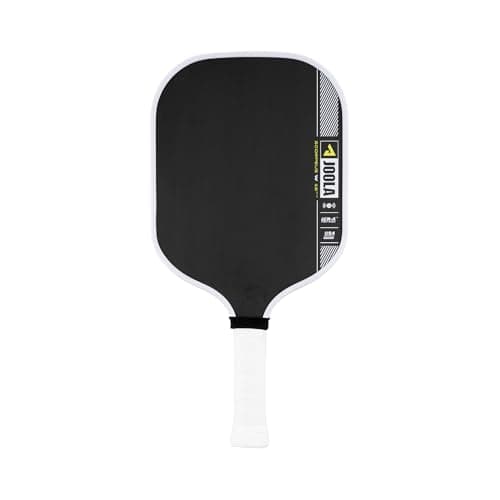
The standard-shape Perseus. A more balanced, control-leaning face for players who don't get on with elongated handles.
Same Gen-4 tech as the Perseus in a standard shape, which brings the sweet spot lower and wider and makes hands battles easier to win. If you want JOOLA's power tech but prefer an all-court, control-first feel, this is the one.
The shape lever in a single paddle. The Scorpeus is JOOLA's Pro IV thermoformed build in a standard outline, and a standard outline puts the sweet spot lower on the face, wider, and closer to the hand — which is exactly where a doubles player at the kitchen line makes contact. Our four scores are an 8 on every axis, the most even spread we publish. It is the pick for a player whose misses are on the sides of the face rather than the tip, and who does not want an elongated frame's swing weight. The con is flagship-tier money for a paddle that leads no single category.
- Core
- 16 mm
- Shape
- Standard
- Face
- Charged carbon-fiber surface
- Weight
- ~8.0 oz
- Build
- Thermoformed
- Gen
- Pro IV (Gen 4)
Manufacturer-listed as USA Pickleball approved. Approvals and delistings change — verify against the current USAP equipment list before tournament play (checked 2026-07).
Where the sweet spot actually sits
Not in the geometric center. On almost every paddle the sweet spot sits slightly above the center of the face, toward the tip, because the handle and throat add stiffness and mass to the lower half and the face is freest to flex — and return energy — a little higher up. On an elongated frame it sits higher still, often well into the top third. That matters for technique: a player who makes contact low on the face, which is common on blocks and resets at the kitchen, is routinely hitting below the sweet spot of an elongated paddle and inside it on a standard one. It is one reason standard shapes feel "easier" to doubles players and elongated shapes feel "more powerful" to drivers who make contact out in front.
How to find the sweet spot on your own paddle
The drop test. Hold the paddle loosely by the handle with the face horizontal and drop a ball onto it from about a foot. Move the drop point around the face. Where the ball bounces highest and the handle vibrates least is the sweet spot; where it thuds and the handle buzzes is outside it. Five minutes and a ball is all it takes, and it works on any paddle.
The tap test. Hold the handle and tap the face with a knuckle. The sweet spot rings; the perimeter clicks. This also doubles as the check in our delamination guide — a dull, dead area that used to ring is a paddle problem, not a technique problem.
The dust test. After a session on a dusty outdoor court, look at the face. Ball marks cluster where you actually make contact. If that cluster is well below or to the side of where the drop test says the sweet spot is, you have found the cheapest improvement available to you — it is not a new paddle.
How to move it, or widen it, on the paddle you own
You cannot move the sweet spot much — that is set by shape and construction — but you can widen the usable face around it, and the tool costs a few dollars. Tape at the 3 and 9 o'clock positions raises twist weight, which is the property that decides how far off-center a contact can be before the frame turns. Tape at the tip raises swing weight instead, adds plow-through and drags the balance point up, which some players read as the sweet spot moving toward the tip. Our lead tape guide covers placement and quantity and our paddle weights picks cover what to buy. Add a little, play a session, then decide; changing several things at once tells you nothing.
What a big sweet spot costs
Nothing on a spec sheet is free. The thick core that enlarges the spot is slightly slower off the face, which registers as less pop. The standard shape that centers it gives up reach and leverage. The edge mass that widens it raises swing weight. And a damped, forgiving frame gives less feedback about where on the face you hit, which some advanced players dislike because the feedback is how they correct. For most upgrading players the trade is worth it — a paddle that turns a bad contact into a playable ball wins more points than one that makes a good contact marginally better. For a player whose game is fast, flat and clean, our best 14mm paddles page is the other end of the same decision.
What "huge sweet spot" on a listing means
Usually that the paddle is thermoformed with foam edges and a 16mm core, which is most of the market now. It is not a measurement. Two numbers that aremeasurements exist — twist weight, which independent labs like Pickleball Studio publish, and the measured forgiveness or "sweet spot" indexes some labs derive from it — and our how paddles are tested guide explains what those figures mean and why two labs disagree. When a listing gives you an adjective, read the core thickness and the shape instead. They will tell you more.
The bottom line
The sweet spot sits just above center, higher on a long frame; a thicker core makes it bigger, a standard shape makes it lower and wider, twist weight sets how far outside it you can hit and get away with it, and foam softens the cliff at its edge. Read those four off the spec sheet before you buy, run the drop test on what you own, and if the fix turns out to be a few grams of tape rather than a new paddle, take the cheap one.
Where is the sweet spot on a pickleball paddle?
Slightly above the geometric center of the face, toward the tip, because the handle and throat stiffen the lower half. On an elongated paddle it sits higher still, often in the top third; on a standard shape it sits lower, wider and closer to the hand. A drop test with a ball finds it on any paddle in five minutes.
Which pickleball paddle has the biggest sweet spot?
Among the paddles we cover, the Six Zero Double Black Diamond 16mm and the Selkirk LUXX Control Air Invikta carry our joint-highest forgiveness score — the first from a 16mm foam-walled thermoformed build, the second from a 20mm cold-pressed core. For the lowest, most centered sweet spot, the standard-shape JOOLA Scorpeus Pro IV.
Does a thicker paddle have a bigger sweet spot?
Yes. A thicker polymer core compresses more at impact and spreads energy further from the contact point, so the region of the face that returns the ball cleanly grows. A 16mm core has a larger sweet spot than the same paddle in 14mm, and a 20mm core larger still, at the cost of a little pop.
Do elongated paddles have a smaller sweet spot?
Generally, yes, and it sits higher on the face. Paddle dimensions are capped, so an elongated frame buys length with width, which narrows the sweet spot and pushes it toward the tip. The trade is reach and leverage, which is why power players accept it and doubles players at the kitchen often prefer a standard shape.
Can I make my paddle's sweet spot bigger?
You can widen the usable face around it. A few grams of lead or tungsten tape at the 3 and 9 o'clock positions raises twist weight, which resists the frame rotating on off-center contact. It cannot change the core thickness or the shape that set the sweet spot itself, but it is cheap, reversible and fixes the most common complaint.