PBCoR .43, Explained
A number almost nobody can define is now the line between a legal paddle and a banned one. Here is what it measures, who it binds, and why most paddle listings will not tell you.
Disclosure: Drive Dink earns a commission from qualifying Amazon purchases at no extra cost to you. We accept no free products and no paid placements — commissions never change our picks. How this works.
The short version: PBCoR is a cap on how much your paddle trampolines, the limit has been 0.43 since November 1, 2025, and almost every paddle sold today is built to pass it.If you bought a paddle new from a reputable brand in the last year, it almost certainly complies. If you are playing a paddle from 2023 or 2024 that was never re-certified, or a model that has been delisted, you may have a problem — and the only place that gets settled is USA Pickleball's current equipment list, not a product page and not this one.
This is also where two different certifications get confused with each other constantly. USA Pickleball approval and UPA-A certification are separate programs run by separate bodies for separate competitions, and a paddle can hold one without the other.
What the number actually measures
PBCoR stands for Paddle-Ball Coefficient of Restitution. A coefficient of restitution is a ratio: how much of the speed a ball arrives with it leaves with. Fire a ball at a wall and most of the energy is lost; fire it at a trampoline and very little is. A paddle sits between those, and PBCoR puts a number on where.
The idea is borrowed. Pickleball Science describes the USA Pickleball test as a form of the protocol baseball has used for years to stop bats getting too lively — the BBCoR test that followed aluminum bats around the sport in the 2000s. Same problem, same solution: once manufacturers could build a hitting surface that returned more energy than the old one, the governing body had to put a ceiling on it or watch the game change.
Why it exists. Thermoforming and foam construction made paddles genuinely hotter. A stiff hot-molded shell loses less energy to frame flex, so more of it goes back into the ball — which is the whole appeal of the construction and also the reason a limit became necessary. Our thermoformed paddles guide covers what changed, and our Gen 3 and Gen 4 foam guide covers where the foam goes.
The two numbers you will see. The limit arrived in late 2024 at 0.44 and tightened to 0.43 effective November 1, 2025. That is the current figure. A paddle advertised as "PBCoR .43 certified" is telling you it was tested against the current ceiling and came in under it — it is a pass/fail statement, not a performance score, and a paddle at 0.39 and a paddle at 0.429 both print the same claim.
What it does not measure. Not spin — that is a separate surface-roughness limit, covered in our grit and durability guide. Not swing weight, not twist weight, not sweet spot size. PBCoR constrains one axis only, which is why paddles that all pass still feel completely different from each other.
Three paddles we cover publish a PBCoR .43 certification by name. They are below, with live Amazon prices. The rest of this page explains why that list is so short.
JOOLA Ben Johns Hyperion Pro IV 16mm
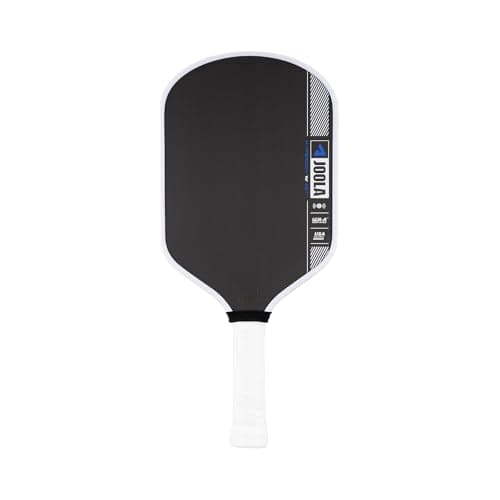
The Perseus Pro IV platform under JOOLA's curved Aero Curve head — the same core, face and throat foam, built to swing quicker and sitting a generation behind the current Pro V on price.
JOOLA publishes the same build for this paddle as for the Perseus Pro IV: a 16mm Propulsion polypropylene honeycomb core with a Hyper-Foam Edge Wall, a Textured Carbon Fiber face, and the Tech Flex Power throat foam that narrows the honeycomb channel to add flex. What differs is the outline — the Hyperion's top edge is curved rather than flat, which reviewers describe as quicker in hand battles at the cost of a little hitting area and mass at the top of the face. The 16mm core is the forgiving one, with a 4 1/4in grip.
If the section above has you wanting a paddle whose paperwork is actually printed rather than assumed, this is the one. JOOLA publishes the Hyperion Pro IV as USAP approved, UPA-A certified AND USAP PBCoR .43 certified - all three, named individually, which almost nobody in this category does. That matters most if you play PPA or MLP events, because UPA-A is the professional-side certification and a USAP-approved paddle is not automatically UPA-A certified. The paddle itself is the Perseus Pro IV platform under a curved head: a polypropylene honeycomb core with an EVA foam edge wall, a Textured Carbon Fiber face, 16.5 x 7.5in with a 5.5in handle. The cons are that the curved head gives up a little hitting area at the top of the face against the flat-top Perseus, that JOOLA publishes no molding method for the Pro IV line, and that it is a high-pop paddle that inexperienced players find hard to control.
- Core
- 16 mm
- Shape
- Hybrid
- Face
- Textured carbon-fiber surface (Tech Flex Power)
- Weight
- ~8.1 oz (7.9-8.3)
- Build
- Thermoformed
- Gen
- Pro IV (Gen 4)
Manufacturer-listed as USA Pickleball approved. Approvals and delistings change — verify against the current USAP equipment list before tournament play (checked 2026-07).
Vatic Pro V-Sol Pro V7 16mm
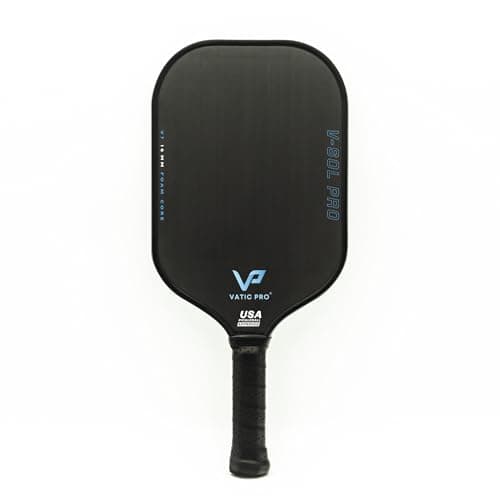
Vatic's foam-core answer to the Gen-4 flagships: a floating EPP core inside an EVA perimeter ring under a raw T700 face, in the 16.5in elongated V7 outline.
The V-Sol Pro is the generational step the Prism never took — out goes the honeycomb core with foam-injected walls, in comes a full EPP foam core ringed by firmer EVA. The V7 is the elongated shape of the three, so it carries the most reach and the most leverage on a drive. Pickleball Studio measured the standard-handle V7 at 8.09 oz static with a 114 swing weight, which is light for a 16mm foam paddle.
The proof that a published certification is not a flagship feature. Vatic lists the V-Sol Pro line as USAP certified and PBCoR .43 certified, and sells it in the value tier - which makes it the cheapest paddle we cover with the number printed on it rather than left to inference. The V7 is the elongated 16.5 x 7.5in shape of the three, wrapped around a floating EPP foam core inside an EVA perimeter ring under a raw Toray T700 face. Pickleball Studio measured the standard-handle V7 at 8.09 oz with a 114 swing weight. The cons are a thin 4.125in grip most players build up, a light static weight that wants lead tape, no published molding method, and a full foam core with no multi-season durability record anywhere.
- Core
- 16 mm
- Shape
- Elongated
- Face
- Raw Toray T700 carbon fiber (heat-compressed texturing)
- Weight
- ~8.0-8.3 oz (listed)
- Build
- Not published
- Gen
- V-Sol (Gen 4 foam core)
Manufacturer-listed as USA Pickleball approved. Approvals and delistings change — verify against the current USAP equipment list before tournament play (checked 2026-07).
Vatic Pro V-Sol Pro Flash 16mm
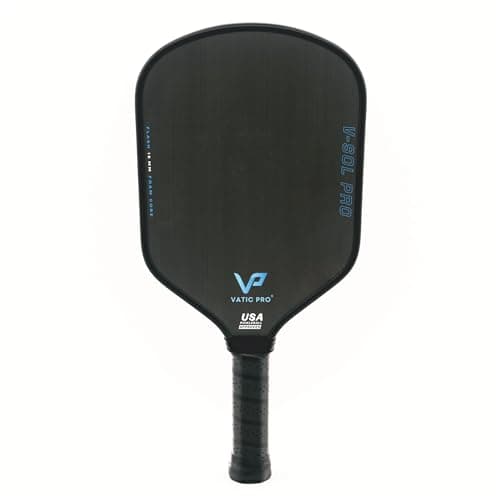
Same foam core and raw T700 face as the V7, in Vatic's 16.3 x 7.7in hybrid shape — a little less reach, a little more hand speed.
Flash is the middle shape of the V-Sol Pro range: shorter and wider than the elongated V7, which moves the sweet spot down and in and makes the paddle quicker to turn over at the net. If you have been playing a standard or hybrid frame and want a foam core without relearning where the paddle face is, this is the version to buy.
Here because the PBCoR number is a property of the construction, not the outline - so the whole V-Sol Pro line carries Vatic's PBCoR .43 listing, and you can pick the shape that suits your game without giving the certification up. Flash is the 16.3 x 7.7in hybrid between the elongated V7 and the widebody Bloom, which moves the sweet spot down and in and makes the paddle faster to turn over in a hands exchange. Same floating EPP foam core, same raw Toray T700 face, same price as its siblings. The cons are the same thin grip and light static weight as the V7, less drive on a third-shot than the elongated version, and the same unproven foam core.
- Core
- 16 mm
- Shape
- Hybrid
- Face
- Raw Toray T700 carbon fiber (heat-compressed texturing)
- Weight
- ~8.0-8.3 oz (listed)
- Build
- Not published
- Gen
- V-Sol (Gen 4 foam core)
Manufacturer-listed as USA Pickleball approved. Approvals and delistings change — verify against the current USAP equipment list before tournament play (checked 2026-07).
USA Pickleball approval and UPA-A certification are not the same thing
This is the single most common confusion in the category, and the two programs answer to different competitions.
| USA Pickleball (USAP) approval | UPA-A certification | |
|---|---|---|
| Who it binds | USA Pickleball sanctioned tournaments, and most clubs and leagues that follow them | Professional PPA and MLP divisions |
| What gets tested | Size, surface roughness, construction, identification and performance — PBCoR is the performance piece | Deflection, power, spin limits, construction and production consistency, plus onsite screening at events |
| Who runs the testing | USA Pickleball's equipment program | UPA-A, working with Pickle Pro Labs and the University of Massachusetts Lowell |
| Matters to you if | You play anything sanctioned, or your club follows the USAP list | You are competing in a professional PPA or MLP division |
The practical consequence: a paddle can be USAP approved and not UPA-A certified. For the overwhelming majority of readers that is irrelevant — if you are not playing a professional division, USAP approval is the standard that governs you. The reason to care about the UPA-A line at all is that brands increasingly advertise it, and an unfamiliar logo on a listing is not evidence of anything you need.
One more practical note for anyone shopping a brand-new release: certification takes time. UPA-A certification has been reported to take up to eight weeks in 2026, so a paddle that launched last month may genuinely be mid-process rather than failing anything.
Is the paddle you already own still legal?
Four steps, in order, and the first one settles most cases:
- Check the current USA Pickleball equipment list. This is the only authority. Not the box, not the product page, not a review site — including this one. Approvals change and paddles get delisted, which is exactly why we date-stamp every approval claim we repeat.
- Check the model AND the version. Brands revise paddles without renaming them. A model that passes in its current revision may be a different object from the one you bought two years ago, and the list is organized by what the manufacturer submitted.
- Ask what your event actually requires. A local club ladder usually requires nothing. A sanctioned tournament requires USAP approval. A professional division requires UPA-A certification. These are three different bars.
- If it is delisted, stop playing it in sanctioned events. It is still a perfectly good paddle for recreational play — a delisting is a compliance judgement, not a safety recall.
What you cannot do is test it yourself. PBCoR needs a laboratory ball cannon and a controlled environment; there is no home version, and any article that offers you one is making it up. Our how paddles are tested guide covers what the independent labs can and cannot measure.
Did the limit make paddles worse?
The honest answer is that we cannot measure it, and neither can anyone else without a lab. What can be said from the specifications is narrower and more useful.
A ceiling on rebound compresses the top of the range, not the whole of it. If the hottest paddles were previously above the line and are now at it, the gap between a flagship and a good value paddle narrows — and that is visible in our own scores, where a value paddle like the Vatic V-Sol Pro now matches the JOOLA Perseus Pro IV on all four axes. Our JOOLA vs Vatic Pro comparison is that finding in full.
It also shifts where brands compete. If you cannot win on raw pop, you win on forgiveness, sweet spot size and twist weight — which is a large part of why the foam-core generation exists at all. Our best foam core paddles roundup and our sweet spot guide cover that shift. If you want the most pop still available inside the rules, our most powerful USAP-legal paddles page is the one ranked on it.
Why only three paddles on our board publish the number
We carry 26 paddles. Two product lines — JOOLA's Hyperion Pro IV and Vatic Pro's V-Sol Pro — publish a PBCoR .43 certification by name. Everyone else publishes a USAP approval claim and leaves the PBCoR figure unstated.
That is not evidence of a problem. A paddle on the USAP approved list has passed the performance testing that PBCoR is part of, so approval implies compliance whether or not the brand prints the acronym. What it does mean is that we will not write the number on a page for a paddle whose maker has not published it. Inferring a specific certification from a general approval is exactly the kind of small invention that turns a specification into marketing, and our methodology does not allow it. Where a maker does not publish, our spec cards say so — the same rule that makes our molding-method rows read "Not published" for the V-Sol and Pro IV lines.
If you want the paddles we cover with the fullest published paperwork, they are the three above. If you want the best paddle and treat compliance as table stakes — which is the reasonable position for a recreational player buying from a major brand — start instead with our how to choose a paddle guide and the spin, power and control roundups.
A note on where these figures come from
USA Pickleball's own PBCoR submission page is permissioned and its Equipment Standards Manual is published as a PDF that we could not extract text from reliably, so rather than quote figures we could not read, the limit and its effective date here are taken from two independent sources that agree, both listed below, and the acronym and the baseball derivation come from Pickleball Science. The official USA Pickleball pages are linked as the primary references. If you need the governing text for a protest or an equipment dispute, go to those — not to us.
The bottom line
PBCoR is a ceiling on trampoline effect, it sits at 0.43 as of November 1, 2025, and it is a pass/fail line rather than a score. USA Pickleball approval is what binds you unless you are playing professionally, in which case UPA-A certification is a second and separate requirement. Almost every paddle currently sold by a brand worth buying from clears both lines, so for most readers this is a thirty-second check against the current USAP list rather than a buying criterion. Where it does become a buying criterion — because you want the paperwork printed rather than inferred — the JOOLA Hyperion Pro IV and the Vatic V-Sol Pro line are the paddles we cover that publish it.
A third line now publishes the number
Since this guide was written, CRBN has become the third maker we cover to print a PBCoR .43 certification by name rather than leave it to be inferred: the TruFoam Genesis is listed as USAP approved and PBCoR .43 certified. One caveat we will not smooth over — CRBN's own pages are inconsistent on UPA-A, describing the paddle as approved in one place and provisionally approved in another, which is exactly the confusion between the two programs this page exists to untangle. Our best CRBN pickleball paddles page covers it alongside the rest of the range. Worth noting the opposite case too: 11Six24's Power 2 line is listed as UPA-A approved and does not name USA Pickleball approval, which matters if you play sanctioned amateur events.
What does PBCoR mean in pickleball?
PBCoR stands for Paddle-Ball Coefficient of Restitution. It is a ratio describing how much of a ball's speed is returned when it rebounds off the paddle face — in plain terms, a measure of the paddle's trampoline effect. USA Pickleball uses it as a ceiling on how lively a paddle is allowed to be. The approach is adapted from the test baseball has long used to keep bats from getting too hot.
What is the current PBCoR limit?
0.43, effective November 1, 2025. The limit was introduced in late 2024 at 0.44 and then tightened. A paddle advertised as PBCoR .43 certified has been tested against the current ceiling and came in under it — it is a pass/fail statement rather than a performance rating, so two paddles with very different pop can both carry the same claim.
Is my pickleball paddle still legal?
Check the current USA Pickleball equipment list for your exact model and version — that list is the only authority, and approvals and delistings change. Then check what your event requires: a club ladder usually requires nothing, a sanctioned tournament requires USAP approval, and a professional PPA or MLP division requires UPA-A certification. If a paddle has been delisted it is still fine for recreational play.
What is the difference between USAP approved and UPA-A certified?
They are separate programs for separate competitions. USA Pickleball approval governs sanctioned amateur tournaments and most clubs and leagues; UPA-A certification governs professional PPA and MLP divisions and is run by UPA-A working with Pickle Pro Labs and the University of Massachusetts Lowell. A paddle can be USAP approved without being UPA-A certified. Unless you are competing professionally, USAP approval is the one that binds you.
Can I test my paddle's PBCoR at home?
No. The test needs a laboratory ball cannon and controlled conditions, and there is no valid home version — anything presented as one is invented. The only way to know a paddle's compliance status is to look up the model on the current USA Pickleball equipment list.
Did the PBCoR limit make paddles less powerful?
It capped the top of the range rather than reducing everything, and nobody outside a lab can measure the before-and-after on a given model. What is visible on the spec sheets is that the gap between flagship and value paddles narrowed, and that brands shifted to competing on forgiveness, sweet spot size and twist weight — which is much of why the foam-core generation exists.
- USA Pickleball — PBCoR certification submission (official program page)
- USA Pickleball — Equipment Standards Manual (PDF, primary reference)
- Pickleball Science — Paddle Dynamics & PBCoR (acronym, baseball BBCoR derivation)
- Pickleball Nation — USAP approved vs UPA-A certified (0.43 limit and effective date, UPA-A testing partners)
- Angry Penguins — Paddle certification: cutting through the noise (introduction date, who each program binds)