Selkirk vs Vatic Pro
One of these paddles costs several times what the other does and has a worse spin face. Here is exactly what the difference buys — and when it is worth paying.
Disclosure: Drive Dink earns a commission from qualifying Amazon purchases at no extra cost to you. We accept no free products and no paid placements — commissions never change our picks. How this works.
This is the comparison that decides most upgrade budgets, and it is rarely presented honestly. The usual framing is that premium paddles are better and value paddles are compromises. The reality is more specific: Vatic Pro wins on the material property that governs spin, Selkirk wins on nearly everything that is not the hitting surface, and which of those matters more depends entirely on the buyer.
Live Amazon prices for both are above. We compile manufacturer-published specifications and never type a price into the copy. Units we claim to have tested: 0.
| # | Paddle | Best for | Score | Price |
|---|---|---|---|---|
| 1 | 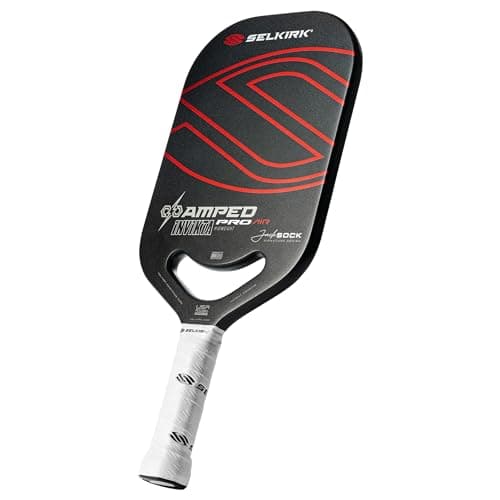 Selkirk Amped Pro Air Invikta Reach + leverage in an elongated frame | The premium brand pick | 7.5 | $99.99 · View on Amazon #adPrice as of October 24, 2026 |
| 2 | 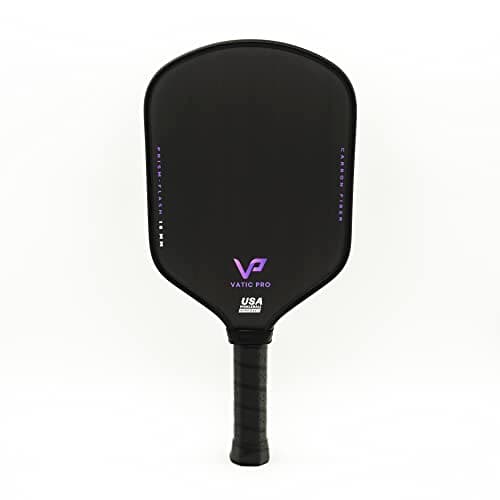 Vatic Pro Prism Flash 16mm The value spin champion (best under ~$110) | The value challenger | 8.0 | $99.99 · View on Amazon #adPrice as of October 24, 2026 |
Tap any row to jump to the full write-up. Prices are pulled live from Amazon.
Selkirk Amped Pro Air Invikta
Selkirk's elongated reach option — the Invikta shape gives real reach and leverage, with the open Air throat trimming swing weight.
The Invikta is one of the longest-standing elongated shapes in the sport, and the Amped Pro Air pairs that reach with Selkirk's open Air Dynamic Throat, which the brand says raises swing speed through the air. The FiberFlex+ fiberglass face and 16mm X5+ honeycomb core are tuned for balanced power and a large sweet spot rather than raw thermoformed pace, so it is a former-tennis-player favorite: leverage on drives, a long paddle face, and a quieter, more refined feel than the raw thermoformed crowd.
Selkirk is the closest thing pickleball has to an establishment brand: American manufacturing, a real warranty process, wide retail presence, strong resale value and a refined, quiet feel that the value field does not match. The Amped Pro Air Invikta is its elongated power option, and everything about owning it is easier than owning a direct-to-consumer paddle.
- Core
- 16 mm
- Shape
- Elongated
- Face
- FiberFlex+ fiberglass face over an X5+ honeycomb core
- Weight
- 7.8-8.2 oz
- Build
- Cold-pressed
- Gen
- Amped Pro Air
Manufacturer-listed as USA Pickleball approved. Approvals and delistings change — verify against the current USAP equipment list before tournament play (checked 2026-07).
Vatic Pro Prism Flash 16mm
The value-shopper's spin paddle: raw T700 carbon and a thermoformed build that punches well above its price.
Vatic built a reputation on giving you 90% of a $250 paddle for around a hundred bucks. The Prism Flash's raw T700 face grips for spin and the elongated frame adds reach — the paddle we recommend when 'best spin under $100' is the search.
Vatic Pro built its reputation on giving you the two things that actually change how the ball leaves the paddle — a raw Toray T700 carbon face and genuine thermoformed construction — at a fraction of premium money. On the specification that decides spin, it is arguably the better paddle. What you give up is everything that happens off the court.
- Core
- 16 mm
- Shape
- Elongated
- Face
- Raw Toray T700 carbon fiber
- Weight
- ~8.0 oz
- Build
- Thermoformed
- Gen
- Prism
Manufacturer-listed as USA Pickleball approved. Approvals and delistings change — verify against the current USAP equipment list before tournament play (checked 2026-07).
Side by side
| Spec | Selkirk Amped Pro Air Invikta | Vatic Pro Prism Flash 16mm |
|---|---|---|
| Shape | Elongated (Invikta) | Elongated |
| Core thickness | 16mm | 16mm |
| Face | FiberFlex+ fiberglass face | Raw Toray T700 carbon fiber |
| Construction | Not thermoformed | Thermoformed |
| Listed weight | 7.8-8.2 oz | ~8.0 oz |
| Our spin score | Good | Higher |
| Our power score | Comparable | Comparable |
| Retail presence & warranty | Broad, established | Limited, direct-focused |
Read that table without knowing the prices and you would struggle to guess which paddle costs more. That is the entire point of this comparison, and it is why the value bracket has become genuinely competitive rather than merely cheap.
Where Vatic Pro wins
The hitting surface.The Prism Flash uses a raw, unpainted Toray T700 carbon face — the same material family that sits at the top of measured spin charts. Selkirk's FiberFlex+ fiberglass face is textured and grips the ball well, but it is not the raw-carbon specialist surface, and our spin score reflects the gap. Since spin is overwhelmingly a face property, this is not a small point. Our carbon fiber vs fiberglass guide and how paddle spin works guide explain why the surface dominates.
Construction.The Vatic is thermoformed — heat-molded into a stiff unibody shell with foam-filled perimeter walls. The Selkirk is not. Thermoforming is the mechanism behind the modern power era, and on paper it is the more current build. The two land level on our power ranking, but by different routes: the Prism Flash fires the ball out of a stiff shell, while the Amped Pro Air leverages its drive out of the Invikta's length. Our thermoformed paddles guide covers the difference.
Price per unit of performance. This is the honest headline. If you rank the two paddles purely by what happens between the face and the ball, the value paddle is not several times worse, and on one axis it is better. Our paddle price guide breaks down where money actually goes in this category.
Where Selkirk wins
Everything that happens off the court. Selkirk has a warranty process you can actually reach, a service history, and a distribution network that means you can hold one before buying. Vatic Pro is a direct-focused brand with limited retail presence — demoing before purchase is unlikely, and if something goes wrong you have fewer options.
Resale value. Paddles get sold on. A used Selkirk moves quickly at a predictable price; a used value paddle from a smaller brand does not. If you are the kind of player who changes paddles every year, the effective cost gap is smaller than the sticker gap.
Finish and feel. This is subjective but consistent: Selkirk paddles are quieter, more damped and better finished than the raw thermoformed field. Thermoformed paddles can feel loud and hollow. If you have hit both and preferred the Selkirk, that preference is real and worth paying for — it is not a placebo.
Durability confidence. Early thermoformed paddles across the whole industry developed a reputation for edge-foam cracking under heavy play, with the failure mode being a paddle that goes dead rather than one that snaps. Manufacturing has broadly improved, but a non-thermoformed paddle from a brand with a reachable warranty is the lower risk purchase — see our grit and durability guide.
Both are elongated — which is a shared limitation
These two paddles happen to share an outline, and it is a demanding one. Elongated frames buy reach and leverage at the cost of a higher, narrower sweet spot and slower head rotation in fast exchanges. If you have been losing hands battles at the kitchen line, neither of these paddles fixes that — a standard shape does.
Both brands sell one. Vatic's is the Prism V7, and Selkirk's range includes standard-shape options alongside the Invikta line. Our elongated vs standard shape guide covers the decision, and it is more consequential than the brand choice for most club doubles players.
Who should buy which
- You are upgrading from a starter paddle and money is tight: Vatic Pro. You are buying the change that actually matters — raw carbon and thermoforming — and spending the difference on court shoes, which will do more for your results than any paddle upgrade at this stage.
- Spin is the weakness you are fixing: Vatic Pro. The raw T700 face is the better surface for that job, full stop.
- You want to demo before you commit: Selkirk. You can find one in a shop; you generally cannot find a Vatic.
- You play tournaments and cannot risk equipment failure: Selkirk. Warranty access and a backup you can buy locally are worth real money in that context.
- You change paddles often: Selkirk, once resale is factored in.
- You disliked how a thermoformed paddle felt: Selkirk. The damped, non-thermoformed character is exactly what you are after, and no value thermoformed paddle will give it to you.
The option neither brand wants you to consider
There is a middle tier that beats both on the specific axis most buyers care about. The Six Zero Double Black Diamond sits between these two on price, uses the same raw T700 face as the Vatic, is thermoformed, and carries one of the widest engineered sweet spots in the category. It does not have Selkirk's retail presence or warranty depth, but it is a more forgiving paddle than either of the two here.
We compare that brand against both sides of this page in Six Zero vs Selkirk and Six Zero vs Vatic Pro, and it is the paddle we point undecided upgraders toward more often than either brand on this page.
The total-cost argument, honestly run
Sticker price is the wrong number for anyone who changes paddles more than once, and the gap between these two narrows considerably once you run the whole picture.
Resale. A used Selkirk moves quickly at a fairly predictable fraction of retail, because the brand has enough presence that buyers know what they are getting. A used value paddle from a direct-focused brand has a thinner market and a wider spread. If you sell on every year, the effective annual cost of the premium paddle is meaningfully lower than the sticker suggests.
Grit life. This cuts the other way, and it cuts hard. Every raw or textured carbon face polishes smooth with play, faster on abrasive outdoor courts with hard outdoor balls. That is a recurring cost on both paddles, and it is proportionally far more painful on the expensive one. A player replacing an inexpensive raw-carbon paddle when the bite fades may well spend less over two seasons than someone nursing a premium frame past its best surface. Our grit and durability guide works through the cost-per-session framing, and when a paddle is actually done covers how to tell.
Warranty. Hard to price, easy to underrate until you need it. If a paddle fails inside its warranty period, the Selkirk becomes considerably cheaper in retrospect and the Vatic becomes a support-ticket exercise.
Net: for a player who keeps a paddle until the face is gone, the value paddle wins the total-cost argument clearly. For a player who rotates paddles and sells them on, the gap is much smaller than it looks.
What hitting both would actually tell you
If you can borrow both — which is realistic for the Selkirk and unlikely for the Vatic, and that asymmetry is itself part of the comparison — here is what to pay attention to, because the obvious things will mislead you.
Ignore your first impression of power. A stiffer, louder paddle feels more powerful in a warm-up than it proves to be over a match, and the thermoformed Vatic will sound livelier than the non-thermoformed Selkirk regardless of how they actually compare on outcomes.
Test the reset, not the drive. Have someone drive at you and block ten balls with each paddle. That single drill separates these two more reliably than anything else, because damping is where the Selkirk earns its money and it is invisible in a warm-up rally.
Check the mishits deliberately. Hit a few balls off the throat and off the tip with each. You are looking for how much the paddle twists and how dead the ball goes, and the answer will tell you more about which paddle suits you than any spec on this page.
Then decide whether you can feel the difference at all. Plenty of players cannot, and there is no shame in it — if the two feel broadly equivalent in your hands, the cheaper one is the correct purchase and the money is better spent on court shoes.
The verdict
The premium is real, but it is not where most buyers assume. You are not paying Selkirk for a grippier face — you are paying for American manufacturing, a reachable warranty, retail availability, resale value and a refined feel. Those are legitimate goods, and for a tournament player or someone who wants to hold a paddle before buying it, they justify the gap comfortably.
For a club player upgrading a specific weakness on a fixed budget, they mostly do not. Vatic Pro gives you the raw carbon face and thermoformed build that change how the ball comes off the paddle, and the money you save covers a full kit of everything else you need. Start from our spin paddle roundup if grip is the goal, or our power paddles under $200 if pace is — and read our methodology for how we score without running a lab.
Is Selkirk worth the extra money over Vatic Pro?
It depends what you are buying. Selkirk gives you American manufacturing, a reachable warranty, retail availability, better resale value and a more damped, refined feel. Vatic Pro gives you a raw Toray T700 carbon face and thermoformed construction — the two things that most change how the ball leaves the paddle — for a fraction of the price. If spin is your goal and budget is tight, Vatic is the rational buy.
Which has more spin, Selkirk or Vatic Pro?
Vatic Pro, on our scoring. The Prism Flash uses a raw, unpainted Toray T700 carbon face, which is the material family that anchors the top of measured spin charts. Selkirk's FiberFlex+ fiberglass face is textured and grips well but is not a raw-carbon surface at all. Independent labs such as Pickleball Studio publish calibrated RPM comparisons.
Is Vatic Pro a reliable brand?
Vatic Pro has a strong reputation for build quality relative to price and a large following among value buyers. The honest caveats are structural rather than about the paddles: it is a direct-focused brand with limited retail presence, so you probably cannot demo one before buying, warranty support is thinner than a major brand's, and the resale market is smaller.
Should I buy a premium paddle as my first upgrade?
Usually not. The single biggest change most players feel is moving from a composite starter paddle to a raw-carbon thermoformed frame, and you can buy that in the value bracket. Spending the difference on court shoes typically does more for results at that stage than the gap between a good value paddle and a flagship.