What Paddles Do the Pros Use?
Four signature paddles you can actually buy, what the endorsement does and does not prove, and the one spec difference in the range that is worth more to you than any name on the throat.
Disclosure: Drive Dink earns a commission from qualifying Amazon purchases at no extra cost to you. We accept no free products and no paid placements — commissions never change our picks. How this works.
The honest verdict first: the paddle a professional plays is not quite the paddle you can buy, and the gap matters less than you think. What you can buy is the signature retail model — the frame a tour player's name is printed on, built to the specification the manufacturer sells. What a pro actually has in hand is usually that same frame, hand-selected from a production run for weight and balance and then modified with lead tape, a built-up grip, or both.
So "what paddle does Ben Johns use" has a true and useful answer — the JOOLA Perseus line, currently the Pro V — and an asterisk that nobody selling you one will mention. Below: the four signature models we carry, what the endorsement proves, what it does not, and the single spec difference in the range that is worth more to a normal player than any name on the throat.
Units we claim to have tested: 0,and we hold no tour credentials. Everything here is JOOLA's own published specification plus our editorial read of it. Prices come from our live layer and move daily.
JOOLA Perseus Pro V
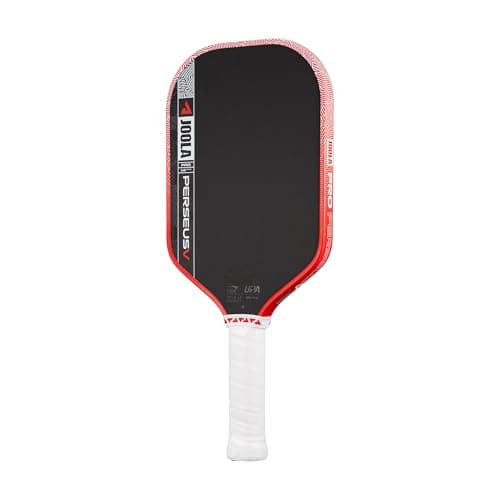
JOOLA's newest Perseus generation — a raw-carbon face for spin and a flexing KineticFrame throat over the familiar thermoformed power, offered in 14mm and 16mm.
Launched in March 2026, the Pro V changes the Perseus formula in two places: a raw-carbon hitting surface aimed at spin, and JOOLA's patent-pending KineticFrame, a slimmer throat built to flex on contact. It's the priciest paddle we cover; whether it's worth the jump over a Pro IV comes down to feel preference more than a spec gap.
The newest paddle carrying the Perseus name, launched in March 2026. JOOLA publishes a raw carbon-fiber hitting surface and its patent-pending KineticFrame - a slimmer throat built to flex on contact - over the familiar thermoformed 16mm hybrid platform at about 8.0 oz. It scores a 9 on both spin and power in our ratings. For the player who wants the most current generation of the most recognisable paddle in the sport, this is it, and it is the priciest paddle we cover. The cons deserve equal billing: whether it is worth the jump over a Pro IV comes down to feel rather than a spec gap, our own Pro IV vs Pro V comparison reads the change as a throat and face revision rather than a measurable upgrade, and a 7 on control means it asks the same thing of your soft game that every power flagship does.
- Core
- 16 mm
- Shape
- Hybrid
- Face
- Raw carbon-fiber texture
- Weight
- ~8.0 oz
- Build
- Thermoformed
- Gen
- Pro V (Gen 5)
Manufacturer-listed as USA Pickleball approved. Approvals and delistings change — verify against the current USAP equipment list before tournament play (checked 2026-07).
JOOLA Ben Johns Perseus Pro IV 16mm
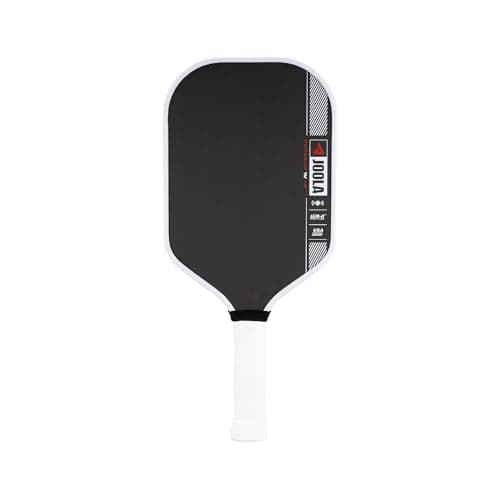
JOOLA's Gen-4 Perseus: thermoformed power and a grippy Charged surface, with the 16mm core adding forgiveness the 14mm gives up. Now the previous generation to the Pro V.
The Perseus Pro IV set the benchmark the rest of the power field chased, and JOOLA's March 2026 Pro V refines that formula rather than replacing it. The 16mm version trades a little raw pop for a larger, more forgiving sweet spot — the sensible pick if you want top-tier power without punishing off-center hits. Charged Surface Technology keeps spin high.
For the player who wants the signature platform and would rather spend the difference on court time. The Perseus Pro IV 16mm is the generation that set the benchmark the rest of the power field chased: a thermoformed Gen-4 frame, a Charged carbon-fiber Tech-Flex surface, 9s on spin and power, and a 16mm core that keeps a forgiving sweet spot where the 14mm gives one up. It sits at roughly half the Pro V's live price on our layer. If you came here because a pro's name sent you, this is the pick that gets you the most paddle for the money. The cons: it is explicitly the previous generation now, which matters to resale and to nobody else; a 7 on control; and thermoformed construction carries the delamination history that comes with the process.
- Core
- 16 mm
- Shape
- Hybrid
- Face
- Charged carbon-fiber surface (Tech-Flex)
- Weight
- ~8.0 oz
- Build
- Thermoformed
- Gen
- Pro IV (Gen 4)
Manufacturer-listed as USA Pickleball approved. Approvals and delistings change — verify against the current USAP equipment list before tournament play (checked 2026-07).
JOOLA Collin Johns Scorpeus Pro IV 16mm
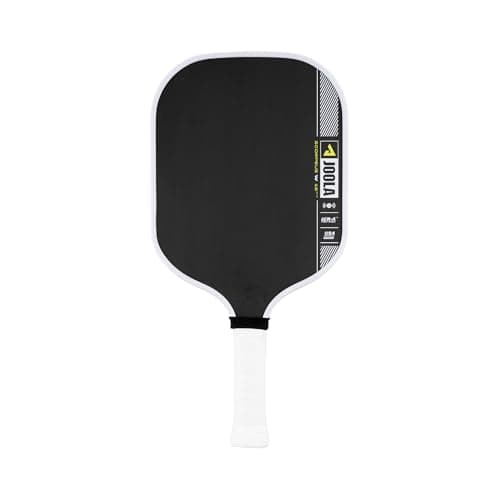
The standard-shape Perseus. A more balanced, control-leaning face for players who don't get on with elongated handles — and now the previous generation to JOOLA's Scorpeus Pro V.
Same Gen-4 tech as the Perseus in a standard shape, which brings the sweet spot lower and wider and makes hands battles easier to win. If you want JOOLA's power tech but prefer an all-court, control-first feel, this is the one. JOOLA launched a Scorpeus Pro V in its 2026 Pro V collection at roughly twice the Pro IV's current price; the change is a KineticFrame throat and a raw carbon face rather than a new spec sheet.
For the player who wants the pro platform in an outline that is not elongated. The Scorpeus Pro IV is the Perseus construction in a standard shape: thermoformed Pro IV frame, Charged carbon-fiber surface, 16mm core, and the only paddle in our catalog scoring a straight 8 on all four axes - spin, power, control and forgiveness. A standard shape puts the sweet spot lower and wider, where contact actually happens at the kitchen, and turns the head over faster in a speed-up. It is the most quietly sensible paddle in this list. The cons: you give up the reach and leverage the elongated Perseus buys on a stretch volley and an overhead, it is priced as a JOOLA flagship, and like the Perseus it is now the previous generation to a Pro V version.
- Core
- 16 mm
- Shape
- Standard
- Face
- Charged carbon-fiber surface
- Weight
- ~8.0 oz
- Build
- Thermoformed
- Gen
- Pro IV (Gen 4)
Manufacturer-listed as USA Pickleball approved. Approvals and delistings change — verify against the current USAP equipment list before tournament play (checked 2026-07).
JOOLA Simone Jardim Hyperion Pro IV 16mm
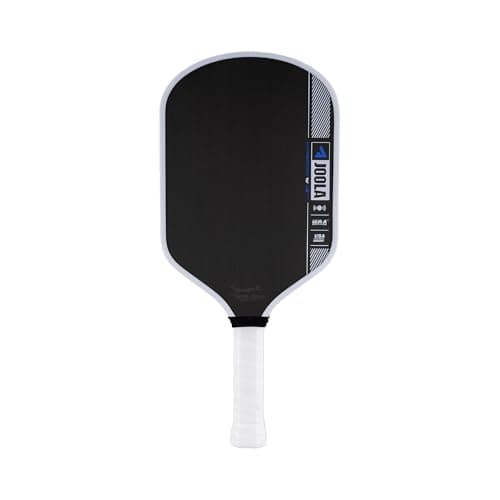
Spec-for-spec the 16mm Hyperion Pro IV with a 4 1/8in grip instead of 4 1/4in — the version to buy if your hand is between sizes.
A signature colorway is usually just paint, but here it changes a number that matters. Every published spec is identical to the Ben Johns 16mm — 16.5 x 7.5in, 5.5in handle, 16mm Propulsion honeycomb, Hyper-Foam Edge Wall, Textured Carbon Fiber face, 8.1 oz average — except the grip, which is listed at 4 1/8in rather than 4 1/4in. If you overgrip every paddle you own, that is the smarter starting point, because an overgrip adds roughly an eighth of an inch back.
For the player whose hand sits between grip sizes, which is a far better reason to buy this paddle than the name on it. Every published spec is identical to the Ben Johns 16mm Hyperion Pro IV - 16.5 x 7.5in, a 5.5in handle, a 16mm Propulsion honeycomb core, a Hyper-Foam Edge Wall, a Textured Carbon Fiber face and an 8.1 oz average - except the grip, which JOOLA lists at 4 1/8in rather than 4 1/4in. That eighth of an inch is the most useful difference in this entire range, because an overgrip adds roughly an eighth back: start at 4 1/8in and one overgrip lands you where you wanted to be. It scores a 9 on spin. The cons: it is a colorway, not a different paddle, so do not expect different performance; and like every Pro IV it gives up control to buy power.
- Core
- 16 mm
- Shape
- Hybrid
- Face
- Textured carbon-fiber surface (Tech Flex Power)
- Weight
- ~8.1 oz (7.9-8.3)
- Build
- Thermoformed
- Gen
- Pro IV (Gen 4)
Manufacturer-listed as USA Pickleball approved. Approvals and delistings change — verify against the current USAP equipment list before tournament play (checked 2026-07).
What a signature paddle actually proves
It proves a contract. That is not a cynical reading, it is the structure of the sport: professional players are sponsored, and the paddle on court is the paddle the sponsor makes. The useful inference is narrower than "this is the best paddle," and it is still worth something.
What you can reasonably conclude from a signature model: the frame is good enough that a top-level player can win on it, the manufacturer has quality control tight enough to be confident in a production run, and the construction is current rather than a clearance line. What you cannot conclude: that it suits your game, that it is the best value at its price, or that the pro has not quietly modified theirs.
The part that gets lost is that elite players adapt to equipment far better than recreational players do. A pro can win with a paddle that would cost you fifteen points a session, because their contact point is consistent enough that forgiveness barely registers. That is precisely why "the pros use it" is a weak buying argument for an intermediate player and why we rank on published specs instead — see our methodology.
The range, and how the names map to paddles
JOOLA's signature range is the one most readers are asking about, and the naming is less confusing than it looks once you separate the three axes.
| Name | Model line | Shape | Generation | Notable spec |
|---|---|---|---|---|
| Ben Johns | Perseus | Hybrid | Pro V (current), Pro IV | Pro V adds a KineticFrame throat + raw carbon face |
| Ben Johns | Hyperion | Hybrid | Pro IV, CFS | 16.5 x 7.5in, 4 1/4in grip, PBCoR .43 on the Pro IV |
| Collin Johns | Scorpeus | Standard | Pro IV, Pro V | Straight 8s across all four of our axes |
| Simone Jardim | Hyperion | Hybrid | Pro IV | Identical to the Ben Johns 16mm but a 4 1/8in grip |
Two things fall out of that table. First, Perseus and Hyperion are different platforms, not different paint — the Perseus is the one most people mean by "the Ben Johns paddle", and the head-to-head is on Hyperion vs Perseus. Second, the Jardim model is the Ben Johns Hyperion with one number changed, which is the most honest thing anyone can say about a signature colorway.
The grip difference is worth more than the signature
JOOLA lists the Simone Jardim Hyperion Pro IV at a 4 1/8in grip against the Ben Johns version's 4 1/4in. Everything else is published identically.
That eighth of an inch is genuinely useful, because it is almost exactly what one overgrip adds back. If you overgrip every paddle you own — most players do — buying the 4 1/4in version and wrapping it lands you at roughly 4 3/8in, which is a size up from where you meant to be. Starting at 4 1/8in and wrapping once puts you back at 4 1/4in. A grip that is too big is the quiet cause of a lot of arm trouble and a lot of lost hand speed; our grip size guide covers how to measure yours, and replacing a grip covers the stack.
Pro IV or Pro V — the generation question
JOOLA launched the Pro V collection in March 2026. The Pro V changes the Perseus formula in two places: a raw-carbon hitting surface and the patent-pending KineticFrame, a slimmer throat built to flex on contact. It is the priciest paddle we cover, at roughly double the Pro IV's current live price.
Our read, which we have not changed since the launch: it is a feel revision rather than a measurable spec upgrade, and the Pro IV remains the better purchase for almost everyone. If you want the detail rather than the summary, it is on the Perseus core comparison and in our Pro V review. The same logic applies to the Scorpeus: JOOLA sells a Pro V version at roughly twice the Pro IV's price for a throat redesign and a face change.
What a pro's paddle cannot tell you about yours
Every paddle in this list is a power-first frame with a 7 on control in our ratings. That is not a coincidence — professional doubles is played at a speed where the paddle's job is to generate and survive pace, and the soft game is handled by hands that have hit ten thousand more resets than yours.
If the points you lose are drops that sit up rather than drives that get blocked, a signature power paddle will make your week worse, not better, regardless of whose name is on it. Diagnose first: power vs control paddles is the five-minute version. And if the paddle you actually need is a standard shape or a widebody, the honest pick from this list is the Scorpeus, with our standard-shape roundup as the cross-brand comparison.
The bottom line
Buy the Pro V if you want the current generation of the sport's most recognisable paddle and the price is not the deciding factor. Buy the Perseus Pro IV 16mm if you want the same platform for roughly half the money, which is the pick we would make. Buy the Scorpeus Pro IV if you want the pro construction in a standard outline. And buy the Jardim Hyperion if your hand sits between grip sizes — which is a better reason than any of the others on this page.
What none of them will do is make you play like the person on the throat. If you want the version of that argument with the evidence attached, it is in do pickleball paddles actually matter.
What paddle does Ben Johns use?
The JOOLA Perseus line, which carries his name. The current generation is the Perseus Pro V, launched in March 2026 with a raw carbon face and JOOLA's KineticFrame throat; the previous Pro IV is still widely sold and costs roughly half as much on our live price layer. Note that tour players typically hand-select and modify their own frames with lead tape and grip build-ups.
Is the paddle a pro uses the same as the one you can buy?
It is the same model, usually not the same unit. Professionals commonly select a frame from a production run for weight and balance and then customise it with lead tape, a built-up grip or both. The retail signature paddle is the same construction and specification; what differs is the tuning.
What is the difference between the Ben Johns and Simone Jardim Hyperion Pro IV?
One number. JOOLA publishes identical specs for both — 16.5 x 7.5in, a 5.5in handle, a 16mm Propulsion honeycomb core, a Hyper-Foam Edge Wall and an 8.1 oz average — except the grip, listed at 4 1/8in on the Jardim against 4 1/4in on the Ben Johns. If you add an overgrip, the Jardim is the smarter starting point.
Should I buy a pro's signature paddle?
Only if the specification suits your game. Every signature frame in JOOLA's range is power-first and scores a 7 on control in our ratings, because that is what professional doubles demands. If the points you lose are drops that sit up rather than drives that get blocked back, a signature power paddle makes the problem worse.
Is the JOOLA Perseus Pro V worth it over the Pro IV?
For most players, no. The Pro V adds a raw carbon face and the KineticFrame throat at roughly double the Pro IV's current price, and our read is that the change is a feel revision rather than a measurable spec upgrade. The Pro IV 16mm remains the better value on the same platform.