Best Standard-Shape Pickleball Paddles
Almost every paddle marketed to upgrading players is elongated. If you keep getting beaten at the kitchen line, the outline is the spec to change — and these are the three non-elongated frames we can point you at.
Disclosure: Drive Dink earns a commission from qualifying Amazon purchases at no extra cost to you. We accept no free products and no paid placements — commissions never change our picks. How this works.
If you want one answer: the JOOLA Collin Johns Scorpeus Pro IV 16mm is the standard-shape paddle to buy, and it is for the upgrading player who loses more points at the kitchen line than off the baseline. It is the only paddle in our catalog that scores a straight 8 across spin, power, control and forgiveness, which is exactly what a balanced outline is supposed to produce. Buy the Vatic Pro Prism V7 instead if you want the same shape for value-tier money and can accept one point less power, and the Vatic Pro V-Sol Pro Bloom if your real problem is off-center contact — it is a widebody rather than a true standard, and we say so below.
Units we claim to have tested: 0. Picks are ranked on manufacturer-published construction and dimensions and on our editorial scores, compiled from those specs and the consistent reviewer record. Live Amazon prices render on every card below and move daily.
| # | Paddle | Best for | Score | Price |
|---|---|---|---|---|
| 1 | 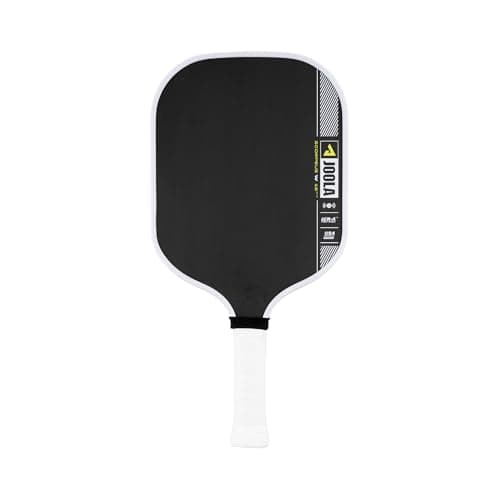 JOOLA Collin Johns Scorpeus Pro IV 16mm Standard-shape all-court control + spin | Best standard shape overall | 8.0 | |
| 2 | 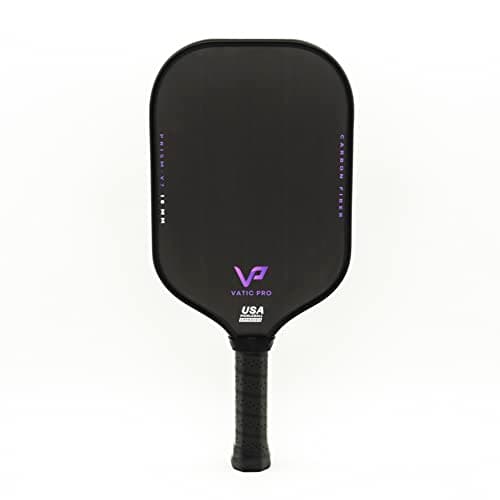 Vatic Pro Prism V7 16mm Value control in a standard shape | Best value standard shape | 7.8 | $99.99 · View on Amazon #adPrice as of October 24, 2026 |
| 3 | No image Vatic Pro V-Sol Pro Bloom 16mm Maximum face width and margin on mishits | Best widebody alternative | 8.5 |
Tap any row to jump to the full write-up. Prices are pulled live from Amazon.
JOOLA Collin Johns Scorpeus Pro IV 16mm
The standard-shape Perseus. A more balanced, control-leaning face for players who don't get on with elongated handles — and now the previous generation to JOOLA's Scorpeus Pro V.
Same Gen-4 tech as the Perseus in a standard shape, which brings the sweet spot lower and wider and makes hands battles easier to win. If you want JOOLA's power tech but prefer an all-court, control-first feel, this is the one. JOOLA launched a Scorpeus Pro V in its 2026 Pro V collection at roughly twice the Pro IV's current price; the change is a KineticFrame throat and a raw carbon face rather than a new spec sheet.
For the player who wants flagship Gen-4 construction without the elongated handle that comes with almost every flagship. The Scorpeus Pro IV is the Perseus platform in a standard outline: a thermoformed Pro IV frame with a Charged carbon-fiber surface over a 16mm core, and it is the only paddle in our catalog scoring a straight 8 on all four axes - spin, power, control and forgiveness. That flat scorecard is the whole point of a standard shape. The sweet spot sits lower and wider than on an elongated frame, which is where most contact actually happens at the kitchen, and the shorter head turns over faster in a speed-up exchange. The cons are honest ones: you give up the reach and leverage an elongated frame buys on a stretch volley and an overhead, it is priced as a JOOLA flagship rather than a value paddle, and it is now the previous generation to JOOLA's Scorpeus Pro V - a KineticFrame throat and a raw carbon face at roughly twice the money, which our Perseus Pro IV vs Pro V comparison reads as a feel change rather than a measurable upgrade.
- Core
- 16 mm
- Shape
- Standard
- Face
- Charged carbon-fiber surface
- Weight
- ~8.0 oz
- Build
- Thermoformed
- Gen
- Pro IV (Gen 4)
Manufacturer-listed as USA Pickleball approved. Approvals and delistings change — verify against the current USAP equipment list before tournament play (checked 2026-07).
Vatic Pro Prism V7 16mm
The standard-shape Prism: the same value-carbon face in a more control-friendly, maneuverable body.
The V7 is the Prism for players who prefer a standard shape — a lower, wider sweet spot and quicker hands than the elongated Flash, at the same wallet-friendly price. A lot of paddle for the money on the control end.
For the player who is already convinced about the outline and does not want to spend flagship money to test it. The Prism V7 is Vatic Pro's standard-shape frame: thermoformed, 16mm, with a raw Toray T700 carbon face, scoring an 8 on spin, control and forgiveness with a 7 on power. In practice it is the Scorpeus one point softer on drives, which is a fair trade at the price and arguably the right trade if what you are buying a standard shape FOR is hands and resets. It is also the paddle we put at the top of our senior and tennis-elbow pages, so it is a known quantity on this site rather than a one-page pick. The cons: the lowest power score of the three here, a value-tier finish rather than a flagship one, and a thin stock grip most players build up with an overgrip.
- Core
- 16 mm
- Shape
- Standard
- Face
- Raw Toray T700 carbon fiber
- Weight
- ~8.0 oz
- Build
- Thermoformed
- Gen
- Prism
Manufacturer-listed as USA Pickleball approved. Approvals and delistings change — verify against the current USAP equipment list before tournament play (checked 2026-07).
Vatic Pro V-Sol Pro Bloom 16mm
The widebody V-Sol Pro — 16 x 8in, long handle only. The widest, most forgiving face in the line and the one to buy if off-center contact is the weakness you are fixing.
Bloom trades the V7's reach for width: Vatic lists it at 16 x 8in against the V7's 16.5 x 7.5in, which spreads the sweet spot sideways and raises twist weight — the spec that decides how much a paddle turns in your hand on an off-center ball. It ships in the 5.6in long handle only, so two-handed backhand players lose nothing by choosing it.
For the player whose actual weakness is off-center contact rather than head speed - and the honest caveat is that this one is widebody, not standard. Vatic lists Bloom at 16 x 8in against the V7's 16.5 x 7.5in, so the face gets wider instead of taller and twist weight rises, which is the spec that decides how much the paddle rotates in your hand on a ball struck away from the middle. It carries our joint-highest forgiveness score at 9 alongside a 9 on spin, wrapped around the full floating EPP foam core of the V-Sol Pro line. Buy it over the two standard shapes if your misses are wide rather than late. The cons are real: it ships in the 5.6in long handle only, Vatic publishes no molding method for the line, the full foam core has no multi-season durability record anywhere, and the listed 8.0-8.3 oz static weight wants lead tape for most players.
- Core
- 16 mm
- Shape
- Widebody
- Face
- Raw Toray T700 carbon fiber (heat-compressed texturing)
- Weight
- ~8.0-8.3 oz (listed)
- Build
- Not published
- Gen
- V-Sol (Gen 4 foam core)
Manufacturer-listed as USA Pickleball approved. Approvals and delistings change — verify against the current USAP equipment list before tournament play (checked 2026-07).
Why this page has three paddles and not ten
Because that is how many non-elongated frames we cover. Of the paddles in our registry, two are listed by their makers as a standard shape and one as a widebody; everything else is elongated or a hybrid. That is not an accident of our shopping — it is what the prosumer end of this market actually sells. Elongated frames photograph as serious, they put reach in a spec sheet, and almost every brand's halo paddle is built that way. If you want a standard shape at this tier you are shopping a short list, and padding this page with hybrids to reach a round number would make it longer and less useful.
So we have told you which is which. The Scorpeus and the Prism V7 are standard; Bloom is a widebody and is on the page because it solves the same problem from the other direction. If you want the full taxonomy — standard against elongated against widebody, and what each outline does to swing weight and twist weight — our paddle shape guide is the explainer this roundup sits on top of.
What the outline actually changes
A paddle's face area is capped by the rulebook: USA Pickleball limits combined length plus width to 24 inches, with a maximum length of 17 inches. Every manufacturer is therefore spending the same budget in different proportions. Make the paddle taller and it must get narrower. Make it wider and it must get shorter. There is no outline that is simply better — there is only which trade suits your game.
| What it decides | Standard / widebody | Elongated |
|---|---|---|
| Sweet spot position | Lower and wider — near the middle of the face | Higher and narrower — up toward the tip |
| Head speed at the kitchen | Faster — less mass out at the tip to turn over | Slower — more swing weight to accelerate |
| Reach on a stretch volley | Shorter | Longer — the reason the shape exists |
| Leverage on a drive or overhead | Less | More — mass further from your hand |
| Margin on an off-center ball | Higher twist weight, less rotation in the hand | Lower twist weight on a narrow frame |
| Two-handed backhand room | Set by the handle, not the head | Usually paired with a 5.5in+ handle |
Note the row that decides this for most people: head speed. Swing weight is the number that describes how hard a paddle is to accelerate, and moving face area down toward your hand lowers it without taking any mass out of the paddle. That is why a standard shape feels quicker even at the same listed 8.0 oz — our swing weight and twist weight guide works through the mechanism properly.
Who should actually switch outlines
Be specific about the symptom, because the outline fixes one kind of problem and not the others.
Switch to a standard shape if you are losing speed-ups. The honest test: in a hands battle at the kitchen, are you late? Not beaten by placement — late, as in the ball is past you before the paddle arrives. If that is the pattern, you are fighting swing weight, and a shorter head is a bigger fix than any amount of practice on a frame that is too slow for your reactions. Our paddles for hand speed page is the same argument taken further.
Switch to a widebody if your misses are wide. Different symptom entirely: the ball goes roughly where you aimed but the contact feels dead and the paddle twists in your hand. That is twist weight, and width raises it. The most forgiving paddles page ranks on exactly that axis.
Stay elongated if you are being passed, not out-handed. If the balls you lose are the ones you could not reach, a shorter head makes your week worse. Go to the elongated paddles page instead.
And one thing the outline will not fix: contact that is consistently high on the face. An elongated paddle rewards a player who finds the upper third; a standard shape moves the reward down toward the middle. If you have grooved high contact over years of tennis, the switch can feel worse before it feels better. Our paddles for former tennis players page covers that case, and our sweet spot guide explains where each outline puts it.
Standard, hybrid, and the marketing in between
One more complication worth naming, because it is where most buyers get misled. “Hybrid” is not a governed term. Manufacturers use it for any outline sitting between their own standard and elongated models, and the actual dimensions vary a great deal between brands. JOOLA lists the Perseus Pro IV and the Hyperion Pro IV as hybrids at 16.5 x 7.5in; Vatic lists the V-Sol Pro Flash as a hybrid at 16.3 x 7.7in. Those are not the same paddle shape, and neither of them is a standard shape.
So if you have decided the outline is your problem, do not shop the word — shop the two numbers. Length and width are published for most paddles at this tier, and a frame around 16.0 inches long or shorter is where the handling benefit actually shows up. Both standard picks here are inside that; Bloom is 16 x 8in, the widest face in the V-Sol line.
If the brand is what you are deciding rather than the shape, our best JOOLA paddles page covers the Scorpeus against its own stablemates, Perseus vs Scorpeus is the head-to-head between the elongated-ish and standard versions of the same platform, and Selkirk vs Vatic Pro covers the value end the Prism V7 sits in.
How we picked
We filtered the registry to paddles whose makers list them as a standard or widebody outline, then ranked on our editorial scores with a tie-break toward the flattest scorecard — because a balanced outline that produces a lopsided scorecard has not done its job. Scores are our assessment compiled from published specifications and the consistent reviewer record; we do not run a lab and do not claim to. Dimensions quoted are the manufacturers' own. Every listing was confirmed in the registry on October 11, 2026, and prices are pulled live rather than typed in. The full approach is on our methodology page.
The bottom line
Buy the Scorpeus Pro IV if you want the best standard-shape paddle we cover and flagship construction matters to you. Buy the Prism V7 if you want to test the outline without flagship money — that is the pick we would make for most readers arriving on this page, because the shape is the variable you are changing and the V7 changes it cheaply. Buy Bloom if, on reflection, your misses are wide rather than late. And if you are still not sure the outline is the problem at all, read how to choose a paddle before you spend anything.
If the widebody is what you actually wanted
Bloom is on this page as the widebody exception, and it is not the only one we cover. The 11Six24 Pegasus, the Selkirk Power Air Epic and the CRBN2 TruFoam Genesis are all genuinely wide frames, and all three are ranked against each other on our best widebody pickleball paddles page. Read that one instead of this one if your misses are wide rather than late — width raises twist weight, and twist weight is the spec that decides what an off-center ball costs you.
What is the best standard-shape pickleball paddle?
The JOOLA Collin Johns Scorpeus Pro IV 16mm. It is the Perseus platform in a standard outline and the only paddle in our catalog scoring a straight 8 on all four axes — spin, power, control and forgiveness. If you want the same shape for less money, the Vatic Pro Prism V7 gives up one point of power and little else.
What is the difference between a standard and an elongated pickleball paddle?
Face area is capped by the rulebook, so length and width trade against each other. A standard shape is shorter and wider: the sweet spot sits lower and nearer the middle of the face, swing weight is lower so the head turns over faster at the kitchen, and twist weight is usually higher. An elongated paddle is taller and narrower, which buys reach and leverage on drives and overheads at the cost of head speed.
Is a standard-shape paddle better for doubles?
Often, but not because of the format. Doubles at an intermediate level is decided at the kitchen line, and the specific thing a standard shape fixes is being late in a hands exchange. If the points you lose are speed-ups you could not get the paddle to in time, the outline is the right spec to change. If the points you lose are balls you could not reach, it is the wrong one.
Why do you only list three standard-shape paddles?
Because those are the non-elongated frames we cover — two listed as standard and one as widebody. The prosumer end of this market sells overwhelmingly elongated and hybrid outlines, so a standard shape at this tier is a genuinely short list. We would rather say that than pad the page with hybrids to reach a round number.
Is a widebody paddle the same as a standard shape?
No. A widebody is wider than a standard shape and usually shorter again — Vatic lists the V-Sol Pro Bloom at 16 x 8in against the Prism V7's 16.5 x 7.5in. Both are non-elongated and both raise head speed, but the widebody spends more of its area on width, which raises twist weight and the margin you get on an off-center ball.
Are standard-shape paddles legal for tournament play?
Yes, provided the specific model is on USA Pickleball's current approved list. Shape itself is governed only by the dimensional limits — 17 inches maximum length and 24 inches combined length plus width — which every paddle on this page is inside. Approvals and delistings change, so verify your exact model against the current USAP equipment list before tournament play rather than relying on a product listing or a review, including ours.