Power vs Control Paddles: Which Do You Actually Need?
Nobody sells a paddle labelled 'worse'. Power and control are the two ends of one trade, and the only question that matters is which end your own game is short of.
Disclosure: Drive Dink earns a commission from qualifying Amazon purchases at no extra cost to you. We accept no free products and no paid placements — commissions never change our picks. How this works.
The short version: buy the paddle that fixes the points you are actually losing, and if you cannot name those points, buy the all-court frame. "Power" and "control" are not two product categories built by two different kinds of engineer. They are the two ends of one trade-off, and every paddle in the sport sits somewhere on that line. A power paddle returns the ball's energy quickly; a control paddle holds onto it longer. Nothing does both maximally, because the same property — how far the core compresses on contact — governs both.
So the useful question is never "which is better". It is: when you lose a point, is it because the ball came back, or because your own shot missed? The first is a power problem. The second is a control problem. Below, the four specs that decide where a paddle sits, then a three-question diagnostic, then one paddle from each end — and the straight-8 all-court frame that is the right answer more often than either.
Units we claim to have tested: 0.Specs are the manufacturers' published figures; the 1-10 scores are our editorial read of them. Prices come from our live layer and move daily.
CRBN 3X X-Series Power 16mm
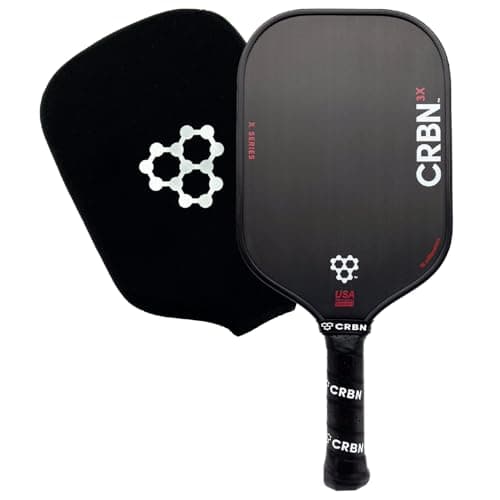
The X-Series elongated frame in its thick-core version — the CRBN to buy if you wanted the X-Series feel without the 14mm's small margin for error.
CRBN publishes a 16.5 x 7.5in elongated outline with a 5.25in handle, a 4.125in grip, a 7.8-8.1 oz range, a T700 Toray carbon surface, a foam-reinforced perimeter and a reinforced unibody with carbon running from face into handle. The core is offered at 14mm or 16mm and this is the 16: two extra millimetres that buy dwell and off-center margin and take a little pop away. CRBN names the core only as an "Upgraded Durable Core" and does not state the material, so neither do we.
For the player whose honest diagnosis is 'a bit of both', which is most people reading this. The CRBN 3X in its 16mm core is the only paddle in our catalog that scores a straight 8 on all four axes - spin, power, control and forgiveness - and a flat card is exactly what you want when you cannot name a single weakness. CRBN publishes a 16.5 x 7.5in elongated outline with a 5.25in handle, a 4.125in grip, a 7.8-8.1 oz range, a T700 Toray carbon surface, a foam-reinforced perimeter and a reinforced unibody. The thick core gives you dwell on resets; the elongated outline and thermoformed build keep real pace available on a drive. The cons: a straight-8 paddle is by definition best at nothing, the 5.25in handle is short for a two-handed backhand, and CRBN does not publish the core material, only calling it an 'Upgraded Durable Core'.
- Core
- 16 mm
- Shape
- Elongated
- Face
- T700 Toray carbon-fiber surface, foam-reinforced perimeter
- Weight
- 7.8-8.1 oz
- Build
- Thermoformed
- Gen
- X-Series
Manufacturer-listed as USA Pickleball approved. Approvals and delistings change — verify against the current USAP equipment list before tournament play (checked 2026-07).
JOOLA Ben Johns Perseus Pro IV 16mm
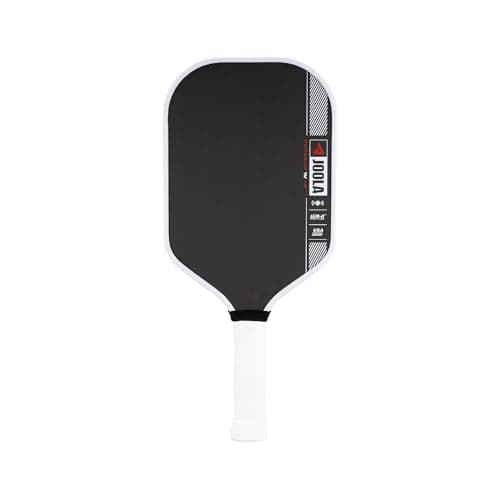
JOOLA's Gen-4 Perseus: thermoformed power and a grippy Charged surface, with the 16mm core adding forgiveness the 14mm gives up. Now the previous generation to the Pro V.
The Perseus Pro IV set the benchmark the rest of the power field chased, and JOOLA's March 2026 Pro V refines that formula rather than replacing it. The 16mm version trades a little raw pop for a larger, more forgiving sweet spot — the sensible pick if you want top-tier power without punishing off-center hits. Charged Surface Technology keeps spin high.
For the player whose points die because the ball comes back. The Perseus Pro IV in 16mm is the paddle the rest of the power field spent two years chasing: a thermoformed Gen-4 frame with JOOLA's Charged carbon-fiber surface, scoring a 9 on both spin and power. The 16mm core is the version we recommend over the 14mm because it keeps a forgiving sweet spot while giving up very little pop - power without the penalty box. If the honest answer to 'what loses you points' is that your drives sit up and your opponents reset everything you hit, this is the end of the market you need. The cons: a 7 on control, which you will feel on drops and resets until you adjust; flagship pricing; and it is now the previous generation to JOOLA's Pro V, which is a feel change rather than a measurable spec upgrade at roughly twice the money.
- Core
- 16 mm
- Shape
- Hybrid
- Face
- Charged carbon-fiber surface (Tech-Flex)
- Weight
- ~8.0 oz
- Build
- Thermoformed
- Gen
- Pro IV (Gen 4)
Manufacturer-listed as USA Pickleball approved. Approvals and delistings change — verify against the current USAP equipment list before tournament play (checked 2026-07).
Selkirk LUXX Control Air Invikta
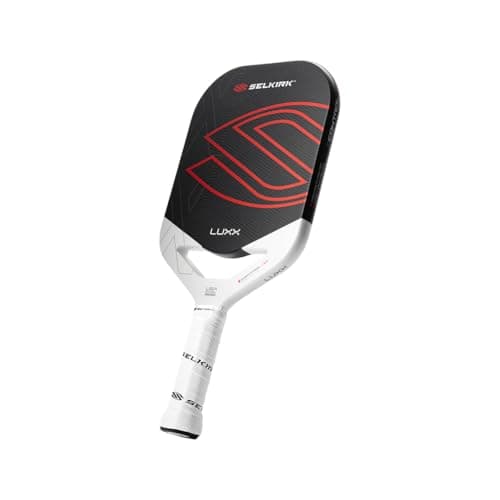
A thick-core, control-first paddle: a plush, soft-hands feel for dinking and resets, not a bomb-thrower.
The LUXX Control leans hard into touch — a thicker core and a muted face make the third-shot drop and the reset the strengths here. If your game wins on placement and hands speed rather than raw pace, this is the control end of the Selkirk line.
For the player who already generates plenty of pace and keeps spraying it. The LUXX Control Air Invikta runs a 20mm core - the thickest we cover by four millimetres - behind a Florek carbon face, in Selkirk's long-standing Invikta elongated outline at about 8.0 oz. It scores a 9 on control and a 9 on forgiveness, which is the softest, most absorbent card on the site. A core that thick compresses a long way on contact, so the ball sits on the face and goes where you aimed it, and incoming pace dies instead of rebounding. Buy it if your third-shot drops float and your resets pop up. The cons are the honest mirror: 7s on spin and power, so you will have to work for pace rather than borrow it; it is not thermoformed; and at 20mm the paddle feels genuinely different from everything else on the rack, which some players never get on with.
- Core
- 20 mm
- Shape
- Elongated
- Face
- Florek carbon face
- Weight
- ~8.0 oz
- Build
- Cold-pressed
- Gen
- LUXX
Manufacturer-listed as USA Pickleball approved. Approvals and delistings change — verify against the current USAP equipment list before tournament play (checked 2026-07).
The four specs that decide which end a paddle sits on
Marketing copy is useless here — every paddle claims both. These four published numbers are not.
1. Core thickness
The biggest single lever. A 13mm core returns energy fast: pop, pace, a ball that leaves before you can shape it. A 16mm core compresses further and holds the ball fractionally longer, which is what you feel as touch. A 20mm core, like the LUXX above, is at the far control end of what anyone builds. Everything else on this list is a smaller adjustment to the trade this one sets. Detail in 14mm vs 16mm.
2. Molding method
Thermoformed paddles are hot-pressed into a stiffer, more unified frame, which raises power and lowers the energy lost into flex. A cold-pressed frame is softer and generally more forgiving on feel. Selkirk largely declined to follow the thermoformed consensus, which is why its paddles read softer than their spec sheets suggest. See thermoformed paddles explained.
3. Shape
An elongated frame puts mass further from your hand, which is leverage: more power on a drive, more reach, and a slower head at the kitchen. A standard or widebody frame turns over faster and tolerates off-center contact better. Shape does not change the core's behaviour, but it changes how much speed you can generate with it. See elongated vs standard vs widebody.
4. Swing weight
How heavy the paddle feels while moving, which is not what the scale says. High swing weight drives the ball harder and arrives late in a hands battle. Low swing weight is quick and gives you less free pace. Very few makers publish it — CRBN publishes 118-120 for the TruFoam Waves, and that honesty is rare. See swing weight and twist weight.
The same four specs across the three picks
| Spec | CRBN 3X 16mm (all-court) | Perseus Pro IV 16mm (power) | LUXX Control Invikta (control) |
|---|---|---|---|
| Core | 16mm | 16mm | 20mm |
| Molding | Thermoformed | Thermoformed | Not thermoformed |
| Shape | Elongated | Hybrid | Elongated |
| Face | T700 Toray carbon | Charged carbon (Tech-Flex) | Florek carbon |
| Listed weight | 7.8-8.1 oz | ~8.0 oz | ~8.0 oz |
| Our power score | 8 | 9 | 7 |
| Our control score | 8 | 7 | 9 |
| Our forgiveness score | 8 | 8 | 9 |
Look at the last three rows together. The total is almost identical across the three paddles; what changes is the distribution. That is the trade-off made visible, and it is why "which is better" has no answer.
A three-question diagnostic
Think about your last three losing games — not your best day, your normal one.
Question one: when you drive, does the ball come back? If your opponents at the kitchen comfortably block and reset everything you hit from the baseline, you are not generating enough pace to force an error. That is a power problem, and a thinner core, a thermoformed frame or an elongated shape all address it. Start at the power roundup.
Question two: when you drop, does it sit up? If your third shot floats high enough to be attacked, or your resets fly past the kitchen, you have too much energy coming off the face and not enough dwell to shape the shot. That is a control problem. Start at the control roundup.
Question three: is the answer "both, depending on the day"? Then your paddle is not your limiting factor and buying a specialist frame will cost you at one end to fix nothing at the other. Buy the all-court paddle, spend the difference on court time, and come back to this page when you can answer question one or two cleanly. Our does the paddle actually matter guide is the honest version of that argument.
The category the labels hide: forgiveness
Power and control get the shelf space, and for most intermediate players neither is the real problem. Forgiveness is — how much a paddle punishes you when contact lands away from the middle of the face. It is governed mostly by twist weight, which is a function of width, and it is nearly invisible in marketing copy because "more tolerant of your mistakes" is a hard thing to put on a box.
If your misses are wide rather than long or short, no amount of core thickness fixes them. The outline does. That is the whole argument of our widebody roundup and most forgiving paddles, and it is worth ruling in or out before you pick a side on this page.
Where spin fits
Spin is a face property, not a core property, which is why it sits outside this trade almost entirely. A raw Toray T700 carbon face grips the ball and generates rotation; a fiberglass-blend face does not, at any core thickness. That is why our Selkirk picks score 7 on spin while cheaper raw-carbon paddles score 8 or 9.
Practically, this means you do not have to trade spin for either power or control — you just have to buy a raw carbon face. The mechanism is in how paddle spin actually works, and the durability catch, which is that grit wears off, is in grit durability.
The bottom line
Power and control are not two shelves. They are one dial, and core thickness turns it. Before you buy, diagnose: the ball coming back is a power problem, your own shot missing is a control problem, misses out toward the edge are a forgiveness problem, and a ball that will not bite is a face problem. Each has a different fix, and a paddle that fixes one will usually make another slightly worse.
If none of the four descriptions is clearly yours, the all-court paddle is not a cop-out — it is the correct purchase, and the CRBN 3X's straight-8 card is what that looks like on a spec sheet. If you want the price-tier version of the same advice, start at how much a paddle should cost.
What is the difference between a power paddle and a control paddle?
How far the core compresses on contact. A power paddle returns the ball's energy quickly — usually a thinner core and a thermoformed frame — which produces pace. A control paddle holds the ball on the face fractionally longer, usually via a thicker core, which lets you shape drops and absorb incoming pace. They are two ends of one trade, not two separate technologies.
Should a 3.5 player use a power or a control paddle?
Skill rating is the wrong input. Diagnose the points you lose instead. If your drives get blocked back and reset all day, you need more power. If your third-shot drops float and your resets fly long, you need more control. If it is both depending on the day, buy an all-court paddle and spend the difference on court time.
Can a paddle be good at both power and control?
It can be good at both and best at neither. The CRBN 3X in 16mm scores a straight 8 across spin, power, control and forgiveness in our ratings, which is what a genuine all-court paddle looks like. What no paddle does is reach a 9 at both ends, because the same core property governs both.
Does a thicker core mean more control?
Generally yes, and it is the most reliable single spec to act on. A 16mm core gives more dwell than a 14mm, and a 20mm core like Selkirk's LUXX is at the far control end of anything built. The cost is pace: thicker cores give up power, which is exactly the trade you are choosing.
Is spin a power or a control feature?
Neither. Spin comes from the face, not the core, so you do not have to trade it against either. A raw Toray T700 carbon face generates far more rotation than a fiberglass-blend face at any core thickness, which is why some cheap raw-carbon paddles out-spin expensive fiberglass ones.