Do Pickleball Paddles Really Make a Difference?
Yes — but not in the way the marketing implies, and not evenly across the price range. Here is which specs change the ball's behavior, which change only the feel, and where the money stops buying anything.
Disclosure: Drive Dink earns a commission from qualifying Amazon purchases at no extra cost to you. We accept no free products and no paid placements — commissions never change our picks. How this works.
The verdict: yes, the paddle makes a real difference — and the single biggest difference available to you is almost certainly the one you have already bought. Moving from an entry-level fiberglass or composite paddle to a thermoformed paddle with a raw carbon face changes how the ball behaves in ways anyone can see inside one game. Moving from a good mid-tier carbon paddle to a flagship changes considerably less, and most of what it changes is which direction the paddle is biased rather than how good it is.
That is the shape of the answer, and the rest of this page is the evidence for it: which four specs measurably change the ball's behavior, which three specs change only how the paddle feels in your hand, and three paddles at three price points that show exactly what each step buys. If what you actually want is a budget rather than an explanation, our how much should a paddle cost guide is the companion page.
Units we claim to have tested: 0. Everything below rests on manufacturer-published construction, the published measurements of independent testers where they exist, and our own editorial scores compiled from both.
The four specs that change the ball
These are the ones with a physical mechanism behind them. If a paddle differs from your current one on these, the ball will behave differently.
1. Core thickness. The biggest single lever in a paddle. A thicker core compresses more, so the ball stays on the face longer, which gives you more influence over where it goes and takes pace off it. The cleanest demonstration on this site is one paddle sold in 14mm and 16mm versions, where our scores move two points on control and forgiveness with nothing else changed. See 14mm vs 16mm and dwell time explained.
2. Face texture. Spin is generated by the face gripping and shearing the ball, and a raw carbon surface grips substantially better than a smooth fiberglass or painted composite one. This is the difference most players notice first when they upgrade, and it is also the one that fades, because grit wears. See how spin actually works and grit durability.
3. Frame stiffness. A thermoformed unibody with foam-injected edge walls loses less energy to frame flex than a cold-pressed paddle with a glued-on edge guard, so more of that energy goes back into the ball. That is a genuine power difference with a genuine mechanism. See thermoformed paddles explained.
4. Swing weight and twist weight. How hard the paddle is to accelerate, and how much it rotates when you miss the middle. These decide whether you can get the paddle to the ball in time and what happens when your contact is imperfect — which, for most players, matters more than either power or spin. See swing weight and twist weight.
The three paddles below are the same four specs at three price points. Read them as a ladder rather than a ranking.
Ronbus R1 Pulsar
The budget thermoformed pick: raw T700 carbon and a real thermoformed build at a price that undercuts almost everyone.
Ronbus is the value-brand's value brand. The R1 Pulsar gets you a raw-carbon, thermoformed paddle for the least money of anything we cover — a smart first 'real' upgrade from a big-box starter paddle before you commit to a $200 frame.
This is the paddle that answers the question most honestly, because it is the cheapest one we cover that still has all four of the specs that actually matter. Thermoformed frame, 16mm core, raw Toray T700 carbon face, elongated outline - the same four structural decisions as paddles costing three times as much, scoring an 8 on spin and power with a 7 on control and forgiveness. If you are moving up from a fiberglass or composite paddle, THIS is the step where the ball visibly behaves differently: more bite on a topspin drive, more pop off a stiff shell, a longer pocket on a reset. Everything above this price point is refinement. The cons are the refinement you give up: our control and forgiveness scores sit two points below the mid-tier benchmark, the sweet spot is smaller, and a value-brand raw carbon face is a consumable that polishes smooth under heavy outdoor topspin.
- Core
- 16 mm
- Shape
- Elongated
- Face
- Raw Toray T700 carbon fiber
- Weight
- ~8.0 oz
- Build
- Thermoformed
- Gen
- Pulsar
Manufacturer-listed as USA Pickleball approved. Approvals and delistings change — verify against the current USAP equipment list before tournament play (checked 2026-07).
Six Zero Double Black Diamond 16mm
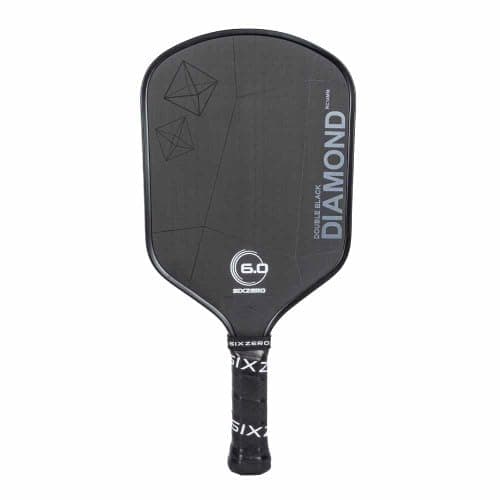
The internet's default 'do-it-all' recommendation: thermoformed power, a raw-carbon spin face, and a famously forgiving sweet spot at a fair price.
The DBD earned its reputation honestly. The 16mm Control build blends thermoformed pop with one of the most forgiving sweet spots in its class, and the raw T700 face grabs the ball for spin. It's the paddle we point undecided upgraders to first.
For the player who wants to know where the sensible ceiling is, this is our answer, and it is why we recommend it to more readers than any other paddle on the site. The 16mm Double Black Diamond is a thermoformed unibody with a raw Toray T700 face and the most complete scorecard we publish: an 8 on spin and power with a 9 on control and a 9 on forgiveness, the joint-highest forgiveness score in our catalog. What the step up from the value tier buys is specifically that - a bigger usable face and more margin when you miss the middle, which is a real and measurable difference you will notice in a game rather than in a spec sheet. What it does not buy is more power or more spin, and we are not going to pretend it does. The cons: the elongated outline swings heavier than a standard shape and turns over more slowly in a hands exchange, and the Gen 2 foam-wall construction has been edged past on mishit stability by the newest foam-core builds.
- Core
- 16 mm
- Shape
- Hybrid
- Face
- Raw Toray T700 carbon fiber
- Weight
- ~8.0 oz
- Build
- Thermoformed
- Gen
- Control (Gen 2 thermoformed)
Manufacturer-listed as USA Pickleball approved. Approvals and delistings change — verify against the current USAP equipment list before tournament play (checked 2026-07).
JOOLA Perseus Pro V
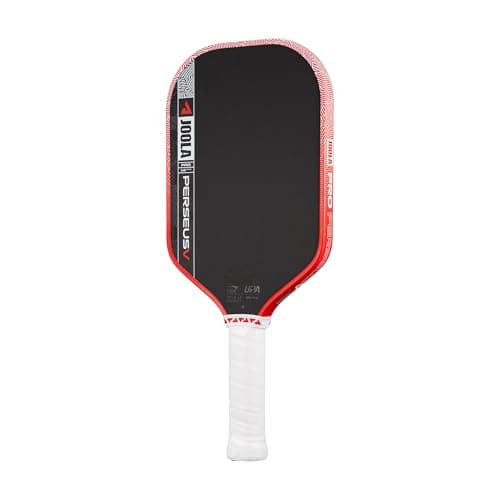
JOOLA's newest Perseus generation — a raw-carbon face for spin and a flexing KineticFrame throat over the familiar thermoformed power, offered in 14mm and 16mm.
Launched in March 2026, the Pro V changes the Perseus formula in two places: a raw-carbon hitting surface aimed at spin, and JOOLA's patent-pending KineticFrame, a slimmer throat built to flex on contact. It's the priciest paddle we cover; whether it's worth the jump over a Pro IV comes down to feel preference more than a spec gap.
Included so you can see what flagship money actually buys, which is the honest end of this question. The Perseus Pro V is JOOLA's current generation - a thermoformed hybrid frame with a raw carbon-fiber texture over a 16mm core, scoring a 9 on spin and power with a 7 on control and an 8 on forgiveness. Against the mid-tier benchmark above, it takes one point on spin and one on power and gives up two on control and one on forgiveness. That is not a better paddle in general. It is a paddle positioned further toward pace, built to a higher standard of finish and consistency, and sold at the top of the market. Buy it if pace is specifically the weakness you are fixing and you want the newest generation while you do it. The cons are the price, the two points of control, and the simple fact that for most upgrading players the previous generation at a lower number is the better purchase.
- Core
- 16 mm
- Shape
- Hybrid
- Face
- Raw carbon-fiber texture
- Weight
- ~8.0 oz
- Build
- Thermoformed
- Gen
- Pro V (Gen 5)
Manufacturer-listed as USA Pickleball approved. Approvals and delistings change — verify against the current USAP equipment list before tournament play (checked 2026-07).
The things that do not change the ball
Equally worth knowing, because this is where a lot of money goes.
Brand, and pro endorsement.A professional's name on a paddle tells you who is paid to use it. It is not a specification, and the same construction appears under several brands at different prices. Our paddle brands guide covers who actually makes what.
Core material names. Almost every paddle in this market uses a polypropylene honeycomb core, and most of the proprietary names describe the same thing. Foam cores are a genuine departure — see Gen 3 and Gen 4 foam paddles — but “Propulsion” and the rest are largely branding over a shared material.
Static weight, on its own. Almost every prosumer paddle weighs between roughly 7.8 and 8.3 oz. What you feel is swing weight, which depends on where the mass sits — so two paddles at the same number on a scale can feel entirely different and a lighter paddle can feel heavier to swing.
Paint, edge colour and the year in the name. No mechanism, no difference.
Generation labels, mostly.“Gen 3” and “Gen 4” are industry shorthand rather than governed terms, and a brand's Gen 4 is not necessarily another's. Shop the construction described in the listing rather than the number.
Where the upgrade curve actually flattens
Here is the honest version of the price question, using our own scores for the three paddles above.
| Value tier | Mid tier | Flagship | |
|---|---|---|---|
| Example | Ronbus R1 Pulsar | Six Zero DBD 16mm | JOOLA Perseus Pro V |
| Thermoformed | Yes | Yes | Yes |
| Raw carbon face | Yes — Toray T700 | Yes — Toray T700 | Yes |
| Core | 16mm | 16mm | 16mm |
| Our spin score | 8 | 8 | 9 |
| Our power score | 8 | 8 | 9 |
| Our control score | 7 | 9 | 7 |
| Our forgiveness score | 7 | 9 | 8 |
| What the step up buys | The four specs that matter, at all | Control and forgiveness — a bigger usable face | Spin and power, at the cost of control |
Read the first three rows and then the last. All three paddles share the same three headline construction decisions. What separates them is execution and bias — and note that the flagship is not the best paddle in two of the four columns. It is a paddle tuned further toward pace, finished to a higher standard, and priced accordingly.
That is why the honest answer to “is an expensive paddle worth it” is: the first upgrade is transformative, the second is real, and the third is a preference you are paying a premium to express. Compare the live buy buttons on the three cards above — the actual gap between tiers moves week to week, and a previous-generation flagship at a mid-tier price is routinely the best value on this site.
Three things that matter more than the paddle
We sell paddles. We would still rather you knew this.
1. The grip. A handle that is the wrong size for your hand costs you more control than any spec difference between two good paddles, and fixing it costs less than a tube of balls. Our grip size guide and grip picks cover it.
2. The shoes. Being in position is worth more than any paddle, and a worn court shoe actively takes that away. See best pickleball shoes and when to replace them.
3. The state of the paddle you own. A worn face stops producing the spin you bought it for, and a delaminated core changes how the paddle plays entirely — and illegally. If your current paddle is two seasons old, the comparison you are making may not be the one you think. See when a paddle is worn out and delamination and core crush.
So what should you actually do?
If you are on a fiberglass or composite paddle: upgrade. This is the one step on the whole curve that is unambiguous, and the value tier is enough to get all of it.
If you are on a decent carbon paddle and winning at your level: do not upgrade for the sake of it. Identify the weakness first, then buy the spec that addresses it — how to choose a paddle is the diagnostic, and our spin, power and control roundups are organised by exactly that.
If you are losing to one specific shot: that is the best possible reason to buy a paddle, because the specs above map directly onto symptoms. Late at the kitchen means swing weight. Misses off-centre means twist weight. Drops sitting up means core thickness. Drives coming back means frame stiffness.
And if the answer turns out to be that you need a better third-shot drop rather than a better paddle, that is also a thing you can buy equipment for — see our ball machine drills.
Do pickleball paddles really make a difference?
Yes, but unevenly. Going from an entry-level fiberglass or composite paddle to a thermoformed paddle with a raw carbon face changes how the ball behaves in ways you can see inside one game. Going from a good mid-tier carbon paddle to a flagship changes much less, and most of what it changes is which direction the paddle is biased rather than how good it is.
Which paddle specs actually matter?
Four: core thickness, which decides how long the ball stays on the face; face texture, which generates spin; frame stiffness, which decides how much energy returns to the ball; and swing weight plus twist weight, which decide whether you can get the paddle there in time and what happens when you miss the middle. Everything else is feel or marketing.
Is an expensive pickleball paddle worth it?
The first upgrade is transformative, the second is real, and the third is a preference you pay a premium to express. On our own scores a flagship does not beat a good mid-tier paddle across the board — it wins on spin and power and gives ground on control and forgiveness. A previous-generation flagship at a mid-tier price is routinely the best value available.
Does the brand of pickleball paddle matter?
Not in itself. A professional's name on a paddle tells you who is paid to use it, and similar constructions appear under several brands at quite different prices. What matters is the construction described in the listing — thermoformed or not, core thickness, face material — which you can compare directly across brands.
Will a better paddle make me a better player?
It will remove a specific obstacle if you have one. If your drops sit up because the core is too thin, a thicker core fixes that; if you are late in hands battles, a lower swing weight fixes that. What a paddle cannot do is supply a shot you have not learned, and for most players the grip, the shoes and the condition of the paddle they already own matter more than the next model up.
What should I upgrade before the paddle?
The grip, if it is the wrong size for your hand — that costs more control than any spec difference between two good paddles and is the cheapest fix available. Then your shoes, because being in position is worth more than any paddle and a worn court shoe takes that away. Then check whether your current paddle's face has simply worn smooth.