Dwell Time, Explained
Every paddle review says a paddle has long dwell or a short pocket. Almost none of them tell you what dwell time is, what changes it, or why you cannot have it and power at the same time.
Disclosure: Drive Dink earns a commission from qualifying Amazon purchases at no extra cost to you. We accept no free products and no paid placements — commissions never change our picks. How this works.
Dwell time is how long the ball stays in contact with the paddle face. It is measured in milliseconds — a pickleball contact is somewhere around one to two thousandths of a second — and it is the single physical idea behind most of the vocabulary paddle reviewers use. A paddle with a long dwell time is described as having a pocket, a plush feel, or control. A paddle with a short dwell time is described as poppy, stiff, hot or powerful. Same property, different adjectives.
The reason it matters to a buyer is that dwell time is not a free variable. It trades against power almost directly, and once you understand why, most of the paddle market stops being confusing: you are not choosing between brands so much as choosing a position on one spectrum. This guide explains the spectrum, tells you which published specs move you along it, and then names three paddles that sit at the two ends and the middle.
What this page does not do: give you a number. Nobody publishes a measured dwell time for a consumer pickleball paddle — not the manufacturers, not the independent testers — so any millisecond figure you see attached to a specific model is an invention. We will tell you the direction and the mechanism, and we will not print a decimal we cannot source.
Selkirk LUXX Control Air Invikta
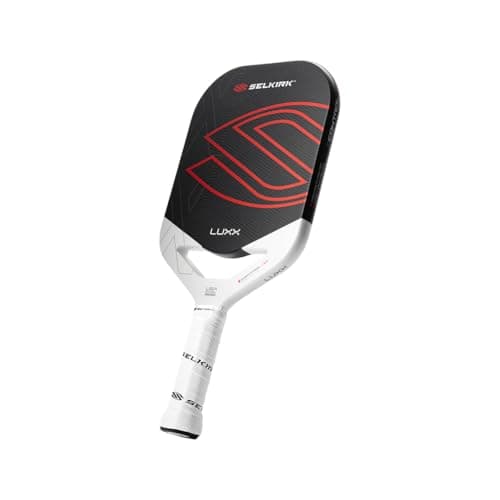
A thick-core, control-first paddle: a plush, soft-hands feel for dinking and resets, not a bomb-thrower.
The LUXX Control leans hard into touch — a thicker core and a muted face make the third-shot drop and the reset the strengths here. If your game wins on placement and hands speed rather than raw pace, this is the control end of the Selkirk line.
For the player who has read the explanation above and decided they want the most dwell we can point them at. The LUXX Control Air Invikta runs a 20mm core - thicker than anything else in our catalog, where 14mm and 16mm are the norm - behind a Florek carbon face, and the scorecard reads exactly as the physics predicts: a 9 on control and a 9 on forgiveness against a 7 on spin and a 7 on power. That is what maximum dwell buys and what it costs. In play it means resets, drops and blocks that stay down, and drives that need a real swing to produce pace because the paddle is not going to give you free speed. Buy it if your game is built at the kitchen and you are tired of balls popping off a stiff face. The cons are the mirror of the benefit: the lowest power score of the three paddles here, an elongated frame with more swing weight than a standard shape, and the highest price on this page.
- Core
- 20 mm
- Shape
- Elongated
- Face
- Florek carbon face
- Weight
- ~8.0 oz
- Build
- Cold-pressed
- Gen
- LUXX
Manufacturer-listed as USA Pickleball approved. Approvals and delistings change — verify against the current USAP equipment list before tournament play (checked 2026-07).
Six Zero Double Black Diamond 16mm
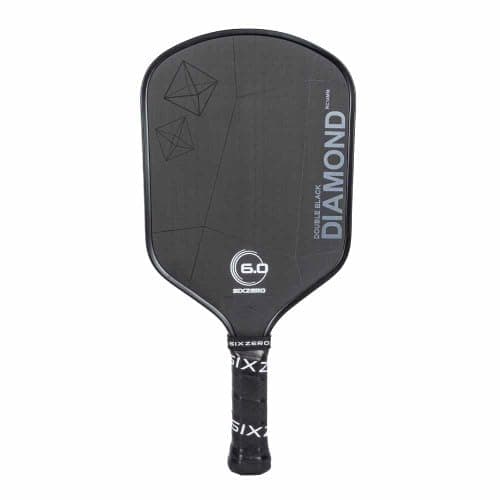
The internet's default 'do-it-all' recommendation: thermoformed power, a raw-carbon spin face, and a famously forgiving sweet spot at a fair price.
The DBD earned its reputation honestly. The 16mm Control build blends thermoformed pop with one of the most forgiving sweet spots in its class, and the raw T700 face grabs the ball for spin. It's the paddle we point undecided upgraders to first.
For almost everyone, and the paddle we point undecided upgraders to before anything else on this site. The 16mm Double Black Diamond is the answer to the question this guide raises - if more dwell means more control and less power, where is the sensible middle? A 16mm thermoformed unibody with a raw Toray T700 face scoring an 8 on spin and power with a 9 on control and a 9 on forgiveness: the most complete scorecard we publish, and the joint-highest forgiveness score in our catalog. It has enough dwell to reset under pressure and enough stiffness to finish a point, which is the combination most intermediate players actually need. The cons are honest: the elongated outline swings heavier than a standard shape and is slower to turn over in a hands exchange, the Gen 2 foam-wall construction has been edged past on mishit stability by the newest foam-core builds, and the raw T700 face is a consumable that polishes smooth under heavy outdoor topspin.
- Core
- 16 mm
- Shape
- Hybrid
- Face
- Raw Toray T700 carbon fiber
- Weight
- ~8.0 oz
- Build
- Thermoformed
- Gen
- Control (Gen 2 thermoformed)
Manufacturer-listed as USA Pickleball approved. Approvals and delistings change — verify against the current USAP equipment list before tournament play (checked 2026-07).
Six Zero Double Black Diamond 14mm
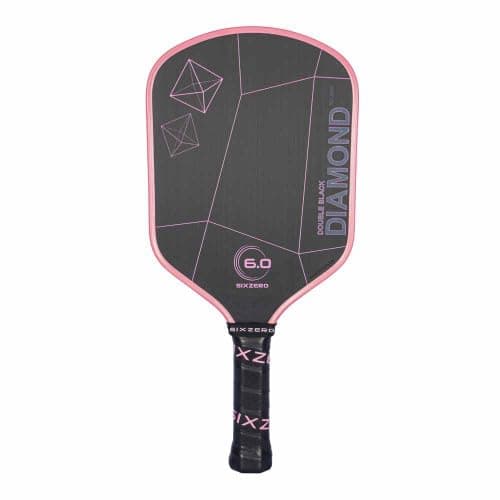
The 14mm DBD trades some of the 16mm's plush forgiveness for extra pace and a quicker, poppier response.
If you loved the DBD's spin and value but wanted more pop, the 14mm delivers it — faster through the air and livelier off the face, with a slightly smaller margin on off-center hits. A strong pick for aggressive all-court players.
Here as the cleanest controlled demonstration on this site of what dwell time does, and as the right buy for one specific player. It is the paddle above with 2mm taken out of the core: same raw Toray T700 face, same thermoformed shell, same elongated outline, same listed weight. Only the core changes - and our scores move from 8/8/9/9 to 8/9/7/7. Power up one, control down two, forgiveness down two. Nothing else in our catalog isolates the variable so cleanly, and it is why this guide can tell you that dwell time is mostly a core-thickness question rather than a brand question. Buy it if you are an aggressive all-court player who drives third shots rather than dropping them and whose contact is reliably centered. If you are not sure which side of that you are on, buy the 16mm.
- Core
- 14 mm
- Shape
- Hybrid
- Face
- Raw Toray T700 carbon fiber
- Weight
- ~8.0 oz
- Build
- Thermoformed
- Gen
- Control (Gen 2 thermoformed)
Manufacturer-listed as USA Pickleball approved. Approvals and delistings change — verify against the current USAP equipment list before tournament play (checked 2026-07).
Why a few milliseconds change your game
Think about what has to happen for you to place a reset drop six inches over the net. The ball arrives, deforms against the face, the face and core deform back, and the ball leaves. All of your influence over where it goes happens inside that window. A longer window means more of the shot is being shaped by the angle you are holding and the direction you are moving the paddle, and less of it is being decided by the raw collision.
That is the whole of the control argument, and it explains two things players notice but struggle to describe. First, why a softer paddle feels like you can aim. Second, why a stiff, poppy paddle punishes a half-committed block — the ball is gone before your hand has had any say in it, so a slightly wrong face angle becomes a ball four feet deep rather than a ball that drops.
Longer dwell also buys spin, though less than people assume. For the face texture to bite and shear the ball, the ball has to be in contact with it; more contact time is more opportunity. But face material and texture dominate here, which is why a 14mm and a 16mm version of the same paddle usually score identically on spin — the face did not change. Our how spin actually works guide covers that properly.
What actually changes dwell time
Four things, in rough order of how much they move it.
1. Core thickness — by far the biggest lever. A thicker core has more material to compress, so the ball sinks further in and takes longer to be pushed back out. This is why the 14mm-versus-16mm decision is the most consequential spec choice in a paddle purchase, and why 20mm paddles feel like a different category. The arithmetic is not subtle: 2mm out of a 16mm core is an eighth of the core.
2. Frame stiffness — the thermoforming question. A thermoformed unibody paddle with foam-injected edge walls is a stiff shell. A stiff shell loses less energy to frame flex, so more of it goes back into the ball, and it rebounds sooner. That is why thermoformed paddles are described as hot and why the same core thickness can feel quite different between a thermoformed frame and a cold-pressed one. Our thermoformed paddles guide covers the construction.
3. Core material and structure. Polypropylene honeycomb is the long-standing default and behaves predictably. The newer foam cores — EPP foam either filling the paddle or floating inside a perimeter ring — behave differently again, generally offering more mishit stability at a similar perceived softness. See our Gen 3 and Gen 4 foam paddles guide and the foam core roundup.
4. Where on the face you hit it. Underrated and worth knowing. The centre of the face has the most material free to deform around it; near the edge guard, the structure is stiffer and the ball leaves sooner. Part of what players call a small sweet spot is a dwell time that varies a lot across the face. Our sweet spot guide covers the related measurement.
What does not change it, despite the marketing
Face material.Raw carbon, Toray T700, charged carbon, fiberglass — these change grip and therefore spin, and they change how the paddle sounds. The face sheet is a thin layer under tension over the core; it is not where the ball's energy is being absorbed. Our carbon vs fiberglass guide and our T700 explainer cover what the face does do.
Static weight and lead tape. Adding tape to the edges changes swing weight and twist weight — how the paddle moves and how much it rotates on an off-centre ball. It does not meaningfully change how long the ball sits on the face. If someone tells you lead tape added dwell, what they added was stability, which feels similar and is not the same thing. See adding lead tape.
Grip and handle. Changes comfort and control of the paddle, not the collision.
Break-in.A paddle's feel does change over its life, but mostly through face wear and, in some cases, core degradation — which is not the same as a paddle breaking in to a longer pocket. Our break-in guide is sceptical for a reason, and delamination and core crush covers the failure that genuinely does soften a paddle — illegally.
The spectrum, with real numbers from our scorecards
The cleanest illustration on this site is one paddle sold in two core thicknesses, because everything except the core is held constant.
| Selkirk LUXX Control | Six Zero DBD 16mm | Six Zero DBD 14mm | |
|---|---|---|---|
| Core | 20mm | 16mm | 14mm |
| Relative dwell | Longest we cover | Middle | Short |
| Our control score | 9 | 9 | 7 |
| Our power score | 7 | 8 | 9 |
| Our forgiveness score | 9 | 9 | 7 |
| Our spin score | 7 | 8 | 8 |
| Face | Florek carbon | Raw Toray T700 | Raw Toray T700 |
Read the two DBD columns first, because they are the same paddle. Two millimetres of core moves power up one point and takes two points off both control and forgiveness. Spin does not move at all, because the face is identical — which is the cleanest possible demonstration that dwell time is a core property and spin is a face property. The full head-to-head is in our DBD 14mm vs 16mm comparison.
The LUXX column is a different paddle and a different brand, so it is not a controlled comparison — but it shows where the spectrum ends. A 20mm core with a 9 on control and a 7 on power is what the far soft end of this market looks like.
How to use this when you buy
Answer one question honestly: which half of the court are you losing on?
Losing the soft game. Your drops sit up, your resets float, your blocks fly long. You want more dwell: a thicker core, and if you are already on 16mm, look at 20mm. Start with our control paddle roundup and the 16mm picks.
Losing the hard game. Your drives come back, you cannot finish from the baseline, your opponents reset you comfortably. You want less dwell and a stiffer frame: a 14mm core, thermoformed. Start with power paddles and the 14mm picks.
Losing both, or not sure. Then you are not fixing a weakness, you are shopping, and the right answer is the middle of the spectrum — a 16mm thermoformed paddle. That is why the DBD 16mm is the default recommendation on this site and why how to choose a paddle starts there too.
One last caution. Dwell time is the explanation behind feel; it is not the only variable in a paddle. Swing weight decides whether you can get the paddle there in time, twist weight decides what happens when you miss the middle, and neither has anything to do with dwell. Our swing weight and twist weight guide is the companion piece, and how paddles are tested covers what the labs can and cannot measure.
What is dwell time in pickleball?
Dwell time is how long the ball stays in contact with the paddle face during a shot — roughly one to two thousandths of a second. It is the physical property behind most of the vocabulary reviewers use: a paddle with long dwell is described as having a pocket or plush feel, and one with short dwell is called poppy or hot.
Does longer dwell time mean more control?
Yes, and that is the main reason to care about it. The longer the ball is on the face, the more of the shot is shaped by the angle you are holding and the direction you are moving the paddle, and the less is decided by the raw collision. It is why a softer paddle feels like you can aim a reset and a stiff one punishes a half-committed block.
What increases a paddle's dwell time?
Core thickness is far and away the biggest lever — more material to compress means the ball sinks further in and takes longer to leave. After that: a less stiff frame (a cold-pressed build flexes more than a thermoformed unibody), the core material and structure, and hitting nearer the middle of the face, where more material is free to deform.
Does the face material change dwell time?
Not meaningfully. Raw carbon, Toray T700, charged carbon and fiberglass change grip and therefore spin, and they change how a paddle sounds, but the face sheet is a thin layer over the core rather than where the ball's energy is absorbed. The clearest evidence is that a 14mm and a 16mm version of the same paddle usually score identically on spin.
Can you add dwell time with lead tape?
No. Lead tape changes swing weight and twist weight — how the paddle moves and how much it rotates on an off-center ball. It does not change how long the ball sits on the face. The extra stability can feel similar to a softer paddle, which is where the confusion comes from.
What is a good dwell time in milliseconds?
Nobody publishes one. Neither the manufacturers nor the independent testers release a measured dwell time for consumer paddles, so a specific millisecond figure attached to a model is an invention. Shop the specs that drive it — core thickness and frame construction — rather than a number.