Pickleball Ball Machine Drills
A machine will happily feed you 500 balls you already hit well. These six drills target the shots that actually lose you games — with the settings each one needs.
Disclosure: Drive Dink earns a commission from qualifying Amazon purchases at no extra cost to you. We accept no free products and no paid placements — commissions never change our picks. How this works.
The verdict first: the drill that improves most intermediate players fastest is the backspin reset ladder, and most machines cannot feed it. A ball machine's default behavior is a flat or topspin feed at a fixed spot, which is a shot you rarely have to answer in a game. The shot you do have to answer — a floating, low-bouncing ball arriving at your feet in the transition zone — needs a machine with a backspin setting. If you already own a machine, that is the setting to go and find. If you are buying one, it is the feature to buy on.
What follows is six drills with the published machine settings each one needs, ordered by how much they transfer to a game rather than by how satisfying they feel. Then three machines from our registry that can actually produce them, and an honest note on which drills each one cannot run.
Units we claim to have tested: 0.Every machine capability named here is from the manufacturer's own published spec sheet. Where a maker publishes no figure — ball speed on the jbotsports, oscillation detail on the Tutor Plus — we say so rather than fill the gap.
The four machine settings the drills depend on
Before the drills, the vocabulary. Four published specs decide which drills a given machine can run, and they are the four to check against any listing.
1. Backspin. The single most valuable setting for intermediate drilling, and the least common. A backspin feed floats and bounces low, which is what a well-executed third-shot drop or a dipping reset does to you. Without it, you cannot drill the shot that most often decides a rally. Look for a maker that names topspin andbackspin, not just “spin”.
2. Minimum feed interval. The gap between balls. Two seconds is the normal floor and is fine for groundstrokes and drops. A one-second feed is a different drill entirely — it is the only way to train hands speed at the kitchen on your own.
3. Oscillation. Whether the ball arrives in a different place each time. A fixed feed lets you pre-set your feet, which is exactly the habit you are trying not to build. Random horizontal oscillation is the most useful version; a fixed two-line pattern is better than nothing.
4. Hopper size, and therefore your work-to-walk ratio. A 40-ball hopper at a 3-second feed is two minutes of hitting followed by five minutes of picking balls up. A 125-ball hopper changes the character of the session. This is the spec people regret ignoring.
The three machines below are the ones in our registry that publish the settings these drills require. Our full ball machine roundup covers the wider field, and are ball machines worth it is the page to read first if you have not decided to buy one at all.
Pickleball Tutor Plus (with remote)
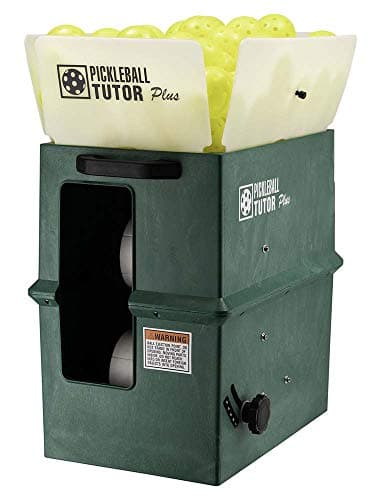
A single dial takes the feed from heavy topspin to heavy backspin, which is the fastest way to make a machine throw the shot you actually struggle against.
Sports Tutor lists 110 balls, speeds up to 65 mph, a feed as fast as one second for reaction volleys out to 10 seconds, and up to four hours per charge, with the remote included on this listing. The topspin and backspin dial is the reason to pick it: dialing in backspin gives you a floating, low-bouncing ball to practice resets and third-shot drops against, which most machines cannot reproduce.
If you are buying a machine FOR the drills on this page, this is the one, because it is the only machine we cover that publishes every setting the list needs. Sports Tutor lists 110 balls, speeds up to 65 mph, a feed as fast as one second out to 10 seconds, up to four hours per charge, and - the reason it leads - a single dial that takes the feed from heavy topspin to heavy backspin, with the remote included on this listing. That backspin dial is what unlocks the reset and third-shot-drop drills: a floating, low-bouncing ball is the shot you actually have to answer in a game, and most machines simply cannot produce one. The one-second feed covers the hands-speed drill at the other extreme. The cons are the obvious ones: it is a serious piece of money, it is heavier than the portable options, and Sports Tutor publishes no oscillation pattern detail for this listing, so plan your footwork drills around manual repositioning.
- Spec 1
- 110-ball capacity
- Spec 2
- Up to 65 mph, 1-10 s feed
- Spec 3
- Topspin/backspin dial, remote included
- Spec 4
- Up to 4 hr battery, built in the USA
Lobster Sports The Pickle
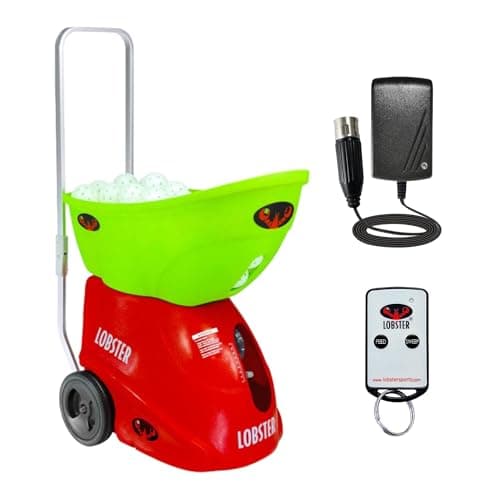
The lightest full-featured machine from the brand that has built ball machines the longest — 125 balls, real topspin and backspin, and 35 lb you can actually carry.
Lobster publishes a complete spec sheet for The Pickle and it reads like the sensible middle of the category: a 125-ball hopper, 10-60 mph, a 2-12 second feed, random horizontal oscillation, manual elevation from drive to lob, and 2-4 hours on a charge. At 35 lb it is the lightest machine here that still does spin and oscillation, which is what makes it the one most people will keep using.
For the player whose honest constraint is whether the machine makes it out of the trunk, and who still wants real drilling rather than a feeder. Lobster publishes a 125-ball hopper, 10-60 mph, a 2-12 second feed, random horizontal oscillation, manual elevation from drive to lob, and two to four hours on a charge - at 35 lb, which is the lightest machine we cover that still does both spin and oscillation. Random horizontal oscillation is the feature that matters most for drill transfer, because a ball arriving somewhere slightly different every time forces the footwork a fixed feed lets you skip. It will run five of the six drills below. The cons: the 2-second minimum feed is too slow for the hands-speed drill as written, the elevation is manual so lob work means walking over to the machine, and it is still a four-figure purchase.
- Spec 1
- 125-ball capacity
- Spec 2
- 10-60 mph, 2-12 s feed
- Spec 3
- 35 lb, 2-4 hr battery
- Spec 4
- Random horizontal oscillation, top/backspin
jbotsports JP-02 Pickleball Launcher
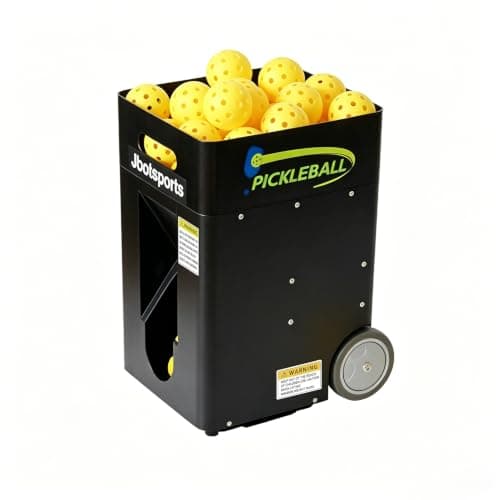
A 22 lb, app-and-remote launcher aimed at juniors and beginners — the entry point to the category, with the compromises that price implies.
jbotsports publishes a 40-ball hopper (80 with the extension panels), a 20-70 degree launch angle, 2-4 hours per charge, 22 lb carry weight and both remote and phone control, with adjustable topspin and backspin and a 2-line oscillation. What it does not publish is a ball-speed range, and the machine is explicitly built around gentler feeds — so treat it as a soft-game and reset trainer, not a drive machine.
For the player who wants the reset and dink drills and is not willing to spend four figures to get them. jbotsports publishes a 40-ball hopper (80 with the extension panels), a 20-70 degree launch angle, adjustable topspin and backspin, two-line oscillation, remote and phone control, and 22 lb carry weight with two to four hours of battery. Two of those matter for this page: adjustable backspin, which is what the reset drills need, and 22 lb, which is light enough that it actually gets used. Be clear about the limit, because it is a real one - jbotsports publishes NO ball-speed range and the machine is explicitly built around gentler feeds, so treat it as a soft-game and reset trainer rather than a drive machine. It will not run the hands-speed or deep-return drills properly. The other cons: the smallest hopper here, so more time picking up balls than hitting.
- Spec 1
- 40-ball hopper (80 with extension)
- Spec 2
- 20-70 degree launch angle
- Spec 3
- 22 lb, 2-4 hr battery
- Spec 4
- Remote + app, 2-line oscillation
The six drills
1. The reset ladder (backspin, 4-5 s feed, fixed)
Start at the kitchen line. Set the machine to a backspin feed at a moderate pace, aimed at your feet, with the slowest comfortable interval. Your job is a dead block that lands in the opposing kitchen — not a dink, not a counter, a reset. Hit ten. Then take one step back toward the baseline and hit ten more. Keep stepping back until you are at the baseline, then walk forward a step at a time doing the same thing.
Why this one leads: the transition zone is where intermediate points are lost, the shot required there is a soft absorption rather than a swing, and it is nearly impossible to practise with a partner because they cannot feed it consistently. A machine can. Pay attention to how much the shot changes between the kitchen and the mid-court — that change is the skill. A thicker-core paddle helps here for reasons our dwell time guide explains.
2. Third-shot drops from the baseline (backspin or flat, 5-6 s feed)
Machine at the kitchen line on the far side, feeding deep to your baseline. You hit a drop into the far kitchen, then move forward two steps as you would in a real point, and reset the ball the machine feeds next. The drill is the pair of shots, not the drop alone — a drop you follow badly is a drop you wasted.
Run twenty pairs. Count how many drops landed in the kitchen, not how many felt good. Most players discover their real number is well under half, which is the most useful thing a machine will ever tell you.
3. Hands speed at the kitchen (1-2 s feed, fixed, chest height)
This is the drill that needs a one-second feed and that most machines cannot run. Machine on the far kitchen line, flat feed at chest height, fastest interval the machine allows. Stand at your kitchen line with your paddle up in front of you and block or counter everything without taking a backswing.
Thirty seconds is a long set. The point is not the shot quality — it is the paddle position between shots, which is the thing that actually decides hands battles. If you are consistently late rather than inaccurate, that is a swing weight problem rather than a reaction problem, and our paddles for hand speed page is the equipment answer.
4. Deep serve returns (top speed, topspin, random oscillation)
Machine at its fastest comfortable setting with topspin, oscillation on, fed deep. You start behind the baseline, return deep and cross-court, and then move to the kitchen line as you would in a real point.
The oscillation is doing the work here. A fixed deep feed teaches you to stand in one place, which is the opposite of returning serve. If your machine does not oscillate, move it two feet between every set of five.
5. The transition-zone ladder (mixed depth, 4 s feed)
The hardest drill on this list and the one most worth the effort. Set the machine to alternate depth if it can — if not, run alternating sets of five deep and five short. Your job is to read each ball and make the right decision: drive the one you can attack, reset the one you cannot, and move forward on both.
Nobody wins this drill. It is a decision drill rather than a technique drill, and the outcome you are looking for is fewer wrong choices rather than better contact.
6. Lob and recover (high elevation, 6-8 s feed)
Elevation up, slow feed. You start at the kitchen line, back-pedal safely — turn and run rather than shuffling backwards — hit an overhead or a defensive lob, and recover to the kitchen before the next ball.
Most machines handle elevation manually, which means this needs to be its own block rather than mixed into another drill. Worth doing anyway: almost nobody practises this, and the back-pedal is the single most common way recreational players get hurt on a court.
Which machine runs which drill
| Drill | Needs | Tutor Plus | Lobster Pickle | jbot JP-02 |
|---|---|---|---|---|
| 1. Reset ladder | Backspin feed | Yes — backspin dial | Yes — top/backspin | Yes — adjustable backspin |
| 2. Third-shot drops | 5-6 s feed, deep | Yes — 1-10 s | Yes — 2-12 s | Yes |
| 3. Hands speed | 1-2 s feed | Yes — 1 s minimum | No — 2 s floor | No — gentle feeds only |
| 4. Deep serve returns | High pace + oscillation | Yes — up to 65 mph | Yes — up to 60 mph, random osc. | No — no published speed range |
| 5. Transition ladder | Varied depth | Manual repositioning | Manual elevation | 20-70 degree launch angle |
| 6. Lob and recover | High elevation | Yes | Yes — manual to lob | Yes — 70 degree max |
| Hopper | Work-to-walk ratio | 110 balls | 125 balls | 40 (80 extended) |
Every cell above is from a manufacturer's published spec sheet. The two “no” entries are the honest ones: the Lobster Pickle's feed interval floor of two seconds is too slow for the hands drill as written, and jbotsports publishes no ball-speed range at all for the JP-02 and describes it as built for gentler feeds, so we are not going to claim it returns serve.
How to structure a session
An hour, in four blocks, is more useful than two hours of whatever feels good.
10 minutes warm-up. Slow feed, mid-court, no targets. Hands first — see our note on that in the guide to playing with arthritic hands, which applies to everyone over about forty.
20 minutes on your worst drill. Not your favourite. If you do not know which it is, it is the transition ladder.
20 minutes on one technical shot. Drops or resets, counting outcomes rather than guessing at them.
10 minutes of hands or returns. Short, fast, finish there.
Two practical notes. Use the balls you play with, not whatever came in the box — a machine will happily feed an indoor ball onto an outdoor court and teach you a bounce that does not exist; our indoor vs outdoor balls guide covers the difference and how long balls last covers when to retire them. And machines eat balls faster than games do, so budget for that rather than drilling with cracked ones.
Finally, on volume: a machine makes it trivially easy to double your playing load in a week, and loading injuries do not care that you were practising. If anything in your feet, elbow or hands is already complaining, the machine is not the fix — see shoes for plantar fasciitis and paddles for tennis elbow.
What is the best ball machine drill for intermediate players?
The backspin reset ladder: a backspin feed aimed at your feet while you work from the kitchen line back to the baseline a step at a time, hitting dead blocks into the opposing kitchen. It targets the transition zone, where intermediate points are lost, and it is nearly impossible to practise with a partner because nobody can feed it consistently.
What machine setting matters most for drilling?
A backspin setting. It is the least common feature and the most valuable, because a floating, low-bouncing ball is what a good third-shot drop or dipping reset actually does to you — and that is the shot that decides rallies. Look for a maker that names topspin and backspin separately rather than just "spin".
Can you practise hands speed with a ball machine?
Only if the machine feeds faster than about two seconds between balls. A one-second feed at chest height from the far kitchen line, with you blocking everything without a backswing, is the closest thing to a real hands battle you can create alone. Most machines have a two-second floor and cannot run it.
How many balls should a ball machine hold?
More than you think. A 40-ball hopper at a 3-second feed gives you about two minutes of hitting followed by several minutes of picking balls up, which changes the session from practice to chores. A 110-to-125-ball hopper is the difference between drilling and tidying.
Does oscillation actually matter for drills?
Yes, more than most buyers expect. A fixed feed lets you pre-set your feet, which trains exactly the habit you are trying to break. Random horizontal oscillation forces real footwork; a fixed two-line pattern is better than nothing. If your machine does not oscillate, move it manually every five balls.
Which balls should I use in a ball machine?
The ones you play with. A machine will happily feed an indoor ball on an outdoor court and groove you into a bounce that does not exist in your games. Machines also wear balls out faster than play does, so plan on replacing them more often rather than drilling with cracked ones.