Are Pickleball Ball Machines Worth It?
It is the biggest single purchase in the sport after a court, and the honest answer depends on one thing: whether the machine is light enough that you will still be getting it out of the trunk in March.
Disclosure: Drive Dink earns a commission from qualifying Amazon purchases at no extra cost to you. We accept no free products and no paid placements — commissions never change our picks. How this works.
The short answer: yes if you have a weakness you can name, no if you do not.A ball machine is the most effective practice tool in the sport for one narrow job — repeating a single shot hundreds of times with a consistent feed — and it is dead money for anyone who would use it to hit a thousand comfortable forehands. If you can finish the sentence "my third-shot drop is unreliable" or "my backhand reset floats," a machine pays for itself in a season. If you cannot, spend the money on court time with a better player instead.
For most buyers the machine to get is the Lobster Sports The Pickle: full features at 35 lb, which is the lightest full-featured machine we have found and the reason people keep using it. If getting it out of the trunk is your real constraint, the Pickleball Tutor Mini; if you want to drill one specific shot, the Pickleball Tutor Plus and its spin dial.
What to look for — the five specs that decide it
1. Carry weight, which matters more than every other spec combined. The machines in this category run from roughly 22 lb to well over 40 lb, and the difference is not convenience — it is whether the machine gets used. A 45 lb machine plus a hopper of balls plus a paddle bag is a two-trip job, and a two-trip job becomes a once-a-month job. Read the published weight before anything else.
2. Oscillation, and what kind. A machine that fires at one spot teaches you to hit from one spot. Random horizontal oscillation makes you move to the ball, which is the point. Fully random three-dimensional feeding — horizontal and vertical — is better still and costs more. Fixed-aim machines are drilling aids for groove work only.
3. Hopper size against your pick-up tolerance. A 60-ball hopper is one standard pick-up basket and roughly four minutes of feeding at a 4-second interval. A 125-ball hopper is twice that. The number you care about is how long you get to drill before you spend three minutes gathering balls, because that ratio is what makes a session feel productive or tedious.
4. Spin control, if your weakness is the soft game. Topspin is common; genuine backspin is not. A backspin feed produces the floating, low-bouncing ball you face on a third-shot drop, and it is the one feature that lets a machine train the soft game rather than just drives and volleys.
5. Battery life against how you practise. Two hours is more than most sessions. Four is useful if you are drilling with a group or leaving it in a garage for a week between charges.
Three machines below clear that bar in different ways, with live Amazon prices. Our best pickleball ball machines roundup ranks the full field we cover, including the cheapest option in the category and the most capable.
Pickleball Tutor Mini
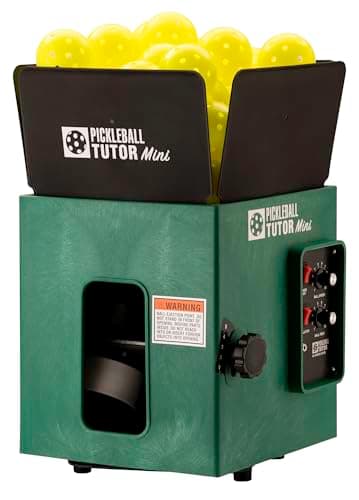
A stripped-back, US-built feeder that does the two things that matter — pace and placement — without the weight or the price of a full drill machine.
Sports Tutor publishes a 60-ball hopper (one standard pick-up basket), speeds up to 50 mph, a 2-10 second feed and up to three hours per charge, with manual elevation from groundstroke to lob. The Amazon listing is the random-oscillator version, so it moves the ball across the court rather than firing at one spot. It is the machine to buy if getting the thing out of the trunk is the deciding factor.
If the section above convinced you that the only machine worth buying is the one you will actually carry, start here. Sports Tutor publishes a 60-ball hopper - one standard pick-up basket - speeds up to 50 mph, a 2-10 second feed and up to three hours per charge, with manual elevation from groundstroke to lob. The Amazon listing is the random-oscillator version, so it moves the ball across the court rather than firing at one spot, which is the single feature that separates drilling from grooving. It is US-built, and Sports Tutor publishes no weight for it - the listing sells it on being carryable alone, and we are not going to invent a figure. The cons are the hopper, which means more interruptions to pick up, no spin control, and no remote - so you are walking back to the machine to change anything.
- Spec 1
- 60-ball capacity
- Spec 2
- Up to 50 mph, 2-10 s feed
- Spec 3
- Up to 3 hr battery
- Spec 4
- Random oscillator, manual elevation
Lobster Sports The Pickle
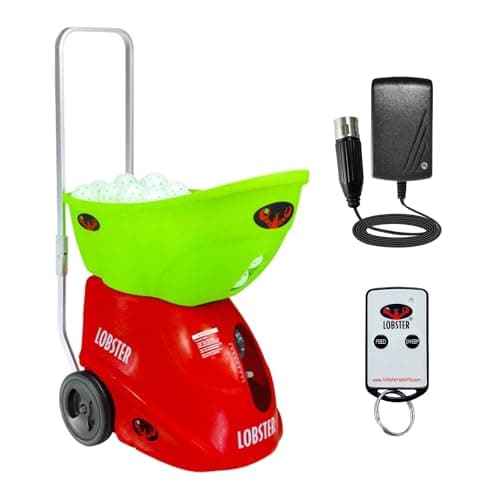
The lightest full-featured machine from the brand that has built ball machines the longest — 125 balls, real topspin and backspin, and 35 lb you can actually carry.
Lobster publishes a complete spec sheet for The Pickle and it reads like the sensible middle of the category: a 125-ball hopper, 10-60 mph, a 2-12 second feed, random horizontal oscillation, manual elevation from drive to lob, and 2-4 hours on a charge. At 35 lb it is the lightest machine here that still does spin and oscillation, which is what makes it the one most people will keep using.
The machine most people should buy, and the one most likely to still be in use a year later. Lobster publishes a 125-ball hopper, 10-60 mph, a 2-12 second feed, random horizontal oscillation, manual elevation from drive to lob, real topspin and backspin, and 2-4 hours on a charge - at 35 lb, which is the lightest full-featured machine we have found. That combination is the whole argument: it does everything a drilling session needs and it is light enough that getting it out is not a decision. Lobster has also been building ball machines longer than anyone in the category. The cons are that elevation is manual rather than electronic, there is no pre-programmed drill library, and 35 lb is still 35 lb up a flight of stairs.
- Spec 1
- 125-ball capacity
- Spec 2
- 10-60 mph, 2-12 s feed
- Spec 3
- 35 lb, 2-4 hr battery
- Spec 4
- Random horizontal oscillation, top/backspin
Pickleball Tutor Plus (with remote)
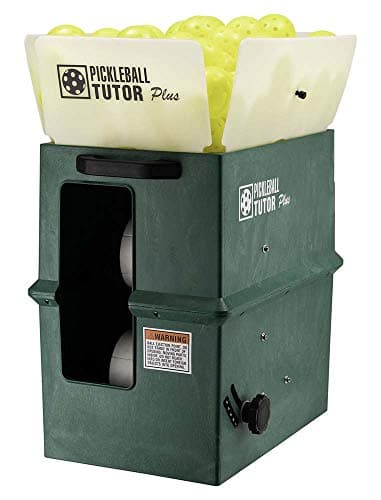
A single dial takes the feed from heavy topspin to heavy backspin, which is the fastest way to make a machine throw the shot you actually struggle against.
Sports Tutor lists 110 balls, speeds up to 65 mph, a feed as fast as one second for reaction volleys out to 10 seconds, and up to four hours per charge, with the remote included on this listing. The topspin and backspin dial is the reason to pick it: dialing in backspin gives you a floating, low-bouncing ball to practice resets and third-shot drops against, which most machines cannot reproduce.
Buy this one if you already know what you are bad at. Sports Tutor lists 110 balls, speeds up to 65 mph, a feed as fast as one second for reaction volleys out to 10 seconds, up to four hours per charge and the remote included on this listing. The reason to choose it over the Lobster is a single dial that takes the feed from heavy topspin to heavy backspin: dialling in backspin produces a floating, low-bouncing ball, which is the only way a machine can make you practise third-shot drops and resets against the shot you actually face. Most machines cannot reproduce it. The cons are that it is the priciest machine on this page, that Sports Tutor publishes no weight for it, and that the spin dial is a feature you will only value if your practice is specific.
- Spec 1
- 110-ball capacity
- Spec 2
- Up to 65 mph, 1-10 s feed
- Spec 3
- Topspin/backspin dial, remote included
- Spec 4
- Up to 4 hr battery, built in the USA
What a machine genuinely fixes
Repetition at a consistent feed. A human partner cannot feed you four hundred identical balls, and would not want to. A machine can, and that is what builds a stroke you can rely on under pressure.
The shot nobody will feed you. Everyone will rally with you. Nobody wants to spend forty minutes hitting low floaters at your backhand so you can practise resets. The machine does not mind.
Practising alone. The single biggest advantage. Court time is often available when partners are not, and a machine turns a free hour into a real session.
Footwork, if you set it up right. With oscillation on, every ball requires a split step and a move. With oscillation off, you are standing still — which is the mistake most new owners make for the first month.
What it cannot fix, and will quietly make worse
Reading an opponent. A machine telegraphs nothing and disguises nothing. The skill of picking up shoulder rotation and paddle angle before contact is the single biggest difference between a 3.5 and a 4.5, and a machine cannot teach any of it.
Decision-making. Every machine ball is a known ball. Match play is a sequence of choices under uncertainty, and that is trained by playing points, not by hitting feeds.
Bad technique. Four hundred repetitions of a flawed stroke is four hundred repetitions of a flawed stroke. A machine is an amplifier, which is why the most valuable thing most buyers can do is spend one lesson getting the mechanics checked before they start drilling. If you are unsure whether your gear is the problem instead, our how to choose a paddle guide is the cheaper place to look first.
The three, side by side
Manufacturer-published figures only. Where a maker does not publish a number, we say so rather than estimate.
| Machine | Hopper | Speed | Feed interval | Weight | Battery | Spin |
|---|---|---|---|---|---|---|
| Pickleball Tutor Mini | 60 balls | Up to 50 mph | 2-10 s | Not published | Up to 3 hr | No spin control |
| Lobster Sports The Pickle | 125 balls | 10-60 mph | 2-12 s | 35 lb | 2-4 hr | Topspin + backspin |
| Pickleball Tutor Plus | 110 balls | Up to 65 mph | 1-10 s | Not published | Up to 4 hr | Topspin/backspin dial |
The costs that are not on the listing
The purchase price is not the spend. Four things to budget for:
- Balls, by the dozen and then some. A 125-ball machine wants about 125 balls, and machine feeding is harder on balls than play is. Our pickleball balls page covers what to buy, and how long pickleball balls last covers the replacement cycle — it is the running cost of owning a machine.
- A ball hopper or tube. Picking up 125 balls by hand between hoppers is how a machine becomes a garage ornament.
- Court access you can monopolise. A machine needs a whole court and a tolerant venue. Public courts with a queue are usually not it, which is why a portable net and a driveway or a hired court matter more than owners expect.
- Shoes, because you will move more. A machine session is more lateral movement in an hour than most matches. Our court shoes page is the one to read, and why running shoes do not work explains the risk.
Cheaper things that do part of the job
Before a four-figure purchase, three alternatives are worth being honest about. A wall is free and genuinely excellent for hands, resets and dinks — the feed is fast and relentless, which is exactly what a kitchen exchange is; see our paddles for hand speed page for why that skill is worth training. A drilling partner is better than a machine for everything except repetition volume, and costs nothing but reciprocity. And one lesson often reveals that the shot you were about to drill four hundred times has a mechanical cause that no number of repetitions will fix.
Buy the machine when you have exhausted those and still cannot get the reps. That is the point at which it stops being a toy.
Who should buy one
Buy one if you practise alone by choice, if you have reliable access to a court you can take over, if you can name the shot you want to fix, and if you will be honest about carry weight. Those four conditions describe the owner who still uses the machine two years later.
Do not buy one if your practice time is already limited and shared, if the only courts near you have a queue, if you are hoping it will make the game more fun — it will not, it is work — or if the machine you are drawn to weighs more than you want to carry. The graveyard of this category is full of capable machines that were heavy.
If you are buying for someone else, this is a hard gift to get right for exactly those reasons — our gifts for serious players page has better-targeted options at every budget, and the Black Friday deals hub covers whether machines historically discount.
The bottom line
A ball machine is worth it when you have a specific, nameable weakness and nobody to feed you the shot that exposes it. It is not worth it as a general fitness or enjoyment purchase, and the model you should buy is almost never the most capable one — it is the lightest one that still oscillates and does the spin you need. For most buyers that is Lobster's The Pickle at 35 lb; for anyone whose real obstacle is the trunk, the Tutor Mini; for a player drilling resets specifically, the Tutor Plus. The full field, with prices pulled live, is on our ball machines page.
Are pickleball ball machines worth the money?
Yes if you can name the shot you want to fix and you practise alone; no if you would use it to hit comfortable rally balls. A machine's one real advantage is feeding hundreds of consistent repetitions of a shot no partner wants to feed you. It cannot teach you to read an opponent or make decisions under pressure, and it will happily reinforce flawed technique.
What is the most important spec on a pickleball ball machine?
Carry weight, by a wide margin. Machines in this category range from roughly 22 lb to over 40 lb, and the heavy ones get used less — a machine plus a hopper of balls that takes two trips from the car quietly becomes a once-a-month machine. After weight, the next most important feature is random oscillation, because a machine that fires at one spot teaches you to hit from one spot.
What size hopper do I need on a ball machine?
Work backwards from how often you want to stop. A 60-ball hopper is one standard pick-up basket and roughly four minutes of feeding at a 4-second interval; 125 balls is about twice that. The ratio of drilling time to ball-gathering time is what makes a session feel productive, so bigger hoppers matter more than most buyers expect — and you have to own enough balls to fill them.
Can a ball machine help my third-shot drop?
Only if it does genuine backspin. A backspin feed produces the floating, low-bouncing ball you actually face when dropping, and most machines cannot reproduce it — they do topspin and flat feeds. If the soft game is what you want to train, the spin dial is the feature to pay for rather than top speed.
What else do I need to budget for with a ball machine?
Enough balls to fill the hopper (machine feeding wears balls faster than play), a hopper or pick-up tube, court access you can monopolise for an hour, and decent court shoes, because a drilling session involves more lateral movement than a match. Those additions are a meaningful fraction of the machine's price.