Best Pickleball Nets (2026)
Almost every net on the market claims regulation size. The one that matters is whether it still measures 34 inches in the middle after an hour of play.
Disclosure: Drive Dink earns a commission from qualifying Amazon purchases at no extra cost to you. We accept no free products and no paid placements — commissions never change our picks. How this works.
Every net sold in this category says "regulation size" on the box, and most of them are telling the truth on the day you unpack it. The question that actually matters is whether it still measures 34 inches in the middle after an hour of play — because a sagging net quietly rewrites every dink, drop and passing shot you practice against it.
So we ranked these against the rulebook first and the feature list second. Four things separate one net from another: how it holds center height (a strap, a winch, a bungee-tensioned crossbar, or a catenary boom), frame and wind stability, portability — weight, wheels and setup time, which together decide whether the net gets used — and the surface it has to live on, since a gym floor, an outdoor court and a sloped driveway make different demands.
Live Amazon prices render above. Units we claim to have tested: 0.Every dimension and material below comes from the manufacturer's published material or from USA Pickleball's rulebook, and where a maker publishes no weight or warranty figure we say so on the pick instead of borrowing a retailer's number and presenting it as fact.
| # | Paddle | Best for | Score | Price |
|---|---|---|---|---|
| 1 | 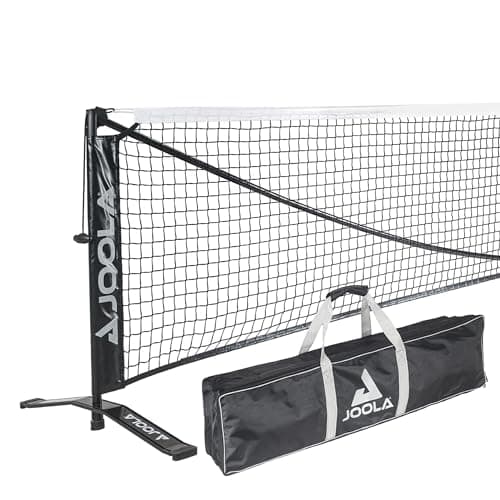 JOOLA Symmetry Portable Pickleball Net Best carry-to-court net from a major brand | Best carry-to-court net | — | $349.95 · View on Amazon #adPrice as of October 23, 2026 |
| 2 | 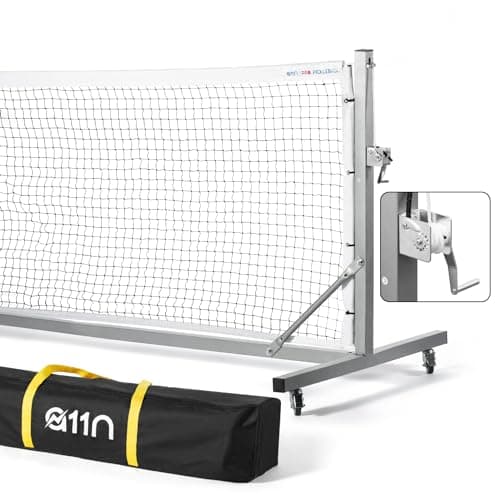 A11N Sports Pro Pickleball Net (wheels + hand winch) Best tension system for a home court | Best tension system | — | $179.99 · View on Amazon #adPrice as of October 23, 2026 |
| 3 | 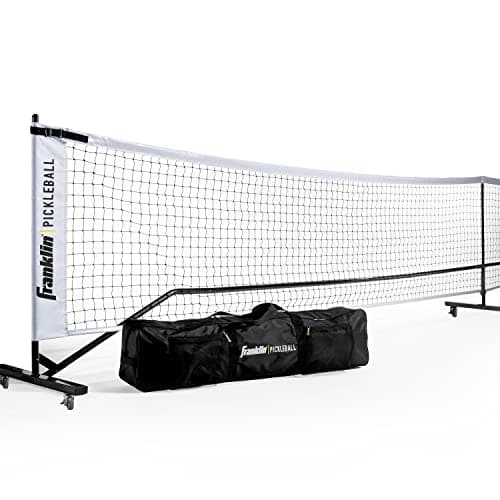 Franklin Sports Pickleball Net System with Wheels Best established-brand net for moving daily | Best established brand | — | |
| 4 | 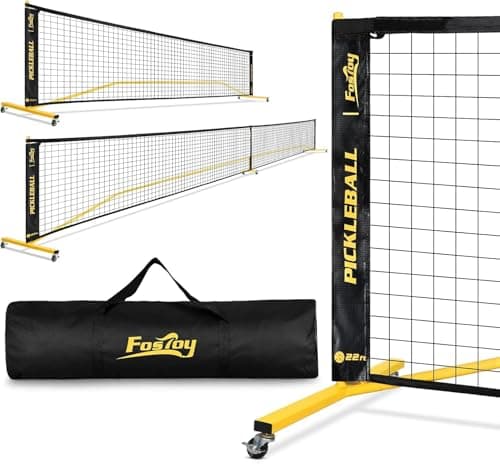 Fostoy Portable Pickleball Net Set with Wheels (22 ft / 11 ft) Cheapest net worth buying, for driveway play | Best budget | — | |
| 5 | 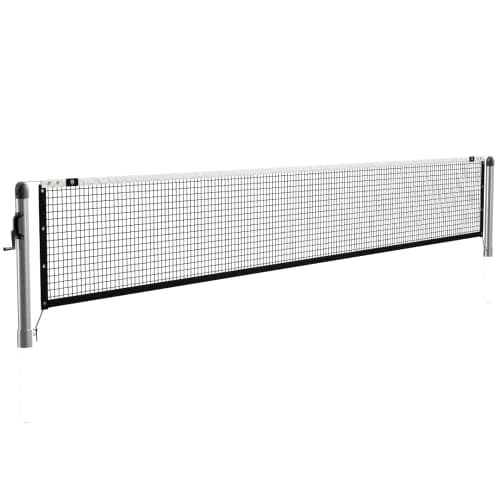 Dominator In-Ground Pickleball System (round posts) Best permanent installation for a dedicated court | Best permanent installation | — | $699.00 · View on Amazon #adPrice as of October 23, 2026 |
Tap any row to jump to the full write-up. Prices are pulled live from Amazon.
JOOLA Symmetry Portable Pickleball Net
A five-piece, shock-corded portable net with a tension lock that holds regulation height — the known-brand net you carry to a court in a bag.
JOOLA publishes a 22-foot regulation net at 36 inches on the sidelines and 34 at the center, a five-piece design whose support pole and posts are pre-connected by shock cord so there are no loose poles to lose, and a tension lock that keeps the top cord taut for setup and quick takedown. JOOLA lists it at under 28 lb, with a 3-to-5-minute assembly and a carrying bag, and notes a 2025 update with reinforced poles and connectors. No wheels, and JOOLA publishes no warranty term or frame-material specification for it.
The Symmetry is the portable pick for the player whose net travels in a bag rather than living on one court, and it earns the slot on two published details. First, it is a five-piece design whose posts and center support are pre-connected by shock cord, so there is nothing loose to lose and JOOLA's own assembly figure is three to five minutes. Second, a tension lock keeps the top cord taut, which is what holds the 34-inch center height through a session and makes takedown quick. It is the only net on this page from a brand most players already own something from. The cons are weight and what JOOLA does not publish. At under 28 lb by JOOLA's figure it is not a light net — roughly the same class as the Franklin — and there are no wheels, so it is carried, not rolled. JOOLA publishes no warranty term and no frame-material specification, which is thinner documentation than the winch and permanent systems below give you. If the net never leaves your home court, the A11N's winch and casters are the better buy for less money.
- Spec 1
- 22 ft, 36 in sidelines / 34 in center
- Spec 2
- Under 28 lb (JOOLA), carry bag, no wheels
- Spec 3
- 5-piece shock-corded design, tension lock
- Spec 4
- 3-5 min setup; no published warranty
A11N Sports Pro Pickleball Net (wheels + hand winch)
A hand winch you can re-tension in seconds, six locking casters and sand-bag ballast — the answer to a net that sags by the third game.
A11N publishes tournament-regulation dimensions, a thick powder-coated metal frame with wide bent legs for wind stability, six lockable caster wheels that roll on gym floors as well as outdoor courts, and a hand winch for adjusting net tension. Two empty bags are included so you can load sand for ballast. The warranty is split: 12 months on the posts, 6 months on the net itself.
If your complaint about every net you have owned is that it sags by the third game, this is the direct fix: a hand winch means re-tensioning the top cord takes seconds rather than a re-assembly. A11N pairs it with a thick powder-coated metal frame on wide bent legs for wind stability, six lockable caster wheels that roll on a gym floor as readily as on outdoor concrete, and two empty bags you fill with sand for ballast. For a net that lives on one court and gets moved to the side rather than packed away, this is the most practical configuration on the page. The cons: A11N publishes no system weight, so plan on a two-person lift into a car; the warranty is split 12 months on the posts but only 6 on the net itself, which tells you which part they expect to wear out; and the winch is one more mechanism that can seize if you leave it out in the weather all winter.
- Spec 1
- 22 ft, 36 in sidelines / 34 in center
- Spec 2
- Hand-winch tension system
- Spec 3
- 6 lockable caster wheels, sand-bag ballast
- Spec 4
- 12-mo post / 6-mo net warranty
Franklin Sports Pickleball Net System with Wheels
Steel frame, tool-free bungee assembly and lockable casters from the brand that supplies the sport's most-played ball — the safe default.
Franklin's 22-foot regulation system uses a crossbar with an internal bungee cord so the sections snap together without tools, and it rides on lockable casters you can free to roll the whole net off court between sessions. The carrying bag holds the complete system plus a dozen balls. Franklin does not publish a weight figure for it; retailers list it at roughly 29 lb with the bag, which makes it the heaviest of the portable options here.
Franklin makes the ball most of the country plays with, and this is the safe default net — the one you buy when you would rather not gamble on an unknown Amazon brand. The crossbar houses an internal bungee cord, so the sections snap together without tools and without a bag of loose hardware to lose, and the whole system rides on lockable casters. The carrying bag swallows the complete net plus a dozen balls, which is a genuinely useful detail for a club or a garage. The cons are weight and tensioning. Franklin does not publish a figure, but retailers list it at around 29 lb with the bag, making it the heaviest portable option here, and it relies on the top cord and frame geometry rather than a winch, so center height is something you check rather than something you crank back. It is a very good net that is beaten on both portability and tension by the two above it.
- Spec 1
- 22 ft, 36 in sidelines / 34 in center
- Spec 2
- Steel frame, internal-bungee crossbar
- Spec 3
- Lockable casters, tool-free setup
- Spec 4
- Bag stores the system + 12 balls
Fostoy Portable Pickleball Net Set with Wheels (22 ft / 11 ft)
One set of poles that builds either a 22-foot regulation net or an 11-foot half-court net — the sensible way into the category at driveway money.
The 2-in-1 configuration is the reason to buy this one: the same poles assemble as a full 22-foot net or an 11-foot half-court net, which is what most driveways and garages can actually fit. It rolls on locking wheels and packs into a carry bag. Fostoy publishes no frame gauge, system weight or warranty term for this configuration, so treat it as a recreational net and expect to re-tension the top cord more often than on the winch-equipped systems.
The cheapest net on this page that we would actually put in a driveway, and the 2-in-1 configuration is why. The same set of poles assembles as a full 22-foot regulation net or an 11-foot half-court net, and the half-court build is the one most driveways, garages and small backyards can genuinely fit — a fact the rest of the category tends to ignore. It rolls on locking wheels and packs into a carry bag. The cons are exactly what the price implies, and we would rather state them than bury them. Fostoy publishes no frame gauge, no system weight and no warranty term for this configuration, so we cannot tell you how it compares structurally; and because there is only one set of poles you choose 22 feet or 11 feet at setup, not both at once. Expect to re-tension the top cord regularly and treat it as a recreational net, not a tournament one.
- Spec 1
- 22 ft regulation or 11 ft half-court
- Spec 2
- Locking wheels, carry bag
- Spec 3
- One set of poles - build one size at a time
- Spec 4
- No published frame gauge, weight or warranty
Dominator In-Ground Pickleball System (round posts)
6061-T6 aluminum posts in concrete-set sleeves with an internal crank tensioner — the one option here that never needs setting up again.
Dominator publishes 6061-T6 aluminum round posts at 2.95 inches in diameter with a 5/32-inch wall, 53.5 inches long with 36 inches above ground, dropped into ground sleeves that are permanently set in concrete so the posts themselves can still be lifted out. Tension comes from an internal crank system, all hardware is stainless steel, and the kit includes the regulation net, sleeves and lacing rods. Posts are set 22 to 25 feet apart center to center.
At some point the right answer stops being a portable net. If you are pouring or resurfacing a court, Dominator's in-ground system is the version you never set up again: 6061-T6 aluminum round posts, 2.95 inches in diameter with a 5/32-inch wall, 53.5 inches long with 36 inches standing above ground, dropped into ground sleeves that are set permanently in concrete. Tension comes from an internal crank, all the hardware is stainless steel, and the kit ships with the regulation net, the sleeves and the lacing rods. Because the posts lift out of the sleeves, you can still clear the court for other uses. The cons are the obvious ones and they are not small: it is the most expensive option here, it requires concrete work and a correctly measured 22-to-25-foot post spacing before anything is playable, and once it is in, it is in. Do not buy this for a driveway you rent.
- Spec 1
- 6061-T6 aluminum, 2.95 in posts, 5/32 in wall
- Spec 2
- 36 in above ground, net 21 ft 9 in
- Spec 3
- Internal crank tensioner, stainless hardware
- Spec 4
- Concrete-set ground sleeves included
What the rules actually require
This is the useful starting point, because it turns a vague shopping decision into a measurable one. USA Pickleball rule 2.C sets the following:
- Post spacing (2.C.2): net posts should be 22 feet plus or minus 1.0 inch, measured from the inside of one post to the inside of the other.
- Net size (2.C.3): the net length should be at least 21 feet 9 inches from post to post, and the net should be at least 30 inches from its bottom edge to its top.
- Height at the sidelines (2.C.5): where the net crosses the sideline markers, the top of the net shall be 36 inches plus or minus 0.25 inch from the playing surface.
- Height at the center (2.C.5): at the point equidistant from both sidelines — 10 feet from each — the top of the net shall be 34 inches plus or minus 0.25 inch.
- Top edge (2.C.4): the top of the net should be edged with a 2-inch white tape binding over a cord or cable running through the binding.
- Material (2.C.1): any mesh fabric that will not allow a ball to pass through it.
Note the tolerance on the center height: a quarter of an inch. That is the number the whole category is really competing on, and it is the reason the picks above are ranked by their tensioning mechanism rather than by their marketing.
Center sag is the failure mode
A pickleball net is 22 feet of fabric hanging between two posts with a two-inch drop built into the middle by design. Gravity wants to make that drop bigger, and every net answers the problem in one of four ways.
A center strap is the traditional answer and the one the rulebook explicitly accommodates: a strap anchored to the ground at the center point, pulling the net down to exactly 34 inches. It works, it is cheap, and it puts a strap in the middle of your court.
A bungee-tensioned crossbar— Franklin's approach — runs an elastic cord through the frame sections so the whole assembly pulls itself tight and stays square. It makes setup fast and tool-free. What it does not give you is a way to add tension later in the session.
A hand winch— A11N's approach, and Dominator's in a permanent form — lets you crank the top cord back to tension in seconds, from the post, without disassembling anything. If you play on the same net several times a week, this is the feature that keeps it legal over months rather than days.
A shock-corded support with a tension lock— the Symmetry's approach — pre-connects the center support to the posts with shock cord and locks the top cord under tension at setup, so the height is set by the frame geometry and the lock rather than by a strap you keep adjusting. It is not a winch; you cannot crank it tighter mid-session, but there is nothing loose to lose and it goes up in minutes. (The one net we know of that removes the problem entirely with a sprung carbon-fiber boom, the Pickle-Ball SwiftNet 2.1, is not currently sold on Amazon under its own listing — see the FAQ below.)
None of these matters if the posts move. Which brings us to the frame.
Frame, wind and the surface underneath
Outdoors, the failure you will actually experience is not a snapped frame — it is a gust catching 22 feet of mesh like a sail and dragging the whole thing sideways. Wide, bent legs and ballast are the practical defenses, which is why the A11N ships with two empty bags for sand and why heavier steel systems feel more planted than light aluminum ones on a windy afternoon. If you play somewhere genuinely exposed, weight stops being purely a disadvantage.
Indoors, the requirement flips. On a hardwood gym floor you need non-marking, lockable casters, and you need them to lock properly, because a net that creeps six inches during a rally is worse than no net. Both wheeled systems here are specified for gym floors as well as outdoor courts.
On a driveway, the honest constraint is space, not stability. A full court is 20 by 44 feet, and a 22-foot net wants clear room on both sides of it. Most driveways cannot host that, which is exactly why the half-court configuration on the budget pick is a real feature rather than a compromise — an 11-foot net with a couple of players dinking across it is a genuinely good use of a two-car driveway.
How we picked
We started from rule 2.C and required that every net on the list state regulation dimensions, then ranked on how each one holds the center height over time, because that is the specification that degrades. Frame, ballast, wheels and setup time broke the ties.
Every figure we quote comes from the manufacturer's own published material or from the USA Pickleball rulebook. Where a maker publishes nothing — Fostoy on frame gauge, weight and warranty; A11N and Franklin on system weight; JOOLA on warranty and frame material — we say so on the pick. The one retailer-sourced number on this page (Franklin at roughly 29 lb with the bag) is labeled as such in its write-up rather than presented as a manufacturer spec. Every listing was confirmed live and in stock on September 3, 2026 (the JOOLA Symmetry on September 15, 2026, when it replaced a listing that had gone unavailable), and prices are pulled live rather than typed in. The same method runs through the rest of the site — our how paddles are tested guide sets out what we do and do not measure ourselves.
Portable, rolling or permanent — pick the category first
Most people shop nets by price and end up with the wrong type. The decision that matters comes first, and it is about where the net lives.
Portable means it goes in a bag and travels — to a public court, on a trip, into a closet. Here weight and piece count are the story: a five-piece net that goes up in three minutes gets brought, and one with a bag of loose hardware does not. Nothing else on the spec sheet matters if you stop bringing it.
Rolling means it lives at one venue and gets pushed aside rather than packed down. This is the configuration for a home court, a driveway that doubles as parking, or a gym. Casters and a re-tensioning mechanism matter; carry weight barely does.
Permanent means posts in concrete and a net that is simply always there. It is the cheapest option per year of use by a wide margin and the most expensive one on day one, and it only makes sense on a surface you own and have already committed to as a court.
What each price tier buys
Driveway tier. A steel-framed set with wheels and, ideally, a half-court option. Regulation dimensions on paper, no published frame specification, and a top cord you will re-tension often. Right for casual family play and for finding out whether you want a net at all.
Home-court tier. Heavier frames, real ballast options, locking casters and — at the top of this band — a winch. This is where most people who play at home several times a week should land, and both wheeled picks above sit here.
Tournament-portable tier. You are paying for a tensioning system that holds regulation height, a setup with no loose parts, and a brand name — not for low weight. Worth it if the net travels and the height has to be right every time.
Permanent tier. Aluminum posts, concrete sleeves, stainless hardware and a crank. Bought once, for a court that is not going anywhere. Current prices for every tier are live at the top of this page.
Who should buy which
You carry the net to a public court: the JOOLA Symmetry. Five shock-corded pieces and a three-to-five-minute setup is the combination on this page that survives contact with a parking lot and a real schedule — it is not light, but nothing about it can be left behind in the trunk.
The net lives on your home court: the A11N Pro. The winch is the feature you will use every month, and the sand bags are the feature you will be grateful for on the first windy day.
You want a known brand and fast, foolproof setup: the Franklin system. Bungee-linked sections mean there is nothing to lose and nothing to tighten, and the bag holding a dozen balls is a better detail than it sounds.
You have a driveway and a budget: the Fostoy 2-in-1. Build it at 11 feet, play cross-court dinks, and spend the difference on better balls — which will do more for the quality of your practice than a more expensive net would.
You are building an actual court: the Dominator in-ground system, and measure the 22-to-25-foot post spacing twice before anyone pours anything.
The rest of a home practice setup
A net on its own gives you somewhere to play. What turns it into practice is what you feed across it. If the point of the net is drilling rather than games, our pickleball ball machine picks cover the other half of that setup, and the two purchases are much better together than either is alone — a machine without a net trains contact but not clearance, and clearance is most of the third-shot drop.
Balls matter more outdoors than most people expect, because a net in a driveway usually means wind, and indoor and outdoor balls behave very differently in it. And the paddle is still where performance lives: if you are setting up to practice a specific weakness, start with how to choose a pickleball paddle so you are drilling with the right tool. The full kit is in our gear hub.
The bottom line
Decide where the net lives before you compare prices. A traveling net should be judged on weight and setup time, a home-court net on its tensioning mechanism and ballast, and a permanent net on materials and the quality of the installation. Those three questions have three different right answers, and the mistake almost everyone makes is answering the wrong one.
If you want a single recommendation: the JOOLA Symmetry if the net moves, the A11N Pro if it does not, and the Fostoy at half-court width if you are working out whether backyard pickleball is going to be a habit before you spend real money on it.
The number every one of these has to hold
Regulation height is 34 inches at the center and 36 at the sidelines over a 22-foot span — and the difficult part is not setting it, it is still measuring 34 inches in the third game. Our pickleball net height guide covers how to measure yours, why portable nets drift below spec, and which tension mechanisms actually do something about it.
What is the official pickleball net height?
USA Pickleball rule 2.C.5 sets the top of the net at 36 inches plus or minus 0.25 inch where it crosses the sideline markers, and 34 inches plus or minus 0.25 inch at the center point 10 feet from each sideline. Posts sit 22 feet plus or minus 1 inch apart, measured inside to inside.
Can I use a tennis net for pickleball?
Not at regulation. A tennis net is 42 inches high at the posts and 36 inches at the center, so it is two inches too high in the middle and much too high at the sides, and a tennis court is wider than 22 feet. It is fine for casual hitting and wrong for practicing anything that depends on clearance, which is most of the soft game.
Why do portable pickleball nets sag in the middle?
Because 22 feet of mesh hangs between two posts and gravity pulls the middle down past the 34-inch target. Nets answer this with a center strap, a bungee-tensioned crossbar, a hand winch, a shock-corded support with a tension lock, or a sprung tension boom. Only the winch lets you correct it mid-session without taking anything apart, and only the boom removes the problem structurally.
Do I need a full 22-foot net for a driveway?
Usually not, and trying to squeeze one in is the common mistake. A regulation court is 20 by 44 feet plus run-off. If your space cannot take that, an 11-foot half-court net used for cross-court dinking and drop practice is a better fit and a genuinely useful drilling setup.
Are portable nets allowed in tournaments?
Portability is not the test — compliance is. A portable net that holds 36 inches at the sidelines and 34 inches at the center within a quarter-inch tolerance across a 22-foot post spacing meets rule 2.C. Plenty of sanctioned events are played on portable systems. Check the event's own equipment requirements before assuming.
What happened to the Pickle-Ball SwiftNet 2.1?
It was our top portable pick until its Amazon listing went 'Currently unavailable' in September 2026. The SwiftNet 2.1 is still made by Pickle-Ball, Inc. and sold direct and through specialty pickleball retailers, so if you want the carbon-fiber tension-boom design it still exists — just not on Amazon under its own listing. The Douglas-branded SwiftNet that is on Amazon is a different SKU with different published specs at roughly double the price, so we do not recommend buying it there. Our current carry-to-court pick is the JOOLA Symmetry.
How long does a portable pickleball net take to set up?
Published setup times run from about two minutes for the lightest tool-free systems to roughly five for the larger wheeled frames. The bigger practical variable is whether the net has to be taken down again: a rolling system on locking casters is pushed aside in seconds, which is why setup time matters far less for a net that lives on one court.
- USA Pickleball — Official Rulebook, Section 2 (court and equipment, rule 2.C)
- JOOLA — Symmetry Pickleball Net product information
- Pickleball Central — SwiftNet 2.1 Portable Pickleball Net (still sold direct / specialty retail)
- A11N Sports — Pro 22ft pickleball net specifications
- Franklin Sports — pickleball nets
- Dominator — heavy-duty in-ground pickleball system specifications
- USA Pickleball — equipment standards