Pickleball Net Height, Explained
34 inches in the middle, 36 at the posts, 22 feet across. The number is the easy part — the hard part is a portable net that still measures 34 inches in the third game.
Disclosure: Drive Dink earns a commission from qualifying Amazon purchases at no extra cost to you. We accept no free products and no paid placements — commissions never change our picks. How this works.
Regulation pickleball net height is 34 inches at the center and 36 inches at the sidelines, measured from the court surface, over a 22-foot span. The two-inch difference is not a tolerance or a mistake — the net is designed to sag in the middle, because a top cord strung between two posts always will, and the rules simply specify where it should end up. If your net measures 36 inches all the way across, it is strung too tight for the design. If it measures 31 in the middle, it is strung too loose and the soft game you practise on it is not the soft game you will play in a league.
That is the whole rule. The useful part of this page is everything after it: how to measure your own net in thirty seconds, why portable nets drift below spec within a session, what the published tension mechanisms actually do about it, and the fact that net height is different in every dimension from tennis — which trips up a surprising number of people converting a court.
Units we claim to have tested: 0.Dimensions are from the USA Pickleball rulebook; every net specification quoted is the manufacturer's own published figure, and where a maker publishes no weight, warranty or frame gauge we say so rather than estimate.
The numbers, and how to check yours
| Dimension | Pickleball | Tennis (for comparison) |
|---|---|---|
| Height at center | 34 in | 36 in |
| Height at sidelines / posts | 36 in | 42 in |
| Net span | 22 ft (court width 20 ft) | Wider — 42 ft for doubles |
| Court size | 20 x 44 ft | 36 x 78 ft (doubles) |
| Center strap | Not used; sag is built in | Used, to pull the center down |
To measure yours: stand a tape measure on the court surface at the exact middle of the net and read the height of the top of the top cord. Not the tape binding, not the top of the mesh below it — the top edge. You want 34 inches. Then do the same within a few inches of each post; you want 36. Check it twice in a session, because the second reading is the one that tells you something.
What to do if it is wrong. Low in the middle only means the top cord needs tensioning. Low everywhere means the posts are leaning inward, which on a portable net usually means the legs are not fully extended or the ballast has shifted. High in the middle means over-tensioned — rare, and it makes dinks behave in a way nowhere else will.
The three systems below are the nets we cover, ordered by how well their published tension mechanism answers the sag problem rather than by price.
A11N Sports Pro Pickleball Net (wheels + hand winch)
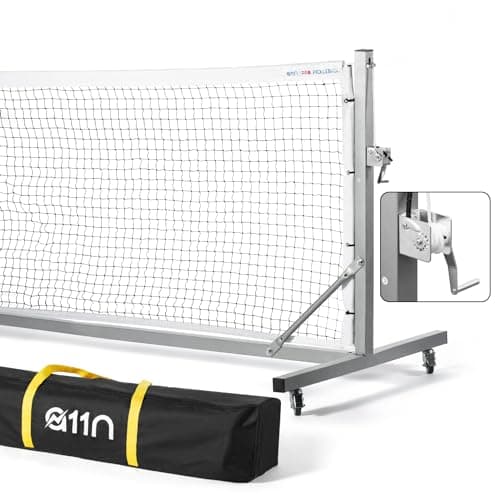
A hand winch you can re-tension in seconds, six locking casters and sand-bag ballast — the answer to a net that sags by the third game.
A11N publishes tournament-regulation dimensions, a thick powder-coated metal frame with wide bent legs for wind stability, six lockable caster wheels that roll on gym floors as well as outdoor courts, and a hand winch for adjusting net tension. Two empty bags are included so you can load sand for ballast. The warranty is split: 12 months on the posts, 6 months on the net itself.
If the problem you are solving is a net that measures 34 inches when you set it up and 32 by the third game, this is the fix - it is the only portable system we cover with a hand winch, which means you can re-tension the top cord in seconds without dismantling anything. A11N publishes tournament-regulation dimensions on a thick powder-coated metal frame with wide bent legs for wind stability, six lockable caster wheels that roll on gym floors as well as outdoor courts, and two empty bags you fill with sand for ballast. The winch is the whole argument: every other portable net on this page is tensioned once at setup and then does whatever it does. The cons are published and worth reading: the warranty is split at 12 months on the posts and only 6 months on the net itself, the frame is heavier than the carry-bag options, and sand ballast means finding sand.
- Spec 1
- 22 ft, 36 in sidelines / 34 in center
- Spec 2
- Hand-winch tension system
- Spec 3
- 6 lockable caster wheels, sand-bag ballast
- Spec 4
- 12-mo post / 6-mo net warranty
Dominator In-Ground Pickleball System (round posts)
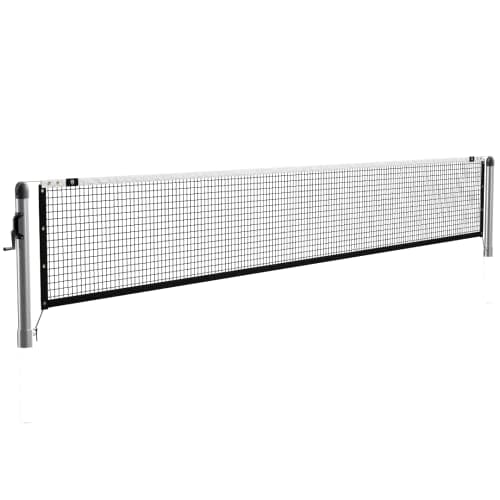
6061-T6 aluminum posts in concrete-set sleeves with an internal crank tensioner — the one option here that never needs setting up again.
Dominator publishes 6061-T6 aluminum round posts at 2.95 inches in diameter with a 5/32-inch wall, 53.5 inches long with 36 inches above ground, dropped into ground sleeves that are permanently set in concrete so the posts themselves can still be lifted out. Tension comes from an internal crank system, all hardware is stainless steel, and the kit includes the regulation net, sleeves and lacing rods. Posts are set 22 to 25 feet apart center to center.
For anyone with a dedicated court, this ends the conversation permanently - a net you never set up is a net that never sags. Dominator publishes 6061-T6 aluminum round posts, 2.95 inches in diameter with a 5/32-inch wall, 53.5 inches long with 36 inches above ground, dropped into ground sleeves that are permanently set in concrete; the posts themselves can still be lifted out. Tension comes from an internal crank system, all hardware is stainless steel, and the kit includes the regulation net, sleeves and lacing rods, with posts set 22 to 25 feet apart center to center. Note that 36 inches above ground is exactly the sideline height the rulebook specifies, which is why a permanent installation is the only configuration where height is a construction decision rather than a maintenance chore. The cons are obvious: it requires concrete, a permanent court and a day with a shovel, and it is the most expensive option here.
- Spec 1
- 6061-T6 aluminum, 2.95 in posts, 5/32 in wall
- Spec 2
- 36 in above ground, net 21 ft 9 in
- Spec 3
- Internal crank tensioner, stainless hardware
- Spec 4
- Concrete-set ground sleeves included
JOOLA Symmetry Portable Pickleball Net
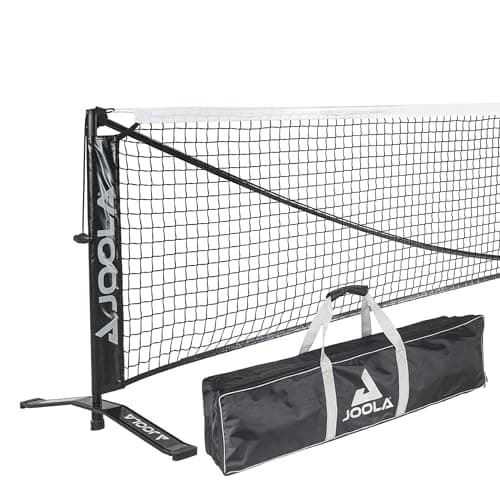
A five-piece, shock-corded portable net with a tension lock that holds regulation height — the known-brand net you carry to a court in a bag.
JOOLA publishes a 22-foot regulation net at 36 inches on the sidelines and 34 at the center, a five-piece design whose support pole and posts are pre-connected by shock cord so there are no loose poles to lose, and a tension lock that keeps the top cord taut for setup and quick takedown. JOOLA lists it at under 28 lb, with a 3-to-5-minute assembly and a carrying bag, and notes a 2025 update with reinforced poles and connectors. No wheels, and JOOLA publishes no warranty term or frame-material specification for it.
For the player whose net lives in a car boot and gets carried to a public court, where the constraint is weight and setup time rather than permanence. JOOLA publishes a 22-foot regulation net at 36 inches on the sidelines and 34 at the center, a five-piece design whose support pole and posts are pre-connected by shock cord so there are no loose poles to lose, and a tension lock that keeps the top cord taut. It is listed at under 28 lb with a 3-to-5-minute assembly and a carrying bag, and JOOLA notes a 2025 update with reinforced poles and connectors. For this page the relevant spec is the tension lock - not a winch, but a real mechanism rather than a knot. The cons: no wheels, so it is carried rather than rolled, JOOLA publishes no warranty term or frame-material specification for it, and it is priced well above the recreational nets.
- Spec 1
- 22 ft, 36 in sidelines / 34 in center
- Spec 2
- Under 28 lb (JOOLA), carry bag, no wheels
- Spec 3
- 5-piece shock-corded design, tension lock
- Spec 4
- 3-5 min setup; no published warranty
Why portable nets sag, and why it matters
A portable net is a top cord in tension between two posts that are standing on the ground rather than set into it. Three things work against the number.
The cord stretches. Every top cord does, most in its first few sessions. A net that was dead-on when you bought it will measure low a month later, and nothing is broken.
The posts lean in. Tension in the cord pulls the two posts toward each other. On an in-ground system the concrete resists it; on a portable system the only thing resisting it is the footprint of the legs and whatever ballast you have added. This is why wide bent legs and sand bags appear in the specs of the better portable nets, and it is why the cheap ones droop.
Nobody re-tensions mid-session. Which is the real reason a winch matters: not because it tensions better, but because re-tensioning becomes something you will actually do rather than a job requiring the net to come apart.
Does two inches matter? For the hard game, barely. For the soft game, a great deal. A dink that clears a 32-inch net comfortably clips a 34-inch one, and a third-shot drop you have grooved against a low net is a drop that floats into a put-away when you play somewhere with a proper one. If you are drilling the soft game at home — and our ball machine drills guide is largely soft-game work — the net height is part of the practice equipment, not scenery.
Converting a tennis or badminton court
A common plan and a common disappointment. A tennis net is 36 inches at the center and 42 at the posts, so playing pickleball over it puts the net two inches too high in the middle and six inches too high at the edges — which changes every shot in the soft game and makes a passing shot down the line nearly impossible. It is fine for a knockabout and useless for practice that transfers.
A badminton net is worse in the other direction: the standard height is around five feet, which is not in the same conversation.
So if you are putting pickleball lines on an existing court, budget for a net. The portable options above exist precisely for this, and the in-ground system is the answer if the court is yours and the conversion is permanent. Our pickleball net roundup covers the wider field including the lighter recreational systems.
If your space is smaller than a court
Worth saying plainly, because a lot of people searching for net height are really asking whether this fits in their driveway. A full court is 20 by 44 feet plus run-off, and the net span is 22 feet. Most driveways are not that wide.
The practical answer is a half-court setup: an 11-foot net across a single service box gives you a usable space for dinks, drops, resets and serve practice — which is most of what you would be drilling alone anyway. Some systems build either width from one set of poles, and that configurability is a better reason to buy than a few dollars of price difference. The height does not change: 34 at the center, 36 at the ends, whatever the width.
What you cannot do in a half-court space is practise the hard game, and you should not try — driving a ball into a garage door teaches you nothing and costs you a garage door.
The other net rules worth knowing
Three that come up, briefly, because they are the ones people get wrong in play rather than in setup.
The net is in play. A ball that hits the net and continues into the correct court is live, except on a serve, where it is a fault under current USA Pickleball rules — the let serve was removed.
You may not touch the net. Not with the paddle, not with your body, not with your clothing, at any point while the ball is live. This includes the posts and the cord.
The non-volley zone is measured from the net.Seven feet on each side, which is why the net's position matters as much as its height if you are painting lines. If the net is not where the lines say it is, the kitchen is the wrong size.
Rules change between seasons, and the authoritative text is USA Pickleball's current rulebook rather than any page summarising it, including this one. Our USAP approval and delisting guide makes the same point about equipment.
Where to go next
If you are kitting out a home court, the net is one of four decisions: the net, the balls, the shoes and the paddle. Our ball picks and indoor vs outdoor balls guide cover the surface question, court shoes cover the one piece of gear that most affects whether you get hurt, and how to choose a paddle covers the rest. If the court is for solo practice, read are ball machines worth it before you spend on anything else.
What is the regulation pickleball net height?
34 inches at the center and 36 inches at the sidelines, measured from the court surface to the top of the top cord, over a 22-foot span. The two-inch difference is intentional: a cord strung between two posts sags in the middle, and the rules specify where that sag should end up rather than trying to eliminate it.
Is a pickleball net the same height as a tennis net?
No, and it differs at both measuring points. A tennis net is 36 inches at the center and 42 at the posts; a pickleball net is 34 and 36. Playing pickleball over a tennis net puts it two inches too high in the middle and six too high at the edges, which changes every shot in the soft game.
How do I measure my pickleball net height?
Stand a tape measure on the court surface at the exact middle of the net and read the height of the top edge of the top cord — not the tape binding and not the mesh. You want 34 inches. Then measure within a few inches of each post, where you want 36. Check it again later in the session, because the second reading is the informative one.
Why does my portable net sag below regulation height?
Three reasons, all normal. The top cord stretches, most in its first few sessions. Tension pulls the two posts inward, and on a portable net only the leg footprint and any ballast resist that. And almost nobody re-tensions mid-session — which is why a hand-winch tension system is worth more than its spec sheet suggests.
Does a pickleball net use a center strap?
No. Tennis uses a center strap to pull the middle of the net down to the correct height; pickleball does not, because the designed sag between the posts is what produces the 34-inch center. If a net needs a strap to reach spec, the cord is strung too tight for the system.
Can I use a shorter net in a driveway?
You can use a narrower one — an 11-foot half-court net across a single service box is a genuinely useful practice space for dinks, drops, resets and serves. The height does not change: 34 inches at the center and 36 at the ends regardless of the span. What a half-court space cannot do is the hard game, and driving balls at a garage door is not practice.