Can You Wear Running Shoes for Pickleball?
You can, and most people start there. But a running shoe is engineered for one direction and pickleball is played in the other three — and the failure mode is an ankle, not a blister.
Disclosure: Drive Dink earns a commission from qualifying Amazon purchases at no extra cost to you. We accept no free products and no paid placements — commissions never change our picks. How this works.
The short answer: you can, nobody will stop you, and you should not for long. A running shoe is an excellent piece of engineering aimed at one problem — moving a body forward efficiently over distance — and every choice that makes it good at that makes it worse on a pickleball court. The injury people actually get from it is a rolled ankle on a lateral push-off, which costs weeks. A proper court shoe is the cheapest meaningful upgrade in this sport, cheaper than any paddle we cover, and it is the one we recommend before a paddle upgrade rather than after.
For most players making the switch, the Skechers Viper Court Pro 2.0 is the default. If your joints are the reason you were in running shoes, the ASICS Gel-Dedicate; if price was the reason, the FILA Volley Zone.
Why running shoes fail — the four design choices
1. A tall, soft stack. Modern running shoes put a lot of compliant foam between your foot and the ground, because that foam absorbs repeated vertical impact. Load the same foam sideways and it shears — the platform tips, your foot goes with it, and your ankle is the thing that stops the motion. The taller and softer the stack, the further your ankle travels before anything resists it.
2. A sole built narrow for efficiency. Running soles taper to save weight and encourage a clean heel-to-toe roll. A court shoe deliberately runs wider under the forefoot and flares at the edges, because the base needs to be wider than the foot in a lateral cut. This is the single biggest structural difference and the one you cannot feel until you plant hard.
3. An outsole designed for forward grip, and the wrong rubber. Running outsoles are optimised for traction in the direction of travel and for durability on pavement. Court outsoles use a non-marking compound in a herringbone or modified pattern that grips and releases on a lateral slide — grip that does not release is how knees get hurt. Non-marking also matters practically: plenty of indoor venues will not let you on a wood or sport-court floor in street soles.
4. An unreinforced upper. Running uppers are light mesh, because nothing is pushing sideways on them. In pickleball they get pushed sideways on every point, and two things follow: your foot slides inside the shoe, which costs you accuracy and skin, and the mesh tears at the outside of the little toe. If your trainers have a hole exactly there, that is this.
A court shoe trades away ten per cent of the comfort for all four of those. The four below are the ones we would put a new player in, with live Amazon prices on each.
Skechers Viper Court Pro 2.0 (Men's)
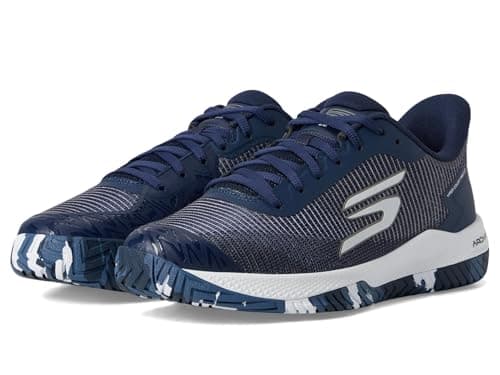
A dedicated pickleball court shoe with lateral support and a non-marking outsole — comfortable enough for long sessions.
Skechers went after pickleball specifically with the Viper Court line, and it shows: real lateral containment for side-to-side play, a grippy non-marking sole, and the cushioning Skechers is known for. The default recommendation for most men.
If the section above describes what your running shoes are doing to you, this is the default fix. Skechers went after pickleball specifically with the Viper Court line rather than adapting a tennis last, and the result does the three things a running shoe cannot: real lateral containment through a side-to-side cut, a grippy non-marking outsole that will not mark a gym floor or shred on an abrasive outdoor court, and enough cushioning to get through a long session. It is the shoe we recommend to most men making the switch. The cons are that it is heavier than a running shoe and will feel like it for the first session, and that Skechers' court shoes run narrower than their walking lines.
- Spec 1
- Court-specific lateral support
- Spec 2
- Non-marking outsole
- Spec 3
- Cushioned midsole
Skechers Viper Court Pro 2.0 (Women's)
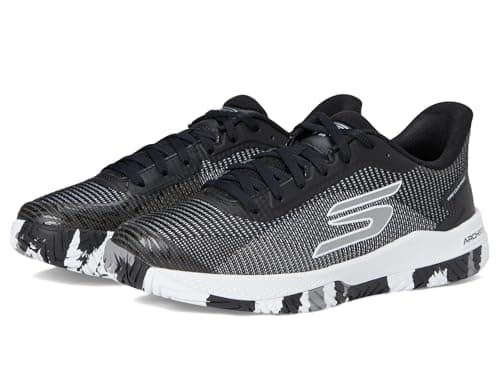
The women's cut of our top overall pick — court-tuned support and cushioning in a women's-specific fit.
Same court-focused design as the men's Viper Court Pro 2.0 in a women's-specific last: lateral support for quick changes of direction, a non-marking outsole, and all-day cushioning. Our top overall women's court shoe.
The same shoe in a women's-specific last, and our top overall women's pick for the same reasons. Lateral support for quick changes of direction, a non-marking court outsole and all-day cushioning, built around pickleball movement rather than borrowed from running or tennis. If you have been playing in trainers and your complaint is that your foot slides inside the shoe when you push off sideways, that is the problem this fixes - the upper holds the foot over the platform instead of letting it roll off the edge. The cons are the same: more weight than a running shoe, and a narrower fit than a lifestyle sneaker.
- Spec 1
- Women's-specific fit
- Spec 2
- Lateral court support
- Spec 3
- Non-marking outsole
ASICS Gel-Dedicate Court Shoe
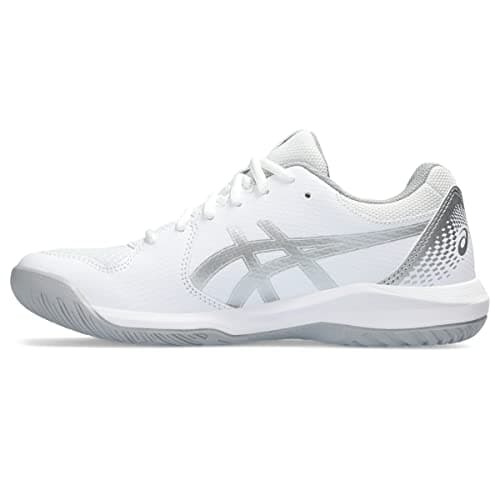
ASICS' GEL cushioning is the reason to buy — the pick if knees and joints take a beating on hard courts.
A tennis court shoe that translates perfectly to pickleball, the Gel-Dedicate brings ASICS' signature GEL cushioning for shock absorption. If you play on hard courts and your joints feel it the next day, this is the comfort pick.
The pick for the specific player who came to running shoes for the cushioning and does not want to give it up. The Gel-Dedicate is a tennis court shoe that translates directly to pickleball, and it brings ASICS' GEL rearfoot cushioning for shock absorption on top of a proper hard-court outsole and a supportive upper. That is the combination a running shoe cannot offer: the padding is there, but it sits on a platform that will not tip when you load it sideways. If you play on concrete or asphalt and feel it the next day, start here. The cons are that it is a tennis last rather than a pickleball-specific one, and that plush cushioning always costs a little court feel.
- Spec 1
- GEL rearfoot cushioning
- Spec 2
- Hard-court outsole
- Spec 3
- Supportive upper
FILA Volley Zone Pickleball
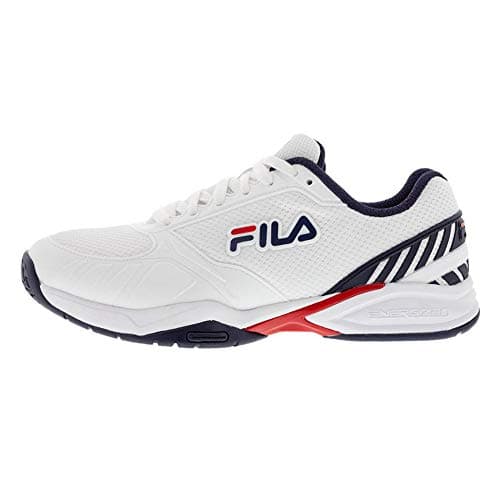
The value pick: a genuine court shoe with pickleball-appropriate support at a budget-friendly price.
You don't have to spend big for a proper court shoe. The FILA Volley Zone delivers the lateral support and non-marking sole you need for pickleball at a price well under the specialty options — the smart budget choice.
Here because the most common reason people keep playing in running shoes is not stubbornness, it is price. The FILA Volley Zone is a genuine court shoe with pickleball-appropriate lateral support and a non-marking sole at a price well under the specialty models, which removes the last excuse. It is not the plushest or the most structured shoe on this page; it is a real court shoe, which is the whole bar this page is arguing you should clear. The cons are less cushioning than the ASICS and less containment than the Skechers, and that FILA court shoes list per size and colour, so the listing you land on may not carry your size - the buy row falls back to a model search if so.
- Spec 1
- Budget-friendly
- Spec 2
- Court-appropriate support
- Spec 3
- Non-marking sole
Running shoe against court shoe, feature by feature
| Feature | Running shoe | Court shoe | Why it matters on a court |
|---|---|---|---|
| Midsole | Tall, soft, compliant | Lower, firmer, more stable | Soft foam shears sideways. A lower platform puts your ankle closer to the ground and gives it less distance to roll. |
| Sole width | Tapered to save weight | Wider, flared at the forefoot | A base wider than the foot is what stops the shoe tipping in a lateral plant. |
| Outsole | Forward-traction tread, marking rubber | Non-marking court compound, herringbone pattern | Grips and releases on a slide, and is allowed on indoor floors. |
| Upper | Light unreinforced mesh | Reinforced toe and lateral panels | Holds the foot over the platform; survives the drag on the outside of the little toe. |
| Weight | Lighter | Heavier | The one category a running shoe wins, and the reason the first session in court shoes feels like work. |
When you can get away with running shoes
Three honest cases. If you are playing your first few sessions and finding out whether you like the sport, wear what you own — buying court shoes before you know you will play again is backwards. If you play exclusively social doubles at a gentle pace and never genuinely sprint sideways, the risk is much lower, though it is not zero. And if the alternative is not playing at all, play.
What makes the risk real is not the level, it is the intensity of the lateral push-off — and that arrives the moment you start caring about winning the point. If you have started lunging for a wide dink, you have left this list.
One case where running shoes are actively worse than you think: an abrasive outdoor court. Court surfaces eat running-shoe outsoles quickly because they were compounded for pavement, so the shoe you are trying to save money by keeping is being destroyed anyway. The money goes the same place either way.
What about tennis shoes, or trail runners?
Tennis shoes are fine — they are court shoes, and most of the best pickleball shoes on the market are tennis lasts with the branding changed. The differences are real but second-order: pickleball lives in a smaller box with more short, sharp steps and less sliding, so pickleball-specific models tend to be a little lighter and a little more flexible in the forefoot. Our pickleball shoes vs tennis shoes page covers that comparison in full. If you already own tennis shoes, you do not need to buy anything.
Trail runners are not a shortcut. They are stiffer and more supportive than road shoes, which sounds like progress, but the lugged outsole is designed to bite into soft ground and it does not release on a hard court — that is grip in the wrong direction. The stack is usually still tall and soft as well.
Basketball shoes get closer: a wide base, a reinforced upper and lateral support are all there. They are heavier than they need to be and the outsole is tuned for a wood floor, but for indoor play they are a defensible stopgap.
Indoor and outdoor are not the same shoe
If you play both, the outsole is the thing that differs. Outdoor courts are abrasive and want a harder, more durable compound; indoor wood and sport-court floors want a softer non-marking gum that grips a clean surface. A shoe built for outdoor durability can feel slick indoors, and a soft indoor outsole wears out fast outside. All four shoes on this page are non-marking and usable on both; if you play mostly on one surface, our court shoes roundup breaks the field down further, with men's and women's pages for fit-specific picks. The same indoor-and-outdoor split applies to the ball, which is a genuinely different object rather than a colour variant — see indoor vs outdoor pickleballs.
How often to replace a court shoe
Sooner than you will want to, and the tell is not the tread. Court shoes usually fail in the midsole before the outsole looks finished: the foam packs out, the platform stops resisting lateral load, and the shoe quietly becomes the running shoe this page is arguing against. The practical check is to put the shoe on a flat surface and push the upper sideways with your hand — if the sole rolls easily, the structure is gone. Players who drill as well as play burn through them faster, which is one of the hidden costs in our ball machine guide.
Buy this before you buy a paddle
This site is mostly about paddles, so take the following as written against our own interest: if you are playing in running shoes and shopping for a paddle upgrade, buy the shoes first. A paddle changes how a ball leaves your face by a few per cent; a court shoe changes whether you get to the ball and whether your ankle survives getting there. The same logic applies to eye protection and to a fresh grip, which together cost less than the cheapest paddle in our under-$100 roundup. When you are ready for the paddle, our how to choose a paddle guide is the place to start.
The bottom line
You can play pickleball in running shoes and plenty of people do. The four things that make a running shoe good — a tall soft stack, a tapered sole, a forward-biased outsole and a light upper — are the four things a court shoe deliberately reverses, and the reason is that this sport is played sideways. Buy the Skechers Viper Court Pro 2.0 if you want the default answer, the ASICS Gel-Dedicate if cushioning is why you were in trainers, and the FILA Volley Zone if price is. Then keep the running shoes for running.
Can you wear running shoes for pickleball?
You can, and nobody will stop you, but you should not for long. Every design choice that makes a running shoe good — a tall soft midsole, a tapered sole, an outsole optimised for forward traction and a light unreinforced upper — works against you in a sport played with sharp lateral movement. The common injury is a rolled ankle on a sideways push-off.
What is the difference between running shoes and pickleball shoes?
Four things: a court shoe has a lower, firmer midsole that does not shear sideways; a wider sole flared at the forefoot so the base is wider than your foot in a lateral plant; a non-marking court outsole that grips and releases on a slide; and a reinforced upper that holds your foot over the platform. A running shoe trades all four for lightness and forward efficiency.
Are tennis shoes OK for pickleball?
Yes. Tennis shoes are court shoes, and many of the best pickleball shoes on the market are tennis lasts with different branding. Pickleball-specific models tend to be slightly lighter and more flexible in the forefoot because the sport involves shorter, sharper steps and less sliding, but if you already own tennis shoes you do not need to buy anything.
Will running shoes damage an indoor pickleball court?
They can, and many venues will not let you on a wood or sport-court floor in them. Court shoes use a non-marking compound specifically so they do not leave scuffs; most running outsoles are not formulated that way. On abrasive outdoor courts the damage runs the other way — the court will chew through a running-shoe outsole far faster than pavement does.
How do I know when my court shoes are worn out?
Check the midsole, not the tread. Court shoes usually fail by the foam packing out and losing its resistance to lateral load, which can happen while the outsole still looks fine. Stand the shoe on a flat surface and push the upper sideways by hand: if the sole rolls over easily, the structure is gone and the shoe is no safer than a trainer.