Ball Machine vs Practice Wall
A wall is free and gives you a thousand reps an hour. It also cannot feed you the single shot that decides most intermediate games. Here is where the line actually falls.
Disclosure: Drive Dink earns a commission from qualifying Amazon purchases at no extra cost to you. We accept no free products and no paid placements — commissions never change our picks. How this works.
The verdict first: a wall is the best value in pickleball practice and it cannot feed you the shot that decides most intermediate games. A wall is free, it is available, and it will give you more repetitions per hour than any machine — but every ball it returns is a direct consequence of the ball you just hit, which means it can only ever hand back energy, never absorb it. The floating, low-bouncing, dying ball you have to answer with a reset is physically impossible for a wall to produce.
So the question is not "which is better". It is which shots you are losing points on. If your drives and volleys are the problem, buy nothing and go hit a wall twice a week. If your drops sit up and your resets pop, a machine that publishes backspin is the only practice tool that can feed the problem. Below: what each one trains, the four shots a wall cannot produce, the cost-per-session arithmetic, and three machines at three price points.
Units we claim to have tested: 0.Machine specs are the manufacturers' published figures. Prices come from our live layer and move daily.
jbotsports JP-02 Pickleball Launcher
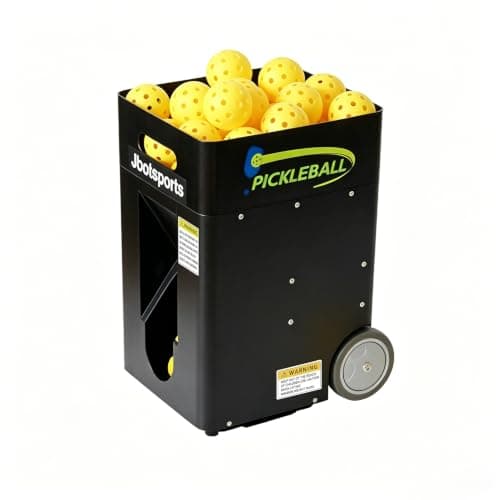
A 22 lb, app-and-remote launcher aimed at juniors and beginners — the entry point to the category, with the compromises that price implies.
jbotsports publishes a 40-ball hopper (80 with the extension panels), a 20-70 degree launch angle, 2-4 hours per charge, 22 lb carry weight and both remote and phone control, with adjustable topspin and backspin and a 2-line oscillation. What it does not publish is a ball-speed range, and the machine is explicitly built around gentler feeds — so treat it as a soft-game and reset trainer, not a drive machine.
For the player whose honest complaint about the wall is that it cannot feed a soft ball. jbotsports publishes a 40-ball hopper (80 with the extension panels), a 20-70 degree launch angle, adjustable topspin AND backspin, two-line oscillation, remote and phone control, 22 lb carry weight and two to four hours of battery. Backspin is the feature that matters against a wall: a floating, low-bouncing ball is the one you actually have to answer in a game, and a wall returns the opposite of what you hit at it. At 22 lb it is also light enough that it gets used rather than admired. The cons are real and specific: jbotsports publishes NO ball-speed range and the machine is explicitly built around gentler feeds, so this is a soft-game and reset trainer rather than a drive machine, and the 40-ball hopper means more time picking balls up than hitting them.
- Spec 1
- 40-ball hopper (80 with extension)
- Spec 2
- 20-70 degree launch angle
- Spec 3
- 22 lb, 2-4 hr battery
- Spec 4
- Remote + app, 2-line oscillation
Lobster Sports The Pickle
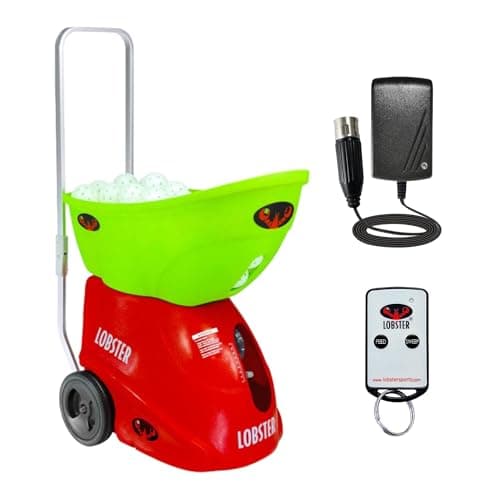
The lightest full-featured machine from the brand that has built ball machines the longest — 125 balls, real topspin and backspin, and 35 lb you can actually carry.
Lobster publishes a complete spec sheet for The Pickle and it reads like the sensible middle of the category: a 125-ball hopper, 10-60 mph, a 2-12 second feed, random horizontal oscillation, manual elevation from drive to lob, and 2-4 hours on a charge. At 35 lb it is the lightest machine here that still does spin and oscillation, which is what makes it the one most people will keep using.
For the player who has decided a wall is not enough and wants one machine that does everything without needing a trolley. Lobster publishes a 125-ball hopper, 10-60 mph, a 2-12 second feed, random horizontal oscillation, manual elevation from drive to lob, and two to four hours on a charge - at 35 lb, the lightest machine we cover that still does both spin and oscillation. Random horizontal oscillation is the feature a wall can never replicate: a ball arriving somewhere slightly different every time forces the footwork a fixed feed lets you skip, and footwork is where wall practice quietly goes wrong. The cons: the 2-second minimum feed is too slow for a true hands-speed drill, elevation is manual so lob work means walking to the machine between sets, and it is a four-figure purchase that needs a court you can occupy for an hour.
- Spec 1
- 125-ball capacity
- Spec 2
- 10-60 mph, 2-12 s feed
- Spec 3
- 35 lb, 2-4 hr battery
- Spec 4
- Random horizontal oscillation, top/backspin
Pickleball Tutor Mini
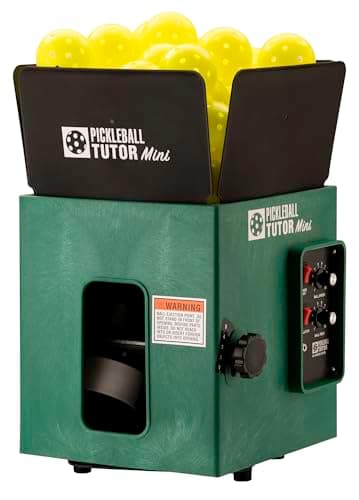
A stripped-back, US-built feeder that does the two things that matter — pace and placement — without the weight or the price of a full drill machine.
Sports Tutor publishes a 60-ball hopper (one standard pick-up basket), speeds up to 50 mph, a 2-10 second feed and up to three hours per charge, with manual elevation from groundstroke to lob. The Amazon listing is the random-oscillator version, so it moves the ball across the court rather than firing at one spot. It is the machine to buy if getting the thing out of the trunk is the deciding factor.
For the player whose deciding constraint is the walk from the car. Sports Tutor publishes a 60-ball hopper, speeds up to 50 mph, a 2-10 second feed and up to three hours per charge, with manual elevation from groundstroke to lob; the Amazon listing is the random-oscillator version, so it moves the ball across the court rather than firing at one spot. It is a feeder rather than a full drill machine, and that is the point - it does pace and placement, the two things a wall gets wrong, without the weight or price of a machine that does everything. The cons: no published spin control, which means the reset and third-shot-drop drills a wall cannot feed are also outside this machine's range; a 60-ball hopper is one standard pick-up basket; and manual elevation means lob work interrupts the session.
- Spec 1
- 60-ball capacity
- Spec 2
- Up to 50 mph, 2-10 s feed
- Spec 3
- Up to 3 hr battery
- Spec 4
- Random oscillator, manual elevation
What a wall genuinely does well
It is worth being specific, because the usual advice treats a wall as a poor substitute and it is not. For four things it is the better tool.
Repetition volume. A wall returns the ball in under a second with no hopper to refill and nothing to pick up. In an hour you will hit several times what any machine on this page can feed you, and for grooving a stroke, volume is the variable.
Reaction speed and hands.Stand close and a wall is the fastest feed in the sport — faster than a machine's minimum interval, faster than a partner. For hand-speed work at the kitchen, nothing beats it.
Volley consistency. Continuous blocked volleys against a wall are the cheapest way to build a reliable punch volley, and the feedback is immediate — a sloppy face sends the ball somewhere you have to chase.
Zero friction. The best practice tool is the one you actually use. A wall needs no charging, no setup, no trunk space, and no court booking.
The four shots a wall cannot feed
A wall is an energy mirror. It returns what you give it, minus a little. That single property creates four blind spots, and they happen to be the shots that separate a 3.5 from a 4.0.
1. The reset off a hard ball. To practise absorbing pace you need pace arriving that you did not generate. A wall only gives you back your own, so the harder you hit the harder it comes back — which trains you to hit harder, the exact opposite of a reset.
2. The third-shot drop against a real incoming ball. The drop is a response to a deep return. A wall cannot produce a deep, looping return with backspin on it; it produces a rebound.
3. Anything with backspin. A wall reverses the spin you put on the ball in a way that is nothing like what an opponent sends. Floating, low-skidding balls — the ones that are genuinely hard to lift — are outside its physics entirely.
4. Movement. A wall returns to roughly where you hit from. Real points move you, and footwork practised without movement is footwork practised wrong. This is the quiet one: hours of wall work can make your stroke better and your positioning worse.
Those four are why the machines above are worth considering. Our ball machine drills guide has the specific settings for each, and are ball machines worth it is the money version of this argument.
Side by side
| What you want to drill | Practice wall | Ball machine |
|---|---|---|
| Reps per hour | Highest available | Limited by hopper size and pick-up time |
| Hand speed at the kitchen | Excellent — fastest feed there is | Only with a 1-2 second minimum feed |
| Punch volleys | Excellent | Good |
| Resets off pace | Impossible — it mirrors your own energy | Yes, with adjustable backspin |
| Third-shot drops | Poor — no deep looping feed | Yes, with elevation and backspin |
| Footwork and movement | Poor — ball returns to you | Yes, with random oscillation |
| Deep serve returns | No | Yes, at 50-60 mph |
| Setup cost | Zero | Three to four figures |
| Setup time per session | None | Load, position, retrieve balls |
Read the rows rather than the column totals. The wall wins the high-frequency, low-complexity work; the machine wins everything that requires a ball you did not create. Most players need both, and the wall is the one you should be using first because it is free.
The arithmetic, honestly
A machine is a four-figure purchase at the capable end and a high-three-figure one at the entry level. The way to think about it is cost per useful session, and the denominator is the part people get wrong.
Be realistic about three things. First, how often will you actually drill alone — not how often you intend to, how often you did last month with a free wall available. Second, do you have a court you can occupy for an hour without a queue forming; a machine on a busy public court is a social problem as well as a practical one. Third, weight: the difference between 22 lb and 50 lb is the difference between a machine that lives in your trunk and one that lives in your garage. That is why every machine we rank publishes its carry weight in the specs.
If the answer to any of the three is shaky, the wall plus a partner who will drill with you is the better investment, and spending the money on court time instead is not a lesser option. The full ranked machine list is on best pickleball ball machines.
The approach that actually works
Most players who improve fastest do not choose. They use the wall for the high-volume stroke work — hands, volleys, grooving a drive — two or three short sessions a week, and a machine or a drilling partner for the soft game once a week.
That split works because the two tools fail in opposite directions. A wall overtrains pace and undertrains absorption; a machine session is slower and lets you work on the shot that is losing you points. If you only have one hour a week to drill, spend it on the thing the wall cannot give you.
One more thing worth knowing before you spend: balls wear out faster in machine use than in play, because they are fed, struck and collected continuously. Budget for that — our ball lifespan guide covers how to tell when a ball is done, and the ball roundup covers which ones last.
The bottom line
Hit the wall. It is free, it is the best volume tool in the sport, and if your weakness is volleys or hand speed it is also the best tool full stop. Buy a machine when you can name a shot the wall cannot feed — a reset off pace, a third-shot drop against a deep return, anything with backspin, or movement. When you do, buy for the two specs that decide whether it gets used: carry weight and adjustable backspin. The jbotsports JP-02 is the cheapest route to the soft-game drills; the Lobster Pickle is the one that does everything at a weight you can still carry.
Is a pickleball ball machine better than a wall?
For different things. A wall gives you far more repetitions per hour and is the best tool in the sport for hand speed and volleys. A machine is the only one of the two that can feed a ball you did not create — which means resets off pace, third-shot drops against a deep return, backspin, and movement via oscillation.
What can't you practise against a pickleball wall?
Four things. Resets off incoming pace, because a wall only returns the energy you gave it. Third-shot drops against a real deep return. Anything involving backspin, because a wall reverses your spin rather than producing an opponent's. And footwork, because the ball comes back to roughly where you hit it from.
Is a pickleball ball machine worth the money?
It depends on the denominator. Work out how many sessions a year you will genuinely drill alone — based on how often you used a free wall last month, not on intentions — and whether you have a court you can occupy for an hour. If both answers are solid, a machine is the fastest way to fix a soft game. If either is shaky, spend the money on court time.
What spec matters most on a pickleball ball machine?
Carry weight and adjustable backspin. Weight decides whether the machine gets used or stored: 22 lb lives in your trunk, 50 lb lives in your garage. Backspin decides whether it can feed the floating, low-bouncing ball that a wall physically cannot produce — which is the main reason to own one at all.
Can you practise third-shot drops against a wall?
Not properly. A drop is a response to a deep, often spinning return, and a wall produces a rebound of your own ball instead. You can groove the swing path against a wall, but the shot you are rehearsing is not the shot you face in a game.