Pickleball Paddles for Arthritic Hands
Grip strength and joint pain are not the same problem as tennis elbow, and the equipment answers are different. Here are the four levers that matter, in order of how much they change.
Disclosure: Drive Dink earns a commission from qualifying Amazon purchases at no extra cost to you. We accept no free products and no paid placements — commissions never change our picks. How this works.
The short version: change the grip before you change the paddle. If arthritis in your hands is what limits how long you can play, the highest-value modification per dollar is a replacement grip that lets you hold the paddle with less squeezing force — and you can fit one to the paddle you already own. Everything else on this page is a bigger, more expensive change with a smaller effect.
This is not medical advice, and we are not clinicians. Arthritis is a diagnosis with several forms, it progresses differently in different people, and the person who should be advising you on playing with it is a rheumatologist, physiotherapist or occupational therapist. What a gear site can honestly contribute is narrower: there are four equipment variables that change how much load reaches your hands, all four are published specifications you can shop on, and most buying guides never name them. That is what the rest of this page is.
The four levers, in order
1. Grip shape — the biggest change for the least money. A round handle has to be squeezed to be controlled. That squeeze is continuous: it is happening on every shot and between shots, and for most players with hand pain it is the dominant load, not the impact of the ball. A grip that your hand can key into rather than clamp around changes the demand rather than cushioning it. This is also the only lever you can test cheaply, because grips fit any paddle.
2. Grip diameter — in whichever direction is wrong for you. Conventional advice says a larger grip reduces strain, and for some players it does, because a thicker handle needs less finger closure. For others a grip that is too large is worse, because a hand that cannot close comfortably around it grips harder to compensate. There is no universal answer here, which is why the honest instruction is to measure, start at the size that fits, and adjust one layer at a time. Our grip size guide covers how to measure rather than guess, and replacing a paddle grip covers the difference between a replacement grip, which can make a handle thinner, and an overgrip, which can only make it thicker.
3. Swing weight — the effort cost of every shot. Not static weight. Static weight is what the paddle reads on a scale; swing weight describes how hard it is to accelerate and depends on where the mass sits. Moving face area down toward your hand — which is what a standard shape does — lowers swing weight without removing any mass at all. If what tires your hands and wrists is the work of moving the paddle, this is the lever, and it is larger than most people expect. Our swing weight and twist weight guide has the mechanics, and our standard-shape roundup has the frames.
4. Core thickness — impact, not effort. A thicker core keeps the ball on the face longer and deflects more before it rebounds, which softens the shock arriving at your hands. 20mm is the thickest core we cover; 16mm is the sensible default; 14mm is the thin, poppy, harsh end. If the sensation you want to reduce is the sharp jolt of a hard ball, go thicker. See 14mm vs 16mm and our dwell time guide.
The three items below address levers one, four and three, in that order. Read the trade-offs on each — notably that the thickest-core paddle here has a higher swing weight, so levers three and four genuinely pull against each other and you have to decide which symptom you are treating.
Hesacore Pickleball Paddle Grip
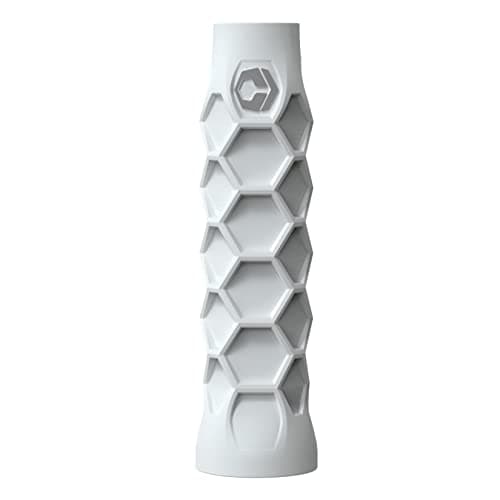
A structured hexagonal replacement grip designed to spread load across the palm and cut vibration into the arm.
Hesacore is not an overgrip — it is a replacement grip with a raised hexagonal pattern that changes how the handle loads your hand. The manufacturer's pitch is reduced vibration, better grip strength and support for players managing tennis elbow. It is the most expensive grip here and the most polarizing: people who like it will not go back.
The cheapest change on this page and the one we would make before buying any paddle. Hesacore is not an overgrip - it is a replacement grip with a raised hexagonal pattern, and the reason it belongs here is that it changes WHERE the handle loads your hand rather than only how thick the handle is. A smooth round handle is held by squeezing; a raised hex pattern gives the paddle something to key into, which lets some players hold it securely with less grip force. Less grip force is the whole objective if your fingers are the limiting factor. It fits any paddle handle, so you can test the idea on the paddle you already own for the price of a tube of balls. The honest caveats: it is a replacement grip, so fitting it means stripping the factory wrap, the hex pattern divides opinion sharply on feel, and it is a comfort modification rather than anything clinical.
- Spec 1
- Replacement grip (not an overgrip)
- Spec 2
- Hexagonal load-spreading pattern
- Spec 3
- Manufacturer-marketed for elbow comfort
Selkirk LUXX Control Air Invikta
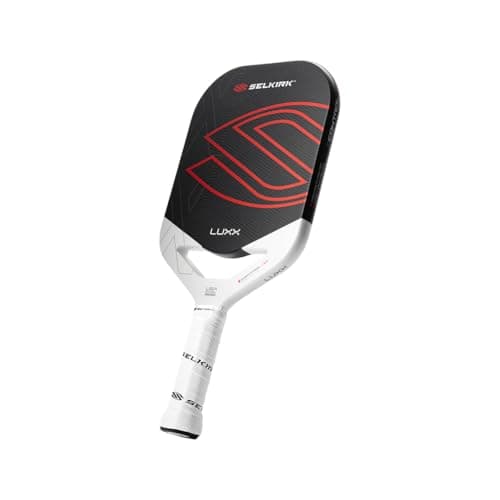
A thick-core, control-first paddle: a plush, soft-hands feel for dinking and resets, not a bomb-thrower.
The LUXX Control leans hard into touch — a thicker core and a muted face make the third-shot drop and the reset the strengths here. If your game wins on placement and hands speed rather than raw pace, this is the control end of the Selkirk line.
For the player who wants the most cushioning between the ball and their hands that we can point at. The LUXX Control Air Invikta runs a 20mm core - thicker than anything else in our catalog, where 14mm and 16mm are the norm - under a Florek carbon face, and it scores a 9 on control and a 9 on forgiveness against a 7 on spin and power. A thicker core means the ball spends longer on the face and the frame deflects more before it rebounds, which is the mechanism behind a softer, less jarring impact. If the sensation you are trying to reduce is the sharp shock of a hard drive arriving, this is the paddle on this page that addresses it. The cons are significant and you should weigh them: it is an elongated frame, so it has MORE swing weight than a standard shape, not less, and if your limiting factor is turning the paddle over quickly rather than absorbing impact, it is the wrong pick. It is also the most expensive item here, and the softest-hitting.
- Core
- 20 mm
- Shape
- Elongated
- Face
- Florek carbon face
- Weight
- ~8.0 oz
- Build
- Cold-pressed
- Gen
- LUXX
Manufacturer-listed as USA Pickleball approved. Approvals and delistings change — verify against the current USAP equipment list before tournament play (checked 2026-07).
Vatic Pro Prism V7 16mm
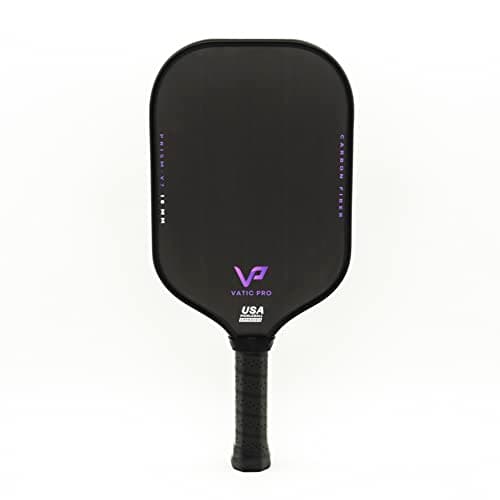
The standard-shape Prism: the same value-carbon face in a more control-friendly, maneuverable body.
The V7 is the Prism for players who prefer a standard shape — a lower, wider sweet spot and quicker hands than the elongated Flash, at the same wallet-friendly price. A lot of paddle for the money on the control end.
For the player whose complaint is effort rather than impact - the paddle feels like work to move, and that work is going through wrists and fingers. The Prism V7 is Vatic's standard-shape frame rather than an elongated one, which moves face area down toward the handle. That lowers swing weight without taking any mass out of the paddle, and swing weight is the number that decides how much force you have to generate to accelerate the head. It is also the cheapest paddle we cover with a 16mm core, a raw Toray T700 face and an 8 on spin, control and forgiveness, and it already leads our senior and tennis-elbow roundups, so it is a known quantity on this site. The cons: the lowest power score of the three items here, a value-tier finish, and a thin stock grip - which is a feature if you are going to replace the grip anyway and a flaw if you are not.
- Core
- 16 mm
- Shape
- Standard
- Face
- Raw Toray T700 carbon fiber
- Weight
- ~8.0 oz
- Build
- Thermoformed
- Gen
- Prism
Manufacturer-listed as USA Pickleball approved. Approvals and delistings change — verify against the current USAP equipment list before tournament play (checked 2026-07).
Why this is not the tennis elbow answer
These two searches get lumped together constantly, and the equipment answers diverge. Tennis elbow is a tendon problem at the elbow, aggravated by vibration and by the shock of off-center contact, and the standard equipment response is a thicker core, a bigger sweet spot and a higher twist weight so the paddle twists less in your hand. Our paddles for tennis elbow page ranks on exactly that.
Arthritic hands are a different load. The dominant demand is not the impulse travelling up your forearm — it is the sustained grip force your fingers are producing for an hour and a half, plus the effort of accelerating the paddle. That is why grip shape leads this page and core thickness comes fourth, which is the reverse of the tennis elbow ordering. If you have both, you are looking for the overlap: a thick core in a low-swing-weight frame with a grip you do not have to clamp. Nothing we cover is all three at once, and we are not going to pretend otherwise.
The three options side by side
| Item | Lever it changes | Key published spec | Trade-off |
|---|---|---|---|
| Hesacore replacement grip | Grip shape and load distribution | Raised hex pattern; fits any paddle handle | Divisive feel; requires stripping the factory grip |
| Selkirk LUXX Control Air Invikta | Impact softness (core) | 20mm core, Florek carbon face, 9 control / 9 forgiveness | Elongated, so higher swing weight; softest-hitting; priciest |
| Vatic Pro Prism V7 | Effort per shot (swing weight) | Standard shape, 16mm core, raw Toray T700 face | Lowest power of the three; thin stock grip |
If you can only make one change, make the grip. If you can make two, make the grip and then pick the paddle by which symptom is worse — jolt, or effort.
The changes that cost nothing
Four of them, and in our view they matter as much as the hardware.
Stop over-gripping between shots. Most players hold the paddle at near-maximum force for an entire rally. The force you actually need is only at contact. This is a habit, it is trainable, and it is free.
Play doubles at the kitchen rather than the baseline. Soft game exchanges generate a fraction of the impulse of drives and overheads. Many players find the limiting factor is not the sport but one specific shot.
Warm up your hands before you warm up your legs. Standard advice from anyone who treats hand conditions, and nobody does it at a pickleball court.
Cap the session. Loading injuries respond to total volume more than to equipment. Two good hours beats three bad ones, and the paddle cannot fix the third hour.
What gear cannot do
No paddle, grip or weight configuration treats arthritis, slows it, or protects a joint from it. The most any of this does is reduce the load a particular movement puts through a particular joint, which can extend how long you are comfortable playing. That is a real benefit and it is worth buying for, and it is also the entire claim. Anything marketed to you as an arthritis paddle is using the word as a keyword, not as a specification.
If your hands are getting worse, or pain is waking you up, or grip strength is changing measurably, that is a clinician's question and not a shopping one. We would rather say that on a page that could easily sell you three paddles.
Where to go next
If you came here because play is getting uncomfortable generally rather than specifically, our paddles for senior players page covers the same territory from the other direction, and the most forgiving paddles page ranks on off-center margin. If the shock of impact is the issue, our quiet paddles guide covers the related question of what a softer core does to feel and sound. And if you want the whole decision rather than one variable, how to choose a paddle is the place to start.
What is the best pickleball paddle for arthritic hands?
The honest answer is that the paddle is the second decision. The highest-value change per dollar is a replacement grip that lets you hold the paddle with less squeezing force, because sustained grip force — not ball impact — is usually the dominant load on arthritic hands. After that, pick between the thickest core you can get, if jolt is the problem, and the lowest swing weight you can get, if effort is the problem.
Does a thicker or thinner grip help arthritis?
It depends on your hand, and anyone who tells you otherwise is guessing. A larger grip needs less finger closure, which helps some players; a grip too large for your hand makes you squeeze harder to control it, which helps nobody. Measure from the crease of your palm to the tip of your ring finger, start at the size that fits, and change one layer at a time.
Is a heavier or lighter paddle better for hand pain?
Think in swing weight rather than static weight. Swing weight describes how hard the paddle is to accelerate and depends on where the mass sits, so a shorter, wider standard-shape frame can be easier to move than a lighter elongated one. If the effort of swinging is what tires your hands, lowering swing weight is the lever — and you can do it without reducing the paddle's actual weight.
Is this the same as choosing a paddle for tennis elbow?
No, and the orderings are close to reversed. Tennis elbow responds to a thicker core, a bigger sweet spot and higher twist weight, because vibration and off-center shock are the aggravators. Arthritic hands are mostly loaded by sustained grip force and the effort of moving the paddle, so grip shape comes first and core thickness comes last.
Can a paddle or grip treat arthritis?
No. Nothing in this category treats, slows or protects against arthritis. The most equipment can do is reduce the load a given movement puts through a given joint, which may extend how long you are comfortable playing. Any product marketed as an arthritis paddle is using the word as a search term rather than a specification.
What can I change for free?
Stop holding the paddle at full force between shots — you only need grip force at contact, and it is trainable. Spend more of your play in soft-game exchanges at the kitchen than driving from the baseline. Warm your hands up before you play. And cap the session, because total volume matters more than equipment for a loading problem.