FRIDAY Aura vs Aura Pro
The rarest comparison in this market: two paddles with the same published outline, the same face, the same grip and the same weight, where the only variable is what is inside. One is the softest foam paddle on the shelf. The other is a weapon.
Disclosure: Drive Dink earns a commission from qualifying Amazon purchases at no extra cost to you. We accept no free products and no paid placements — commissions never change our picks. How this works.
The verdict first: buy the standard Aura unless you specifically want more pop and can find a Pro in stock. FRIDAY publishes the same outline, the same core thickness, the same face, the same handle, the same grip and the same weight on both. The only variable is construction, and the softer construction is the one we would put in most hands.
Overrule us if your complaint is that foam feels dead. That is a real complaint about the standard Aura and the Pro is FRIDAY's answer to it. If you have played a foam paddle and wanted the ball to leave faster, the Pro is the correct purchase and the control point you give up is the price.
Check stock before you get attached to the Pro. When we checked, every Aura Pro colorway on Amazon was in single-digit stock while the standard Aura was in clean unqualified supply. That pattern across four separate listings reads as thin allocation rather than a dead listing, but it means the Pro may be gone by the time you decide. Buying direct from FRIDAY is the fallback and we earn nothing when you do it.
Units we claim to have tested: 0. Specs are FRIDAY's and Pickleball Central's published figures. The swing and twist weight numbers below are The Kitchen's published measurements, attributed as theirs, and they are for the elongated shape rather than the widebody we rank — we say so rather than quietly apply them. Prices come from our live layer and move daily.
| # | Paddle | Best for | Score | Price |
|---|---|---|---|---|
| 1 | 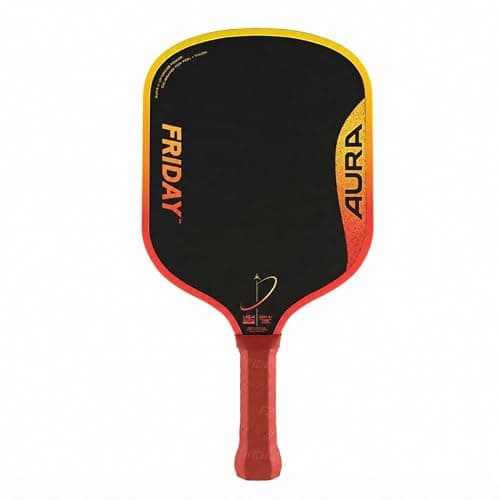 FRIDAY Aura Widebody The most forgiving paddle in FRIDAY's range | The one most players should buy | 8.3 | |
| 2 | 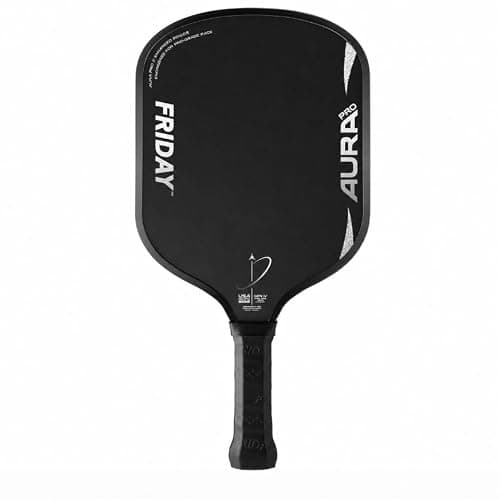 FRIDAY Aura Pro Widebody The firmest, quickest paddle FRIDAY publishes | Buy for pop, if you can get one | 8.0 | $169.00 · View on Amazon #adPrice as of November 20, 2026 |
Tap any row to jump to the full write-up. Prices are pulled live from Amazon.
FRIDAY Aura Widebody
Same published core, face, handle and weight as the Aura Hybrid in a full 8in-wide frame - the widest, steadiest shape FRIDAY sells.
Pickleball Central publishes a 16.0 x 8.0in widebody outline, a 16mm EPP foam core, a textured carbon face, a 5.5in handle, a 4.25in grip and a 7.9 oz average in a 7.7-8.1 oz range - every published number identical to the Aura Hybrid except the outline. Width is what buys twist weight and mishit margin, and the retailer's own copy calls this the safer, more forgiving option of the two.
The all-court half of the pair, and the one in clean stock. Pickleball Central publishes a 16.0 x 8.0in widebody outline, a 16mm EPP foam core, a textured carbon face, a 5.5in handle, a 4.25in grip and a 7.9 oz average in a 7.7-8.1 oz range. FRIDAY positions the standard Aura as the touch-and-reset option and the Pro as the power option, and independent testing agrees: The Kitchen's reviewer calls the Aura the softest-feeling foam paddle they have played, with published figures of 118 swing weight and 5.7 twist weight on the elongated shape against the Pro's 116 and 6.0. We score it 8 spin, 8 power, 8 control, 9 forgiveness - the highest forgiveness number on the FRIDAY shelf, which is what a full 8in of width on a soft core buys you. The cons are specific and the same reviewer names them. Power on big swings is lower than modern thermoformed paddles, so it will not win hands battles against a stiff Gen 4 frame. Resets need an adjustment period because you have to push the ball rather than let the paddle do the work. And a 4.25in grip is on the thicker side of the market, which cannot be reduced the way a thin one can be built up.
- Core
- 16 mm
- Shape
- Widebody
- Face
- Textured carbon fiber
- Weight
- 7.7-8.1 oz (7.9 oz avg)
- Build
- Thermoformed
- Gen
- Aura / Gen 4 (EPP foam core)
Pickleball Central lists this paddle's approvals as USAP and its FAQ states it is approved for USAP-sanctioned play; the Amazon listing title makes no approval claim. Approvals and delistings change - verify your exact model against the current USA Pickleball equipment list before tournament play (checked 2026-10).
FRIDAY Aura Pro Widebody
The Aura Widebody's published frame with a double-thermoformed structure on top - firmer, louder, more aggressive, and the thinnest stock on this shelf.
Pickleball Central publishes the same 16.0 x 8.0in outline, 16mm EPP foam core, textured carbon face, 5.5in handle, 4.25in grip and 7.9 oz average as the standard Aura Widebody, and describes the Pro as adding a double-thermoformed structure with a firmer, quicker response. Tennis Warehouse's listing for the same paddle names a Quad-Foam Core and FRIDAY's patent-pending ElasTECH internal perimeter weighting instead - the sources do not agree, so we quote both.
The same published frame with structure added. Pickleball Central publishes the identical 16.0 x 8.0in outline, 16mm EPP foam core, textured carbon face, 5.5in handle, 4.25in grip and 7.9 oz average, and describes the Pro as adding a double-thermoformed structure for a firmer, quicker response. FRIDAY's own page calls the Pro's core Dual-Foam in the spec table and Full-Foam in the body copy, and a blow-molded carbon frame double-thermoformed for durability; The Kitchen's teardown describes a fully floating EPP core inside EVA foam with a rubber ring softening it. We score it 8 spin, 9 power, 7 control, 8 forgiveness - one more point of power, one fewer of control. The cons are serious enough that it is second here. Every Aura Pro colorway we checked on Amazon is in single-digit stock, our pinned listing showing two units, which makes this a hard paddle to recommend as a considered purchase rather than a grab. The reviewer who liked it best only reached top-tier power after adding tungsten tape to the sides, which is a modification rather than a spec. And FRIDAY's own published construction copy contradicts itself, so nobody shopping this paddle can be certain what is inside it.
- Core
- 16 mm
- Shape
- Widebody
- Face
- Textured carbon fiber
- Weight
- 7.7-8.1 oz (7.9 oz avg)
- Build
- Thermoformed
- Gen
- Aura Pro / Gen 4 (EPP foam core, double thermoformed)
Pickleball Central lists this paddle's approvals as USAP; Tennis Warehouse's spec list for the same paddle makes no approval claim. Approvals and delistings change - verify your exact model against the current USA Pickleball equipment list before tournament play (checked 2026-10).
What actually differs
Everything in the first list is published as identical on both paddles. Everything in the second is not.
Identical: 16.0 x 8.0in widebody outline. 16mm core thickness. EPP foam core. Textured carbon face. 5.5in handle. 4.25in grip. 7.9 oz average in a 7.7-8.1 oz range. FRIDAY's ElasTECH perimeter weighting. Gen 4 generation label.
Different: the Pro adds a double-thermoformed structure, which Pickleball Central describes as producing a firmer, quicker response. That is the whole published difference. Price differs too, modestly and in the Pro's favor at the time of writing, and stock differs a great deal.
This is why the page exists. Comparisons in this market almost always move two or three variables at once — a different core, a different face, a different generation, a different outline. Here the geometry is frozen and the construction moves. If you have ever wanted to know what a construction change does on its own, with the shape held still, this is the experiment. Our Gearbox GBX Power Hybrid vs Elongated comparison is the mirror image of it: one variable, but geometry instead of construction.
What a foam core actually changes
Gen 4 means the honeycomb is gone. A honeycomb core is a grid of hollow polypropylene cells; a foam core is solid material through the middle of the paddle. They are different objects and they age differently.
Solid foam is denser, so a foam paddle carries more of its mass out toward the face and perimeter rather than concentrated at the throat. That is most of why foam paddles feel like they hit a heavier ball at the same listed weight. It is also why they are quieter and why they are harder to delaminate: there is no honeycomb-to-face bond line to fail in the same way. Our Gen 3 and Gen 4 foam paddles guide covers the generation labels properly and paddle delamination explains the failure mode foam is partly a response to.
What foam gives up is the predictable softening curve of honeycomb. A foam core is stiffer from new and stays closer to how it started, which buyers read as either durability or as a paddle that never breaks in depending on what they wanted. Our paddle break-in guide covers which constructions change with use and which do not.
The ElasTECH layer both paddles share is FRIDAY's patent-pending perimeter weighting, and here we have to flag something. FRIDAY's own description of ElasTECH says the layer “sits between the perimeter foam and the honeycomb core” — on a paddle family whose entire Gen 4 pitch is that the honeycomb core has been replaced by foam. The spec table calls the core Dual-Foam; the body copy on the same page calls it Full-Foam. We are quoting both because both are published, and a buyer should know the maker's own copy does not line up before paying flagship-adjacent money for the technology it describes.
The numbers that separate them
FRIDAY publishes a swing weight and a twist weight for the Aura Pro, which is more than most brands publish at all. The Kitchen's review goes further and prints both figures for both paddles side by side on the elongated shape: the Aura at 118 swing weight and 5.7 twist weight, the Aura Pro at 116 and 6.0.
Read those two pairs carefully, because they say something precise. The Pro is slightly lower in swing weight and clearly higher in twist weight. Lower swing weight means faster through the air for the same arm speed. Higher twist weight means more resistance to the face rotating when the ball lands off center. The Pro is the quicker paddle and the more laterally stable one at the same time, which is a genuinely good result and is what the extra thermoforming is buying.
So where does the standard Aura win? Dwell. Everything the reviewer describes about the Aura — the softest foam feel they have played, the ball sitting on the face, the need to push a reset rather than let the paddle absorb it — is a dwell-time story, and dwell is what a softer structure gives you. Our dwell time guide explains why that single property drives most of what players call “feel,” and swing weight and twist weight covers the two numbers above and why a paddle can be fast and stable at once.
The caveat matters and we are not going to bury it: those measurements are from the elongated versions of both paddles. We rank the widebody versions here, because those are the two listings in our registry with matching published geometry. A 16 x 8in frame will not carry the same absolute numbers as a 16.5 x 7.5in one — the widebody will be higher in twist weight on both paddles. What transfers is the direction of the gap between the two constructions, not the values.
Who should buy which
Buy the standard Aura if: you reset and dink more than you drive; you came to foam for feel rather than pop; your contact point varies and you want the most forgiving frame FRIDAY publishes; or you want the paddle you can actually get in the colorway you want. Our best widebody pickleball paddles page ranks the wide-face category across brands if this is the shape you are after.
Buy the Aura Pro if: you have played a foam paddle and found it dead; you are losing hands battles at the kitchen; you want the extra twist weight the thermoforming buys; or you plan to tune the paddle with lead or tungsten tape, in which case the Pro's stiffer platform responds better to it. Our lead tape guide covers how to do that without wrecking the balance, and best foam core power paddles ranks the category across brands.
Buy neither if: you want maximum reach. Both of these are 16in-long widebodies, which is the short end of the market. FRIDAY sells the Aura and Aura Pro in elongated and hybrid outlines too, and our best FRIDAY paddles shelf ranks the whole line including the hybrid and the entry-level Original. Across brands, best elongated pickleball paddles is the page for reach.
Price, stock, and where to actually buy
At the time of writing the standard Aura Widebody is listed on Amazon below its own list price, and the Aura Pro Widebody is roughly twenty dollars above it. Both sit in the upper-mid bracket — below the thermoformed flagships, above the value tier. Live prices on this page refresh daily and we never type a number into the copy.
Stock is the live issue. When we checked, the standard Aura Widebody was in clean unqualified stock while all four Aura Pro listings we found across colorways showed single-digit quantities. We read that as FRIDAY allocating small batches to Amazon rather than discontinuing the paddle, because a discontinued model does not show thin stock on every colorway at once. But the practical advice is unavoidable: if you want the Pro, decide quickly or buy direct.
On buying direct, two things are worth knowing. FRIDAY's own store runs kit pricing that has at times landed below Amazon on specific colorways, and it runs final-sale clearance on others. We earn nothing on those and we would still rather you paid less — the same call we made on our FRIDAY shelf, which tells readers outright that a specialist retailer has undercut Amazon on this brand before.
The approval picture
Pickleball Central lists both paddles' approvals as USAP and its FAQ states they are approved for USAP-sanctioned play. The Amazon listing titles for both make no approval claim at all, and Tennis Warehouse's spec list for the Pro makes none either. That is an absence rather than a contradiction, but it is an absence on a paddle family new enough that you should not assume.
Look your exact model and shape up on the current USA Pickleball equipment list before sanctioned play. Shape matters here: approvals are granted per model and the Aura line ships in three outlines. Our USAP approved paddles guide explains how to read the list, and PBCoR .43 explained covers the test limit that newer power paddles are measured against.
The verdict
Buy the standard Aura. It is the most forgiving frame FRIDAY publishes, it is the one in stock, it is the cheaper of the two, and the thing it is criticized for — low power on big swings — is a criticism that lands hardest on players who were never going to buy a soft foam paddle anyway. On our scale it carries the shelf's best forgiveness score at 9 and gives up a single point of power.
Buy the Aura Pro if you want pop and you can get one. It is the better-engineered paddle of the two on the published numbers — lower swing weight and higher twist weight at once is not a trade, it is a win — and the double thermoforming is doing real work. Go in knowing two things: that FRIDAY's own construction copy contradicts itself, and that the reviewer who rated its power highest got there by adding tape.
If the one-variable format is what brought you here, the other page on this site built the same way is Diadem Edge 18K Power Pro vs Speed Pro, where the face and the outline hold still and the honeycomb cell size moves instead.
What is the difference between the FRIDAY Aura and the Aura Pro?
Construction, and nothing else that FRIDAY publishes. Both carry the same 16mm EPP foam core, the same textured carbon face, the same 5.5in handle, the same 4.25in grip, the same 7.9 oz average and the same outline within a given shape. Pickleball Central describes the Pro as adding a double-thermoformed structure for a firmer, quicker response. Independent measurements on the elongated versions put the Pro at a lower swing weight and a higher twist weight than the standard Aura, which means faster through the air and more stable off center at the same time.
Which FRIDAY Aura should I buy?
The standard Aura, for most players. It is the more forgiving frame, the cheaper one, and the one in clean stock, and we score it 9 for forgiveness against the Pro's 8. Buy the Aura Pro if you have played a soft foam paddle and wanted more pop, if you are losing fast exchanges at the net, or if you plan to tune the paddle with tape - the Pro's stiffer platform takes weight better.
Is the FRIDAY Aura Pro worth the extra money?
It depends on what you are fixing. The Pro costs modestly more at the time of writing and buys you a point of power, more twist weight and a firmer response, at the cost of a point of control and the dwell that makes the standard Aura easy to reset with. If your problem is that your current paddle feels dead, yes. If your problem is mishits or resets, the standard Aura is the better paddle and the cheaper one.
Is the FRIDAY Aura Pro out of stock?
It is thin rather than gone, as of our last check. Every Aura Pro colorway we found on Amazon showed single-digit quantities while the standard Aura was in clean unqualified stock - a pattern across four separate listings, which reads as small allocation rather than a discontinued product. Our buy row carries a search fallback so it still lands on live FRIDAY listings if a specific one sells out, and FRIDAY's own store is the direct alternative.
Does the FRIDAY Aura have a foam core or a honeycomb core?
Foam, but FRIDAY's own published copy is inconsistent and buyers should know that. The spec table calls the core Dual-Foam while the body copy on the same page calls it a Gen 4 ElasTECH Full-Foam core, and FRIDAY's description of the ElasTECH layer says it sits between the perimeter foam and the honeycomb core - on a paddle family whose Gen 4 pitch is that honeycomb has been replaced. One reviewer's teardown describes a floating EPP core inside EVA foam with a rubber ring. We quote all of it rather than pick the version that reads best.
Is the FRIDAY Aura good for resets and dinks?
Yes, with an adjustment period. The reviewer who tested it calls it the softest-feeling foam paddle they have played, which is exactly the property that makes a reset easy - but they also report that you have to push the ball actively rather than let the paddle absorb it, because a soft foam core behaves differently from a soft honeycomb one. Expect a week of recalibration if you are coming off honeycomb.
Are the FRIDAY Aura paddles USA Pickleball approved?
Pickleball Central lists both as USAP approved and its FAQ says they are approved for sanctioned play. The Amazon listing titles make no approval claim, and Tennis Warehouse's spec list for the Pro makes none either. Approvals are granted per model and the Aura ships in three outlines, so look up your exact model and shape on the current USA Pickleball equipment list before a sanctioned event.