JOOLA vs Gearbox
Both of these paddles hit hard. They do it in completely different ways, and only one of them forgives you for missing the middle.
Disclosure: Drive Dink earns a commission from qualifying Amazon purchases at no extra cost to you. We accept no free products and no paid placements — commissions never change our picks. How this works.
Power is not one property. There is power that comes from a forgiving, springy frame that helps you even when contact is imperfect, and there is power that comes from stiffness and directness, where the paddle transmits exactly what you gave it. The Perseus and the GBX sit at opposite ends of that split, and choosing between them is really a question about how consistently you find the middle of the face.
Live Amazon prices for both are above. We compile manufacturer-published specifications and rank by fit rather than by a single overall score. Units we claim to have tested: 0.
| # | Paddle | Best for | Score | Price |
|---|---|---|---|---|
| 1 | 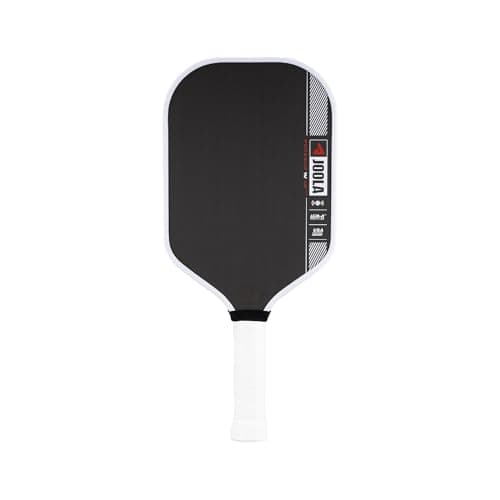 JOOLA Ben Johns Perseus Pro IV 16mm All-court power with a big sweet spot | The forgiving flagship | 8.3 | |
| 2 | 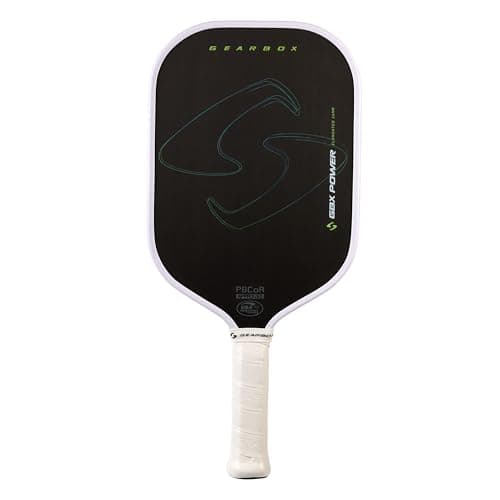 Gearbox GBX Power Elongated Raw drive power for big hitters | The raw directness pick | 7.0 | $179.99 · View on Amazon #adPrice as of October 24, 2026 |
Tap any row to jump to the full write-up. Prices are pulled live from Amazon.
JOOLA Ben Johns Perseus Pro IV 16mm
JOOLA's Gen-4 Perseus: thermoformed power and a grippy Charged surface, with the 16mm core adding forgiveness the 14mm gives up. Now the previous generation to the Pro V.
The Perseus Pro IV set the benchmark the rest of the power field chased, and JOOLA's March 2026 Pro V refines that formula rather than replacing it. The 16mm version trades a little raw pop for a larger, more forgiving sweet spot — the sensible pick if you want top-tier power without punishing off-center hits. Charged Surface Technology keeps spin high.
JOOLA's Perseus Pro IV is what the rest of the power field is chasing: thermoformed pace, a genuinely grippy Charged surface and — in the 16mm build — a sweet spot wide enough that hard hitting does not require perfect contact. It is the safer of these two paddles by a clear margin, and the one we would hand to most players who want power.
- Core
- 16 mm
- Shape
- Hybrid
- Face
- Charged carbon-fiber surface (Tech-Flex)
- Weight
- ~8.0 oz
- Build
- Thermoformed
- Gen
- Pro IV (Gen 4)
Manufacturer-listed as USA Pickleball approved. Approvals and delistings change — verify against the current USAP equipment list before tournament play (checked 2026-07).
Gearbox GBX Power Elongated
A punchy, drive-first power paddle. Gearbox's construction is stiff and solid — you feel the ball leave.
The GBX Power is for the player whose game is put-aways and drives. It's a stiffer, less forgiving frame than the foam paddles, but the payoff is directness — the ball comes off fast and predictably. Not the pick if you need help on mishits.
Gearbox builds paddles that feel different from everything else, and the GBX Power is the clearest expression of it: a stiff, solid, drive-first frame where you feel the ball leave. That directness is the appeal and the cost — it is the least forgiving paddle we cover, and mishits are punished without ceremony.
- Core
- 16 mm
- Shape
- Elongated
- Face
- Raw unidirectional carbon fiber
- Weight
- 8.0 oz avg (7.8-8.2 oz)
- Build
- Thermoformed
- Gen
- GBX (Gen-3 suspended PPE honeycomb)
The Amazon listing title states USA Pickleball approved; Pickleball Central's certification field for this paddle lists UPA-A and PBCoR only. Those are different programs for different competitions — verify your exact model against the current USA Pickleball equipment list before sanctioned play (checked 2026-10).
Side by side
| Spec | JOOLA Perseus Pro IV 16mm | Gearbox GBX Power Elongated |
|---|---|---|
| Shape | Hybrid (long) | Elongated |
| Core thickness | 16mm | 14mm |
| Face | Charged carbon-fiber surface | Carbon-fiber face |
| Construction | Thermoformed | Thermoformed |
| Listed weight | ~8.0 oz | ~8.0 oz |
| Our power score | Very high | Very high |
| Our forgiveness score | Good | Lowest in our catalog |
| Our spin score | Higher | Moderate |
Same power score, very different forgiveness score. That single divergence is the whole comparison, and it is worth more attention than the brand names.
Two kinds of power
The Perseus makes power easy. A thermoformed shell with foam-filled perimeter walls returns energy across a wide area of the face, so a ball struck slightly off-center still comes off hot. The 16mm core adds flex, which broadens the effective sweet spot further. The result is a paddle that flatters your contact — you get most of the available pace even on the shots you did not middle. Our thermoformed paddles guide explains the mechanism.
The GBX makes power honest.Gearbox's construction is notably stiff, and a stiff frame transmits rather than smooths. Hit the middle and the ball leaves fast and predictably, with a directness players who like it describe as feeling connected to the shot. Hit outside the middle and the paddle does not help you — the ball loses pace and the frame twists. The 14mm core reinforces that: thinner cores are poppier and less forgiving, as our 14mm vs 16mm guide covers.
Neither approach is wrong. Directness is genuinely valuable feedback for a strong player who wants to know exactly what they did. It is a liability for a player who is still developing consistency.
Spin: a clear gap
The Perseus wins here, and not narrowly. JOOLA's Charged carbon surface is one of the grippier faces in the flagship field, and our spin score for the Perseus is at the top of our range. Gearbox's face is a carbon-fiber surface tuned more for durability and directness than for maximum bite, and our spin score for the GBX is moderate.
If topspin drives and heavy rolls are how you want to play, that gap matters more than anything else on this page. Our how paddle spin works guide explains why the face dominates, and independent labs such as Pickleball Studio publish calibrated RPM figures across the field — we cite their machine rather than invent our own results. If spin is your priority full stop, neither of these is the optimum; our highest-spin paddles page is.
Why Gearbox paddles feel different
Gearbox has always been a slightly heterodox manufacturer, and the GBX line reflects a design philosophy built around structural stiffness rather than the industry's standard foam-and-shell recipe. The practical consequences are consistent across their range: a solid, low-flex response, strong drive on clean contact, and less of the springy assistance that characterizes the mainstream field.
Players who love Gearbox tend to be strong, confident hitters who found other paddles vague. Players who bounce off Gearbox tend to be intermediates who were sold on the power score and then discovered how much of it is conditional on clean contact. Both experiences are accurate — our full GBX Power review goes through it in detail.
How much forgiveness do you actually need?
The uncomfortable truth is that most players overestimate their contact consistency. A useful self-test: after your next session, think about how many balls felt dead or off — not shots you mis-hit tactically, but shots where the ball came off wrong. If that number is more than a couple per game, forgiveness is worth more to you than directness, and the Perseus is the safer purchase.
There is a third option worth naming, because it attacks forgiveness from a different angle. Gen-4 foam-core paddles inject foam into the core rather than only the perimeter, which stabilizes the face on off-center contact more effectively than either paddle here. The CRBN TruFoam Barrage is the example we cover, and our foam-core paddles guide explains the technology. If you want power and you mishit, that is currently the best-engineered answer.
You can also buy forgiveness with tape. Adding weight at 3 and 9 o'clock raises twist weight, which is the specific property that resists the paddle rotating on off-center contact — see our swing weight and twist weight guide and our paddle weights page. It will not transform the GBX, but it moves it meaningfully.
Who should buy which
- You want power and you are honest about mishits: Perseus. It gives you most of the pace with a much wider margin.
- You are a strong, clean hitter who finds paddles vague: GBX. Directness is the whole reason it exists.
- Spin is part of your power game: Perseus, clearly. The Charged surface out-grips the Gearbox face.
- You play doubles at the kitchen line: Perseus, and consider the standard-shape Scorpeus instead — both of these are long paddles and neither is quick in hands battles.
- You came from tennis and swing full: either, but the GBX rewards a confident full swing more than most paddles. See our power paddles for former tennis players page.
- Budget is the constraint: neither — start with power paddles under $200.
Directness as feedback, not just as feel
The case for the Gearbox is usually made as a feel preference, which undersells it. There is a functional argument too, and it is worth stating properly because it is the reason strong players choose stiff paddles.
A forgiving paddle smooths the difference between your good contacts and your mediocre ones. That is exactly what you want when you are still building consistency — it converts near-misses into playable balls. But it also means the paddle is hiding information. If a ball you struck badly still comes off well, you have lost the signal that would have told you to adjust.
A stiff, direct paddle returns that signal. You feel the difference between the middle and half an inch off it, immediately, on every shot. For a player whose technique is good enough to act on that feedback, it is a genuine coaching aid. For a player whose technique is not there yet, it is just punishment with no lesson attached — which is why the same paddle produces such polarized reactions.
The Perseus sits on the other side of that trade deliberately, and for most club players it is the correct side. Points won matter more than information gained.
Weighting each one
Both paddles respond well to weight tape, and the changes worth making are different for each.
On the GBX, the obvious move is weight at 3 and 9 o'clock. That raises twist weight — the property that resists the paddle rotating on off-center contact — which is precisely the weakness the GBX has. It will not make a stiff paddle plush, but it measurably widens the usable face, and on the least forgiving paddle we cover that is the highest-value few grams you can add.
On the Perseus, the more common complaint is speed at the net rather than forgiveness, so weight at the butt cap is usually the better change: it adds solidity while lowering swing weight, which makes the head quicker without making the paddle feel flimsy.
Both changes cost a few dollars and are fully reversible. Our swing weight and twist weight guide explains the underlying properties, and our paddle weights and tuning tape page covers lead, tungsten and pre-cut strips. Adding a few grams to a paddle you already own is a better first experiment than buying either of these.
The verdict
For most buyers, the JOOLA Perseus Pro IV is the right paddle. It delivers essentially the same power ceiling with a far wider margin for error and a better spin face, and there is no prize for choosing the harder tool. It is the paddle we recommend when someone says they want power and does not add any qualifiers.
The Gearbox GBX Power earns its place for a narrower group: strong hitters who find mainstream paddles mushy and want to feel exactly what they did to the ball. If that is you, nothing in the mainstream field will scratch the itch, and the GBX will. If it is not you, the low forgiveness score is not a detail you will grow out of in a month.
Undecided? Start from the power paddle roundup for the full field, or the most powerful paddles if pace is genuinely the only thing you are optimizing for. Our methodology page explains how we score without running a lab.
Is JOOLA or Gearbox more powerful?
Our power scores for these two paddles are equal at the top of our range — they simply produce that power differently. The Perseus uses a thermoformed shell and a 16mm core to return energy across a wide area, so power arrives even on imperfect contact. The Gearbox is stiffer and more direct, so power is high on clean contact and drops off sharply when you miss the middle.
Why are Gearbox paddles so stiff?
Gearbox builds around structural stiffness rather than the mainstream foam-and-shell recipe, which produces a low-flex, direct response. Strong hitters often prefer it because the paddle transmits exactly what they gave it rather than smoothing the shot. The cost is forgiveness — the GBX Power carries the lowest forgiveness score in our catalog.
Which has more spin, the Perseus or the GBX Power?
The Perseus, by a clear margin on our scoring. JOOLA's Charged carbon surface is one of the grippier faces in the flagship field, while the Gearbox face is tuned more for durability and directness than maximum bite. If topspin drives are central to your game, that gap matters more than anything else in this comparison.
Can I make a stiff paddle more forgiving?
Partly. Adding weight at 3 and 9 o'clock raises twist weight, the property that resists the paddle rotating on off-center contact, which measurably widens the usable face. It will not transform a stiff paddle into a plush one, but it is cheap and reversible. A Gen-4 foam-core paddle is the better-engineered answer if forgiveness is the priority.