Do You Need a Backup Pickleball Paddle?
Paddles do not usually break mid-point. They go quiet over a season, and the player holding one is the last to notice. That is the real argument for a second paddle — and it changes which one you should buy.
Disclosure: Drive Dink earns a commission from qualifying Amazon purchases at no extra cost to you. We accept no free products and no paid placements — commissions never change our picks. How this works.
The verdict first: yes, if you play more than twice a week or ever play competitively — and the reason is not the one most people give. Paddles rarely snap mid-point. What actually happens is slower and harder to spot: the grit wears off the face and your spin quietly halves, or the core softens and your drives start landing short, and because the change happens over weeks you adapt to it instead of noticing it. A second paddle is mainly a reference point — the only reliable way to find out that your main one has gone off.
The spare-tyre argument is real too, and it is seasonal: edge guards get cracked on court digs, handles get slick, and the one time it matters is the one time you have driven forty minutes to a league night. Below: the three failure modes, whether to buy a matched pair or a cheaper spare, and three paddles around the hundred-dollar mark that are good enough to actually play with.
Units we claim to have tested: 0.Specs are the manufacturers' published figures and the scores are our editorial read of them. Prices come from our live layer and move daily.
Selkirk SLK Halo Control Max
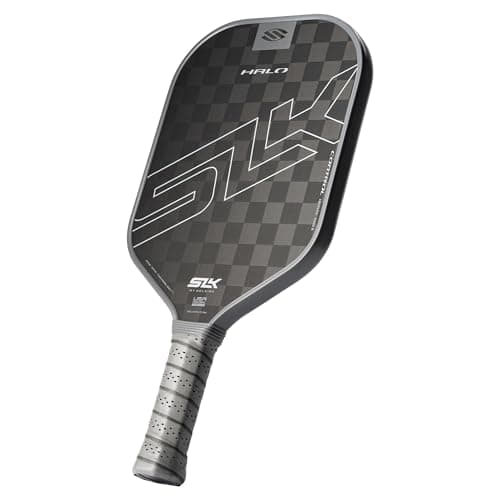
Selkirk's value sub-brand doing the sensible thing: a 16mm core and a raw carbon face in a standard outline, at roughly half what the Vanguard line costs.
The spec table is the argument. Selkirk publishes a 16mm core, a raw carbon face, a 16 x 7.85in standard outline, a short 4.85in handle, a 4.25in grip and a 7.9 oz average. That is the same recipe as paddles costing twice as much, minus the thermoformed shell - Selkirk publishes no molding method for the SLK line, so we do not assert one. The short handle is the real trade: it rules the paddle out for a two-handed backhand.
For the player who wants a second paddle that is not a downgrade. Selkirk publishes a 16mm core behind an 18k UltraWeave raw carbon face in a 16 x 7.85in standard outline, with a 4.85in handle, a 4.25in grip and a 7.9 oz average, at around a third of flagship money on our live layer. It scores an 8 on spin, control and forgiveness with a 7 on power - the most balanced card at this price - which is exactly what you want from a paddle you might have to play a whole league night on. The standard outline also makes it a useful contrast to an elongated main paddle. The cons: the 4.85in handle rules it out for a two-handed backhand, Selkirk publishes no molding method for the SLK line so we do not assert one, and a cold-pressed frame will not match a thermoformed main paddle for pop, which you will notice on the first drive.
- Core
- 16 mm
- Shape
- Standard
- Face
- 18k UltraWeave raw carbon face (per Selkirk's listing)
- Weight
- ~7.9 oz
- Build
- Not published
- Gen
- SLK Halo
Manufacturer-listed as USA Pickleball approved. Approvals and delistings change — verify against the current USAP equipment list before tournament play (checked 2026-07).
Vatic Pro Prism Flash 16mm
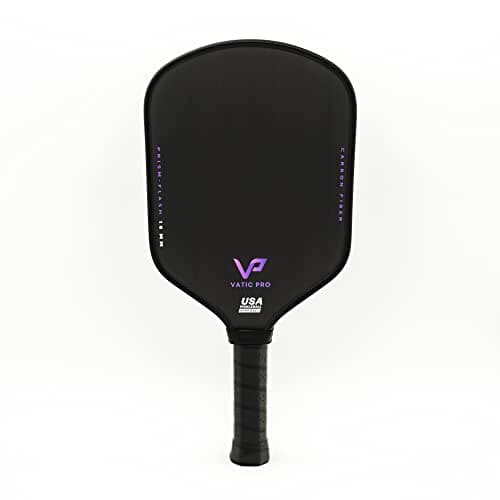
The value-shopper's spin paddle: raw T700 carbon and a thermoformed build that punches well above its price.
Vatic built a reputation on giving you 90% of a $250 paddle for around a hundred bucks. The Prism Flash's raw T700 face grips for spin and the elongated frame adds reach — the paddle we recommend when 'best spin under $100' is the search.
For the player whose main paddle is thermoformed and elongated, and who does not want the backup to feel like a different sport. Vatic publishes a thermoformed 16mm elongated frame with a raw Toray T700 carbon face at about 8.0 oz, and it scores a 9 on spin with an 8 on power - the same construction recipe as paddles costing twice as much. It is the paddle we point to when the search is 'best spin under $100', and as a backup it is the closest thing at this price to a flagship's behaviour. The cons: a 7 on control, so it is a power paddle in a backup slot rather than a safe all-court one; thermoformed construction is the build with the documented delamination history, so your backup carries the same risk as your main; and the stock grip is thin enough that most players build it up.
- Core
- 16 mm
- Shape
- Elongated
- Face
- Raw Toray T700 carbon fiber
- Weight
- ~8.0 oz
- Build
- Thermoformed
- Gen
- Prism
Manufacturer-listed as USA Pickleball approved. Approvals and delistings change — verify against the current USAP equipment list before tournament play (checked 2026-07).
Volair Mach 1 Forza 16mm
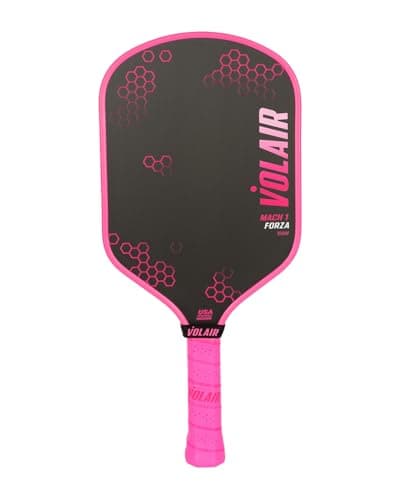
A thermoformed unibody frame with foam-injected edge walls and a long 5.5in handle — flagship construction at roughly half flagship money.
The Mach 1 Forza is the cheapest way we know to buy the full modern power recipe: hot-molded unibody build, raw T700 carbon face, and foam packed into the perimeter walls to widen the sweet spot. At 16.5in long with a 5.5in handle it is a genuine elongated frame, and the listed 8.2oz average weight tells you it is not a light paddle to swing.
For the player who wants the second paddle to cost as little as possible without becoming a wall-hanger. Volair publishes a thermoformed unibody frame with foam-injected edge walls and a raw Toray T700 carbon face, 16.5in long with a 5.5in handle and a listed 8.2 oz average, and it is the cheapest paddle on our live layer by a clear margin. It scores a 9 on both spin and power, which at this price is the most unusual thing on this page. The 5.5in handle also makes it the only pick here that works with a two-handed backhand. The cons: at 8.2 oz listed it is not light to swing, so it feels heavier than your main paddle rather than merely cheaper; a 7 on control; and Volair carries far less circulation than the big brands, which means fewer publicly documented failure modes.
- Core
- 16 mm
- Shape
- Elongated
- Face
- Toray T700 raw carbon fiber
- Weight
- ~8.2 oz
- Build
- Thermoformed
- Gen
- Foam-injected edge walls (Gen 3)
Manufacturer-listed as USA Pickleball approved. Approvals and delistings change — verify against the current USAP equipment list before tournament play (checked 2026-07).
The three ways a paddle ends a session
1. Grit wear — slow, invisible, the most common. A raw carbon face generates spin through surface texture, and that texture abrades every time you brush the ball. There is no moment where it stops working; there is a season over which your topspin dive gets shallower and your serve sits up more. Players almost never catch this on their own paddle, because the change is slower than memory. The only honest test is hitting the same shot with a newer face. Details in grit durability and when a paddle is worn out.
2. Core softening or delamination — gradual, then sudden. Thermoformed paddles have a documented failure mode where the face separates from the core. It often announces itself as a paddle that suddenly plays hotter — balls flying long — followed by a dead spot and a rattly sound. If your drives start sailing for no reason you changed, that is the thing to check for, and a known-good second paddle is how you confirm it. See paddle delamination.
3. Physical damage — rare, instant, usually the edge. Scraping the bumper digging out a low ball, or clipping a partner's paddle in a kitchen scramble. A cracked edge guard will not usually end a game but it will end the paddle's useful life if moisture gets into the core. This is the only one of the three that the spare-tyre framing actually describes.
A matched pair, or a cheaper second paddle?
This is the real decision, and the answer depends on which of the three problems above you are solving.
Buy a matched pair — the same model again — if you play tournaments or serious league. The point of a tournament backup is that nothing changes when you pick it up: same swing weight, same face, same balance. A different paddle in the middle of a match is a second problem on top of the first. The cost is that you learn nothing about grit wear, because both faces age at the same rate if you rotate them evenly.
Buy a different, cheaper paddleif you are a recreational player and the honest use case is "something in the bag" plus a reference point. A second paddle that is deliberately not rotated into regular play keeps a fresh face for months and becomes a reliable test: hit ten serves with each, and if the new one bites noticeably more, your main one is done.
Buy a deliberately different shape if you are still working out what suits you. A standard-shape backup next to an elongated main paddle, or a widebody next to either, teaches you more in a month than reading spec sheets does — and the cheap end of the market is a much better place to run that experiment than the flagship end. Start at the shape guide or standard-shape paddles.
What the picks give up to a flagship
| Spec | SLK Halo Control Max | Vatic Prism Flash | Volair Mach 1 Forza |
|---|---|---|---|
| Core | 16mm | 16mm | 16mm |
| Face | 18k UltraWeave raw carbon | Raw Toray T700 carbon | Toray T700 raw carbon |
| Shape | Standard (16 x 7.85in) | Elongated | Elongated (16.5in) |
| Handle | 4.85in | Not published | 5.5in |
| Molding | Not published | Thermoformed | Thermoformed unibody |
| Listed weight | ~7.9 oz | ~8.0 oz | ~8.2 oz |
| Two-handed backhand | No | Possible | Yes |
| Our spin / power / control / forgiveness | 8 / 7 / 8 / 8 | 9 / 8 / 7 / 8 | 9 / 9 / 7 / 8 |
The row that answers the question is the face. All three run raw carbon, which is the spec that produces spin, and spin is the thing that degrades first on your main paddle. A backup with a fiberglass face would be useless as a reference point because it would never out-bite anything.
How to rotate two paddles
Three practical rules, none of which cost anything.
Do not rotate evenly if you want a reference. Play your main paddle almost always and keep the second fresh. Two paddles worn at the same rate tell you nothing about either.
Run the same grip build-up on both. If your main paddle has an overgrip and your backup does not, they are different handle sizes and the backup will feel wrong in the one moment you need it to feel right. Our grip size guide covers the stack.
Test monthly, not by feel.Same serve, ten balls with each, same target. If the fresh face is clearly biting more, your main paddle's grit has gone — which is a cheaper problem to have discovered deliberately than to find out during a match.
When a backup is a waste of money
If you play once a week recreationally, your face will take a long time to wear and the odds of a mid-session failure are low. A second paddle is a reasonable thing to want and it is not a performance purchase, and we would rather say so than sell you one.
The better spend at that frequency is almost always the same three things: a fresh grip, a good pair of court shoes, and balls that are not out of round. Those change how you play; a spare paddle in a bag does not. See grips and overgrips, pickleball shoes and pickleball balls. And if you are reading this because your current paddle feels off, diagnose that first with when a paddle is worn out rather than buying around the problem.
The bottom line
Own two if you play competitively or more than twice a week. Buy a matched pair if you play tournaments and need nothing to change when you swap. Buy a different, cheaper paddle if what you actually need is a fresh face to measure your main one against — and keep it fresh by not playing it. The SLK Halo Control Max is the best-rounded of the three, the Prism Flash is the closest in behaviour to a thermoformed flagship, and the Volair Mach 1 Forza is the cheapest paddle here we would happily play a league match with.
Do you need a backup pickleball paddle?
If you play competitively or more than twice a week, yes — but the main reason is not breakage. A paddle's grit wears off and its core softens gradually enough that you adapt without noticing, and a second, less-used paddle is the only reliable way to detect it. For once-a-week recreational play, a spare grip and better shoes are a better spend.
Should my backup paddle be the same model as my main one?
For tournaments, yes — the point of a match backup is that nothing changes when you pick it up. For recreational play, a different and cheaper paddle is more useful, because keeping a fresh face in reserve gives you a reference point for how much spin your main paddle has lost.
How do you know when a pickleball paddle is worn out?
Compare it with a fresher face. Hit ten of the same serve with each paddle at the same target: if the newer one visibly bites more, your main paddle's grit has gone. Other signs are drives suddenly flying long, which can indicate delamination, and a rattly or dead-sounding spot on the face.
How much should a backup pickleball paddle cost?
Around a hundred dollars buys a 16mm core and a raw carbon face, which is the same recipe as paddles costing twice as much. Below that you start losing the raw carbon face, which makes the paddle useless as a spin reference point. Above it you are paying for construction you do not need in a paddle you rarely play.
Can you use two different paddles and not get confused?
Mostly, if you keep the grip build-up identical on both — a paddle with an overgrip and one without are two different handle sizes, and that is the difference you will actually feel. Switching shapes deliberately is a useful way to learn what suits you, as long as you are not doing it mid-match.