Best Spin Paddles for Advanced Players
At the top of the game, forgiveness stops being the priority and the ceiling starts being it. These are the paddles that reward consistent contact instead of protecting against bad contact.
Disclosure: Drive Dink earns a commission from qualifying Amazon purchases at no extra cost to you. We accept no free products and no paid placements — commissions never change our picks. How this works.
Almost every paddle roundup is implicitly written for a 3.5 player, and that shapes the recommendations more than anyone admits: forgiveness gets weighted heavily, demanding paddles get marked down, and the safe pick wins. At 4.5 and above the calculus changes. You produce your own spin, you find the middle of the face reliably, and the paddle's job stops being damage control and starts being ceiling.
Units we claim to have tested: 0. We compile manufacturer-published specifications, cite the independent labs that measure spin, and rank by fit. Prices move; the live Amazon price above is the only one to trust.
| # | Paddle | Best for | Score | Price |
|---|---|---|---|---|
| 1 | 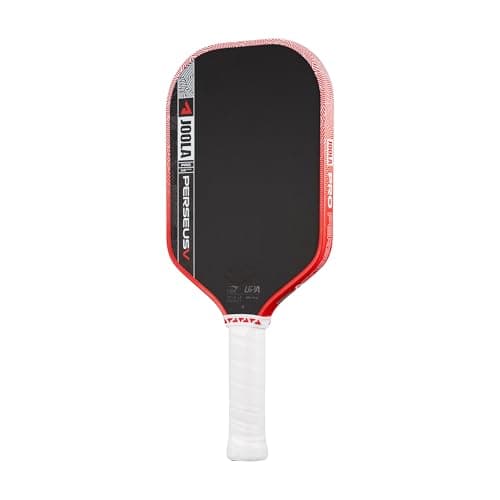 JOOLA Perseus Pro V Buyers who want JOOLA's newest generation | Highest ceiling | 8.3 | $299.95 · View on Amazon #adPrice as of October 22, 2026 |
| 2 | 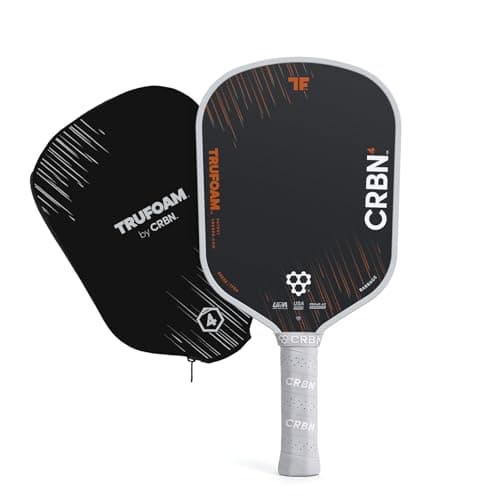 CRBN TruFoam Barrage Newest-gen foam power + stability | Best current-generation build | 8.3 | |
| 3 | 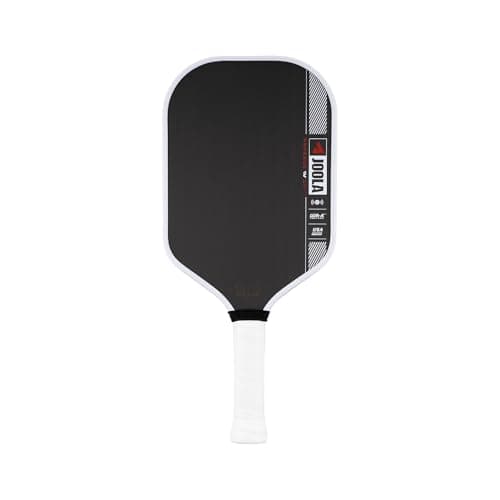 JOOLA Ben Johns Perseus Pro IV 14mm Fast hands + spin at the net | Fastest hands | 7.8 | |
| 4 | 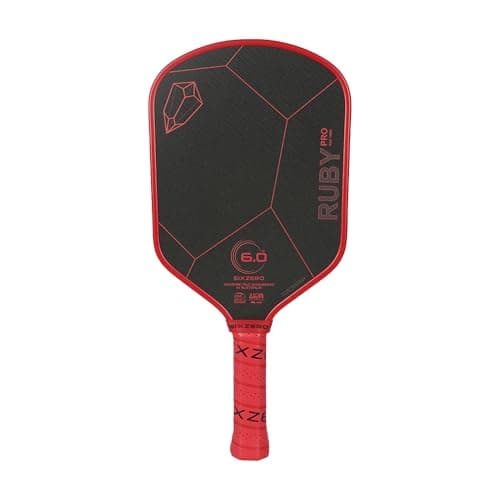 Six Zero Ruby Pro 14mm Spin durability (grit that lasts) | Best grit longevity | 7.8 | $225.00 · View on Amazon #adPrice as of October 22, 2026 |
| 5 | 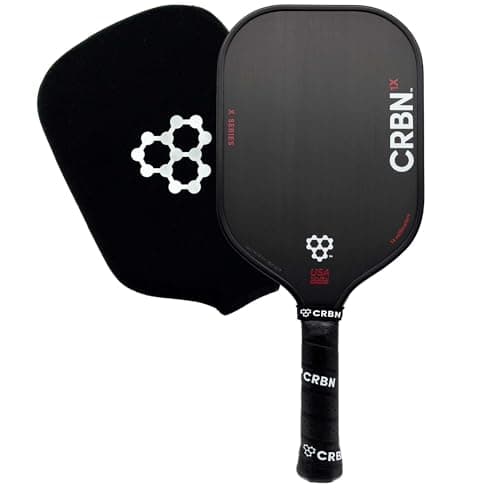 CRBN X-Series Power Clean, refined power feel | Best refined feel | 8.0 | $149.99 · View on Amazon #adPrice as of October 22, 2026 |
Tap any row to jump to the full write-up. Prices are pulled live from Amazon.
JOOLA Perseus Pro V
JOOLA's newest Perseus generation — a raw-carbon face for spin and a flexing KineticFrame throat over the familiar thermoformed power, offered in 14mm and 16mm.
Launched in March 2026, the Pro V changes the Perseus formula in two places: a raw-carbon hitting surface aimed at spin, and JOOLA's patent-pending KineticFrame, a slimmer throat built to flex on contact. It's the priciest paddle we cover; whether it's worth the jump over a Pro IV comes down to feel preference more than a spec gap.
The Pro V is JOOLA's newest Perseus generation and pairs a raw-carbon hitting surface with the thermoformed power the line is built on. For a player who can already produce spin, a raw face plus a flagship power platform is the combination with the least left on the table. The con is straightforward and worth saying plainly: it is the most expensive paddle we cover, and the step up from a Pro IV is a feel difference rather than a spec gap.
- Core
- 16 mm
- Shape
- Hybrid
- Face
- Raw carbon-fiber texture
- Weight
- ~8.0 oz
- Build
- Thermoformed
- Gen
- Pro V (Gen 5)
Manufacturer-listed as USA Pickleball approved. Approvals and delistings change — verify against the current USAP equipment list before tournament play (checked 2026-07).
CRBN TruFoam Barrage
A Gen-4 foam-wall paddle: the foam core widens the sweet spot and adds stability on off-center hits without killing power.
Foam-injected 'Gen 4' construction is where the category is heading — the foam broadens the sweet spot and calms twisting on mishits while keeping the power high. The Barrage is CRBN's take, and it's one of the more polished foam builds you can buy.
Gen-4 foam construction injects foam into the core rather than only the perimeter, which stabilizes the face on off-center contact without deadening the paddle. For an advanced player that is not a crutch — it is what lets you swing at full commitment on a stretch ball and still get a usable result. The con is the 14mm core stacked on an elongated frame: two demanding choices at once, and it plays like it.
- Core
- 14 mm
- Shape
- Elongated
- Face
- Raw carbon face over a foam-injected core
- Weight
- ~8.0 oz
- Build
- Thermoformed
- Gen
- Gen 4 (foam)
Manufacturer-listed as USA Pickleball approved. Approvals and delistings change — verify against the current USAP equipment list before tournament play (checked 2026-07).
JOOLA Ben Johns Perseus Pro IV 14mm
The 14mm Perseus is quicker and poppier than the 16mm — more spin and speed, less forgiveness. A hard-swinging aggressor's paddle.
Same Charged surface and thermoformed build as its 16mm sibling, but the thinner core makes it faster through the air and livelier off the face. You get more spin and more pop at the cost of a smaller margin for error — ideal if your game is built on speed and you catch the ball clean.
The 14mm Perseus is the aggressor's version of the flagship — quicker through the air, livelier off the face, and the pick for a player whose game is speed-ups and counters rather than construction. You keep the Charged surface, so the spin ceiling stays high. The con is margin: the thinner core is measurably less forgiving, and at speed that shows up on the balls you catch slightly late.
- Core
- 14 mm
- Shape
- Hybrid
- Face
- Charged carbon-fiber surface (Tech-Flex)
- Weight
- ~8.0 oz
- Build
- Thermoformed
- Gen
- Pro IV (Gen 4)
Manufacturer-listed as USA Pickleball approved. Approvals and delistings change — verify against the current USAP equipment list before tournament play (checked 2026-07).
Six Zero Ruby Pro 14mm
Six Zero's answer to the industry's biggest spin complaint — a tougher face built to hold its grit longer than typical raw carbon.
Raw-carbon spin is great until the grit wears smooth. The Ruby's abrasion-resistant face is designed to keep biting longer, which matters most to the high-volume player who replaces paddles when the spin dies. Premium price, but the durability angle is real.
Advanced players play more, and playing more is what kills a spin face — raw carbon polishes smooth and the bite fades. The Ruby Pro's abrasion-resistant face is a direct answer to that, and for anyone playing several times a week it may be the cheaper paddle over two seasons. The con is that a durability-focused face is a design compromise: it is not chasing the single highest first-week spin figure.
- Core
- 14 mm
- Shape
- Elongated
- Face
- Diamond-tough abrasion-resistant face
- Weight
- ~8.0 oz
- Build
- Thermoformed
- Gen
- Ruby
Manufacturer-listed as USA Pickleball approved. Approvals and delistings change — verify against the current USAP equipment list before tournament play (checked 2026-07).
CRBN X-Series Power
CRBN's power line has a following for a reason: thermoformed pace with a cleaner, less hollow feel than some rivals.
The X-Series Power gives you the thermoformed power everyone wants but with a feel a lot of players describe as more solid and less 'tinny' than the cheaper thermoformed crowd. A dependable elongated power paddle from a respected brand.
Strong players tend to become picky about feel long before they become picky about specs, and the X-Series Power's reputation rests entirely on feeling more solid and less hollow than the cheaper thermoformed field. Pair that with a raw carbon face and a 14mm core and you get a paddle that transmits exactly what you did. The con is the same as its virtue: it is direct, so it does not smooth over a bad contact.
- Core
- 14 mm
- Shape
- Elongated
- Face
- Raw carbon-fiber face
- Weight
- ~8.0 oz
- Build
- Thermoformed
- Gen
- X-Series
Manufacturer-listed as USA Pickleball approved. Approvals and delistings change — verify against the current USAP equipment list before tournament play (checked 2026-07).
What actually changes at the top of the recreational game
Forgiveness becomes cheaper to give up. Not free — even professionals mishit — but a player who middles the ball nine times out of ten pays a much smaller penalty for a narrow sweet spot than one who middles it six times out of ten. That is why 14mm cores appear three times on this list and would appear zero times on a beginner list.
Spin becomes a tactical weapon rather than a feature. At lower levels spin is mostly about keeping drives in. At higher levels it is what makes a roll volley dip at the opponent's feet, what makes a third-shot drop unattackable, and what turns a defensive lob into an offensive one. The face material stops being a nice-to-have.
Grit longevity starts to matter financially. If you play four or five times a week on outdoor courts, a raw carbon face will noticeably lose bite in a fraction of the time it takes a twice-a-week player. That is a recurring cost, and it is the reason one of these picks is chosen specifically for durability. Our grit and durability guide covers what wears and how fast.
Feel becomes a real selection criterion. Once performance differences between good paddles narrow, how a paddle sounds and responds at contact drives more purchase decisions than spec sheets do. That is not irrational — feel is feedback, and feedback is how you adjust mid-rally.
How we picked
Three requirements. Each paddle had to carry a current-generation hitting surface — raw carbon, a charged/textured carbon surface, or a purpose-built abrasion-resistant face — because a spin list at this level cannot include painted composites. Each had to score at the top of our spin range. And each had to offer something a strong player can specifically exploit: a higher ceiling, a newer construction, more speed, longer grit life or better feedback.
Our scores for spin, power, control and forgiveness are our editorial read of compiled specifications and reviewer consensus — not measurements, and never published as a star rating in structured data. For measured spin figures we defer to Pickleball Studio, which runs calibrated testing and publishes results. Our approach is documented on the methodology page.
The honest caveat about this whole category
Here is something most sites at this end of the market will not tell you: the spread in measured spin between good current-generation raw-carbon paddles is not large. Spin is overwhelmingly a face property, and once you are on a genuinely raw, textured carbon surface, you are in the same neighborhood as everything else on that surface — including paddles costing a third of these. Our how paddle spin works guide explains the mechanism and our best spin paddles under $100 page makes the value case directly.
What flagship money buys an advanced player is not more grip. It is power ceiling, off-center stability, manufacturing consistency (which matters if you tune with weight or carry a matched backup), feel, and warranty access. Those are worth paying for at this level in a way they are not at 3.0. But if someone tells you a two-hundred-dollar paddle spins fundamentally harder than a hundred-dollar raw-carbon paddle, they are selling something. Our paddle price guide works through the tiers.
Core and shape at this level
Three of these paddles run a 14mm core. That is a deliberate skew: a thinner core is stiffer, faster and poppier, and the resulting narrower margin is a cost an advanced player can absorb. If your hands game is built on speed-ups and counters, 14mm is the correct side of the split. If you play a heavier, more constructed game from further back, 16mm still gives you a better platform. Our 14mm vs 16mm guide covers it.
Every paddle here is elongated or hybrid, which is normal at this level — reach and leverage are worth more once you are consistent enough to exploit them. But it is not universal. Plenty of strong doubles players use standard shapes precisely because hands battles decide their points, and the JOOLA Scorpeus Pro IV is the flagship-grade option there. Our shape guide covers the trade.
Tuning is standard practice at this level
Advanced players rarely play a paddle as it comes out of the box, and that is worth knowing before you spend flagship money chasing a characteristic you could add yourself.
Weight at 10 and 2 o'clock raises swing weight and adds drive. Weight at 3 and 9 raises twist weight and widens the usable face against off-center contact. Weight at the handle lowers swing weight and speeds the head up. All three are reversible, cost a few dollars, and change a paddle more than most people expect — our swing weight and twist weight guide explains the properties and our paddle weights and tuning tape page covers what to buy.
Grip is the other lever, and it is more consequential than most players realize — circumference changes how hard you have to squeeze, which changes wrist stability on brushed contact. Our grip size guide and grips page cover it.
Who should buy which
- You want the highest ceiling and price is not the constraint: the JOOLA Perseus Pro V.
- You want the newest construction and swing at full commitment: the CRBN TruFoam Barrage.
- Your game is speed-ups, counters and hands: the Perseus Pro IV 14mm.
- You play four-plus times a week outdoors: the Six Zero Ruby Pro. Grit longevity is a real cost at your volume.
- You want maximum feedback and a solid feel: the CRBN X-Series Power.
What to avoid at this level
Buying for a spec you cannot use. A higher power score is worthless if your errors are all long. Audit your own losses before buying — the paddle should fix the weakness you actually have, not the one the review emphasizes.
Stacking demanding choices. Elongated plus 14mm plus a high swing weight produces a paddle that is genuinely punishing. Strong players get away with more than most, but there is a limit and it arrives sooner in a three-hour session than in a ten-minute demo.
Ignoring USAP status on the newest models. Approval and delisting decisions land on specific model revisions and change over time, and the highest-performance end of the market is where that activity concentrates. If you compete, check the current USAP approved paddle list before you enter — our USAP-approved paddles guide explains how the process works and why it matters more here than anywhere else.
Replacing a paddle that is fine. If your face still grips and your core still feels alive, the upgrade is unlikely to be the thing holding you back. Our guide to when a paddle is actually done gives you a check to run first.
The bottom line
For a strong player with a flexible budget, the Perseus Pro V is the highest-ceiling paddle we cover and the TruFoam Barrage is the most current construction. For a player whose game is speed rather than weight, the 14mm Perseus is the sharper tool. For high-volume players, the Ruby Pro's durable face is the argument nobody makes often enough.
And the contrarian recommendation, which we stand behind: if you are upgrading from a good raw-carbon paddle purely for spin, you may not get what you are paying for. Spend the difference on tuning your current paddle and replacing your court shoes instead. Compare against the full field in our spin paddle roundup and highest-spin paddles pages before committing.
Do advanced players need a different paddle?
Different priorities rather than a different category. A player who consistently finds the middle of the face pays a smaller penalty for a narrow sweet spot, so they can trade forgiveness for a higher ceiling — thinner cores, longer frames, more demanding builds. A 3.5 player making that same trade usually loses more points than they gain.
Is an expensive paddle actually spinnier than a cheap one?
Not by much, once both have genuinely raw, textured carbon faces. Spin is overwhelmingly a surface property, and the spread between good current-generation raw-carbon paddles is smaller than the price spread suggests. What flagship money buys is power ceiling, off-center stability, manufacturing consistency, feel and support — not fundamentally more grip.
Should an advanced player use a 14mm or 16mm core?
It depends on your game rather than your rating. A 14mm core is stiffer, faster and poppier, which suits a hands-and-counters game where speed decides points. A 16mm core gives a steadier platform and a wider margin, which suits a heavier constructed game from further back. Stacking a 14mm core with an elongated frame is a genuinely demanding combination.
How often do advanced players need to replace a spin paddle?
It depends almost entirely on volume and surface. Raw carbon polishes smooth with play and wears faster on abrasive outdoor courts with hard outdoor balls. Playing several times a week outdoors, expect the bite to fade noticeably sooner than a twice-a-week indoor player would see. An abrasion-resistant face is a direct answer to that recurring cost.