Engage Pursuit Pro1 vs Pursuit Alpha Pro
Same 16.5 x 7.5in outline, same raw carbon face, same brand — and a full construction generation plus roughly double the price between them. One of them also has the longer handle, and it is not the expensive one.
Disclosure: Drive Dink earns a commission from qualifying Amazon purchases at no extra cost to you. We accept no free products and no paid placements — commissions never change our picks. How this works.
The verdict first: buy the Pursuit Alpha Pro 16mm unless you hit a two-handed backhand or the price gap decides it for you. It is the only current-construction paddle Engage sells — thermoformed, with a foam edge barrier — and it takes a point of control and a point of forgiveness off the Pro1 for the same spin and power. That is the whole case, and it is a real one.
But the Pro1 wins a spec that no amount of construction can give back: handle length. Engage publishes 5.875in on the Pro1 Elongated against 5.5in on the Alpha Pro. If your backhand needs two hands on the grip, the cheaper, older paddle fits you better than the flagship, and that is an unusual result worth stating plainly before you spend.
Units we claim to have tested: 0.Specs are Engage's and its retailers' published figures; the scores are our editorial read of them. Prices come from our live layer and move daily — we never type a price into the page.
| # | Paddle | Best for | Score | Price |
|---|---|---|---|---|
| 1 | 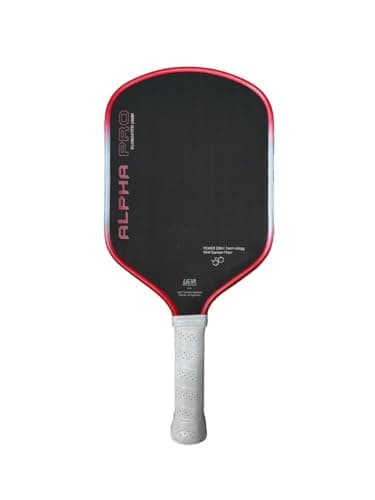 Engage Pursuit Alpha Pro 16mm Engage's current flagship, on the control side | Wins on construction | 8.3 | $199.99 · View on Amazon #adPrice as of October 24, 2026 |
| 2 | 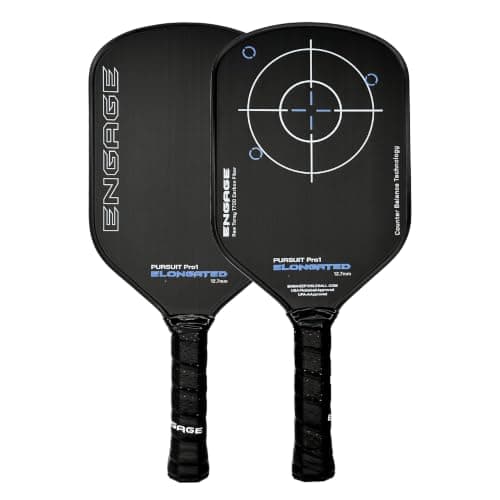 Engage Pursuit Pro1 Elongated 15.2 The cheapest way into Engage's raw-carbon line | Wins on value, and on handle length | 7.8 |
Tap any row to jump to the full write-up. Prices are pulled live from Amazon.
Engage Pursuit Alpha Pro 16mm
Engage's answer to the thermoformed field: a 16mm DrivePro polymer core wrapped in an edge foam barrier, built for resets rather than raw pop.
The Alpha Pro is the paddle that finally puts Engage on current construction — thermoformed, with a DrivePro polymer core and a foam barrier around the edges, behind a raw carbon face. Engage publishes a 16.5 x 7.5in outline, a 5.5in handle, a 4.25in grip and a 7.8-8.2 oz range. The 16mm core is the control cut of the two.
The paddle to buy if you want the best Engage rather than the best-value Engage. Engage publishes a 16mm DrivePro polymer core with a foam barrier bonded around the perimeter, thermoformed, behind a raw carbon face, in a 16.5 x 7.5in outline with a 5.5in handle, a 4.25in grip and a 7.8-8.2 oz range. Thermoforming bonds the whole paddle as one compressed unit instead of gluing a sandwich together, and the edge foam fills the dead space where a cold-pressed paddle goes soft - which is why our forgiveness score for it sits a point above the Pro1's and our control score sits a point higher too. We score it 8 spin, 8 power, 9 control, 8 forgiveness, the most balanced Engage we have specced. The cons are honest ones: it is roughly double the Pro1's money, it is Engage's newest model so almost nothing is publicly known about how the face holds grit past a season, its 5.5in handle is shorter than the paddle it is replacing, and it showed only a handful of units left when we checked stock on October 22, 2026.
- Core
- 16 mm
- Shape
- Elongated
- Face
- Raw carbon fiber
- Weight
- 7.8-8.2 oz (8.0 oz avg)
- Build
- Thermoformed
- Gen
- Pursuit Alpha Pro (DrivePro core + edge foam barrier)
Manufacturer-listed as USA Pickleball approved. Approvals and delistings change — verify against the current USAP equipment list before tournament play (checked 2026-07).
Engage Pursuit Pro1 Elongated 15.2
The value entry to Engage: a 15.2mm MachPro polymer core behind raw T700 carbon, in the longest handle Engage publishes.
Engage publishes a 16.5 x 7.5in elongated outline, a 15.2mm MachPro polymer core, a raw T700 carbon face, a 5.875in handle and a 4 1/4in grip at an 8.0 oz average. It is a cold-pressed polymer paddle rather than a thermoformed foam build, which is exactly why it costs a fraction of the Alpha Pro — and why it gives up pop at the top end.
The paddle to buy if you want most of the Alpha Pro's geometry for a fraction of its price, or if you hit a two-handed backhand. Engage publishes a 15.2mm MachPro polymer core behind a raw T700 carbon face, the same 16.5 x 7.5in outline, an 8.0 oz average, a 4 1/4in grip - and a 5.875in handle, which is the longest Engage publishes and a clear 3/8in longer than the Alpha Pro's. For a two-hander that single spec can decide the whole comparison. We score it 8 spin, 8 power, 8 control, 7 forgiveness, which is a genuinely good all-court card. The con is the one Engage will not print: this is a cold-pressed polymer build, a construction generation behind the Alpha Pro, and you feel it at the perimeter - a ball struck away from the middle goes dead rather than merely weak. It also has no foam barrier and no thermoformed bond, so it is the paddle that will feel older first.
- Core
- 15 mm
- Shape
- Elongated
- Face
- Raw T700 carbon fiber
- Weight
- ~8.0 oz avg
- Build
- Cold-pressed
- Gen
- Pursuit Pro1 (MachPro core)
Manufacturer-listed as USA Pickleball approved. Approvals and delistings change — verify against the current USAP equipment list before tournament play (checked 2026-07).
First, which paddle is which
Engage's naming makes this comparison harder than it should be, so here is the map.
Pursuit Pro1 is part of the older Pursuit Pro family, alongside the Pro MX and Pro EX. All of them are cold-pressed polymer paddles — a honeycomb core pressed between two carbon faces with an edge guard holding the sandwich together — and Engage publishes them at 15.2mm, an unusual thickness that sits almost exactly between the 14mm and 16mm the rest of the market uses.
Pursuit Alpha Pro is the newer line and the only thermoformed one. Engage publishes it on a DrivePro polymer core with an edge foam barrier, in 14mm and 16mm — so the Alpha Pro abandons 15.2mm and asks you to make the standard core-thickness decision instead. This page compares the 16mm Alpha Pro, because that is the control-side cut and the closest match in intent to the all-court Pro1. If you want the 14mm, our best Engage paddles roundup ranks all five current Engage paddles together, including both Alpha Pro cores.
One more trap: the word “Standard” in an Engage listing title is usually the weight option rather than the shape — Engage sells most Pursuit models in Standard and LITE weights. Both paddles on this page are elongated.
The published specs
| Spec | Pursuit Alpha Pro 16mm | Pursuit Pro1 Elongated 15.2 |
|---|---|---|
| Outline | 16.5 x 7.5in (elongated) | 16.5 x 7.5in (elongated) |
| Core | 16mm DrivePro polymer + edge foam barrier | 15.2mm MachPro polymer honeycomb |
| Construction | Thermoformed | Cold-pressed |
| Face | Raw carbon fiber | Raw T700 carbon fiber |
| Handle length | 5.5in | 5.875in |
| Grip circumference | 4.25in | 4.25in |
| Weight | 7.8-8.2 oz (8.0 oz avg) | ~8.0 oz avg |
| Named tech | DrivePro core, edge foam barrier | Vortex Barrier Edge, Variable Release |
| Our scores (spin / power / control / forgiveness) | 8 / 8 / 9 / 8 | 8 / 8 / 8 / 7 |
Read that table carefully and the shape of the decision is obvious: outline, face family, grip and weight are effectively the same paddle. Three things differ — the construction, the core, and the handle. The price difference, which is substantial and which you can see live on the cards above, is being charged for the first two.
What thermoforming and edge foam actually buy
This is the part worth paying for, so it deserves a straight explanation rather than a marketing one.
A cold-pressed paddle is an assembly: core, two faces, adhesive, edge guard. The bond between face and core is glue, and the perimeter of the core is the weakest part of the structure because there is nothing bracing it. That is why a ball struck near the edge of an older paddle feels dead — the core flexes and absorbs instead of returning energy — and it is also where delamination tends to start, because that is where the shear stress on the adhesive is highest.
Thermoforming compresses and bonds the whole paddle as one unit under heat, which stiffens the frame and removes the discrete glue line. Adding a foam barrier around the inside of the perimeter fills the dead space with something that pushes back. The combined effect is a wider usable face and a firmer response at its edges, which is exactly what our one-point gaps in control and forgiveness are describing. Our thermoformed paddles guide covers the process in depth, and Gen 3 and Gen 4 foam paddles explained places Engage's approach next to the foam builds from JOOLA, CRBN and Six Zero.
The honest caveat, and it cuts against the Alpha Pro: thermoformed construction is also the build with the documented delamination history in this category. Stiffer frames that hit harder put more stress on the bond, and the first thermoformed generation produced a well-recorded set of failures across several brands. Our delamination and core crush guide is the page to read before you assume newer construction means more durable. The Pro1's cold-pressed build is a generation behind on performance and arguably a generation ahead on predictability.
16mm versus 15.2mm: eight tenths of a millimeter
Do not overthink this one. The core gap between these two paddles is 0.8mm, which is small enough that it is the least important of the three differences.
Core thickness trades pop against dwell. A thinner core puts less damping material between the ball and your hand, so the ball leaves faster with less feedback and less margin; a thicker core absorbs more, giving a softer, more controllable, more forgiving response and less free pace. Our 14mm vs 16mm guide works through the full decision and our dwell time guide explains the mechanism.
Between 15.2mm and 16mm, though, you are nowhere near the ends of that range. The Alpha Pro's extra control in our scoring comes far more from the thermoformed frame and the edge foam than from 0.8mm of core. Where the core number matters on Engage's shelf is the choicewithin the Alpha Pro line, between its 14mm and 16mm cuts — that is a real 2mm and a real decision, and it is the one we rank in the brand roundup.
The handle, which is the one spec the Pro1 wins outright
Engage publishes 5.875in on the Pro1 Elongated and 5.5in on the Alpha Pro. That 3/8 of an inch is the most consequential number on this page for one specific group of players.
If you hit a two-handed backhand, handle length is a fit requirement rather than a preference. Your bottom hand needs room below your top hand, and when it does not get it you either choke up — losing the leverage you added the second hand for — or you ride your lower hand onto the paddle face, which is uncomfortable and inconsistent. No amount of core technology compensates for a handle your hands do not fit on. Our handle length guide explains how to measure what you need and best paddles for a two-handed backhand ranks the whole catalog on it — for scale, the longest handle we cover anywhere is 6in.
For a one-handed player this is close to irrelevant, and a shorter handle slightly moves mass toward the face, which is where you want it for drive power. So: two hands, buy the Pro1; one hand, the handle should not affect your decision at all.
Availability, and why we are flagging it
Engage listings churn harder than any brand we track, and it is a genuine buying consideration rather than a footnote.
When we verified Engage's current Amazon shelf through the Creators API on October 22, 2026, the Pro1 Elongated was the one Engage paddle in clean, unqualified stock. The Alpha Pro 16mm showed only a handful of units left. Our own registry entry for a third Engage paddle, the Pursuit Pro MX, has had to be re-pinned to three different Amazon listings since July 2026 — each time because Engage relisted the identical paddle under a new graphic and let the previous ASIN die.
Practically: if you decide on the Alpha Pro and the grip and colorway you want are in stock, order it rather than bookmarking it. Every buy row on this site carries a model-name search fallback behind it, so a dead listing still lands you on the right paddle rather than on an error page — but a search result is not the same as the price you saw.
The verdict
Buy the Pursuit Alpha Pro 16mm if you want the best Engage and you hit a one-handed backhand. You are paying roughly double for current construction, and on our scoring that buys a point of control and a point of forgiveness on an otherwise identical paddle. For an upgrading player whose weakness is mishits and resets rather than pace, that is the right side of the trade.
Buy the Pursuit Pro1 Elongated if you hit a two-handed backhand — the 5.875in handle settles it — or if you would rather put the price difference into a second paddle, court shoes or a case of tournament balls. It is a genuinely good all-court paddle with the same outline and the same face family as the flagship, and the gap between them on our card is two points spread across four axes, not a chasm.
Buy neitherif what actually drew you here was “current construction at this price,” because Engage is not where that argument ends well. The thermoformed and foam-core paddles ranked on best Six Zero paddles and best CRBN paddles have deeper public track records at similar or lower money, and best Gearbox paddles is where to look if you want a construction nobody else sells at all. Earlier in the decision than this? Start with how to choose a paddle.
Is the Engage Pursuit Alpha Pro better than the Pursuit Pro1?
On construction, yes. The Alpha Pro is thermoformed on a DrivePro polymer core with a foam edge barrier, while the Pro1 is a cold-pressed 15.2mm MachPro polymer build - a full generation behind. On our scoring that buys the Alpha Pro a point of control and a point of forgiveness for the same spin and power. But the Pro1 publishes a 5.875in handle against the Alpha Pro's 5.5in, so if you hit a two-handed backhand the cheaper paddle is the better fit.
What is the difference between the Engage Pursuit Pro1 and the Pursuit Alpha Pro?
Construction, core and handle. Both publish the same 16.5 x 7.5in elongated outline, a raw carbon face, a 4.25in grip and roughly 8.0 oz. The Alpha Pro is thermoformed on a 16mm DrivePro core with an edge foam barrier and a 5.5in handle; the Pro1 is cold-pressed on a 15.2mm MachPro polymer honeycomb core with a 5.875in handle. The price gap is substantial and it is being charged for the construction, not the geometry.
Is the 0.8mm core difference between 15.2mm and 16mm noticeable?
It is the least important of the three differences between these paddles. Core thickness trades pop against dwell, but 15.2mm and 16mm are both near the thick end of that range, so neither is a drive paddle by core alone. The Alpha Pro's extra control in our scoring comes far more from the thermoformed frame and the edge foam barrier than from eight tenths of a millimeter. Where core thickness genuinely decides something on Engage's shelf is between the Alpha Pro's own 14mm and 16mm cuts.
Which Engage paddle is better for a two-handed backhand?
The Pursuit Pro1 Elongated, at a published 5.875in handle against the Alpha Pro's 5.5in. Handle length is a fit requirement rather than a preference for a two-hander: your bottom hand needs room below your top hand, and when it does not get it you either choke up and lose the leverage you added the hand for, or ride your lower hand onto the face. No core technology compensates for that.
Is thermoformed construction more durable than cold-pressed?
Not necessarily, and this is worth knowing before you pay for it. Thermoforming stiffens the frame and removes the discrete glue line, which is a performance gain. But stiffer frames that hit harder also put more stress on the face-to-core bond, and the first thermoformed generation produced a well-documented set of delamination failures across several brands. The Alpha Pro is a generation ahead on performance; the Pro1's cold-pressed build is arguably a generation ahead on predictability.