CRBN TruFoam Genesis vs Waves
CRBN built one core and wrapped it in two opposite outlines. Everything that separates these paddles is shape — which makes this the cleanest shape decision CRBN sells.
Disclosure: Drive Dink earns a commission from qualifying Amazon purchases at no extra cost to you. We accept no free products and no paid placements — commissions never change our picks. How this works.
The verdict first: buy the CRBN2 TruFoam Genesis unless you can name the shot you lose because your paddle is too short. CRBN put the same 14mm 100% foam core and the same Toray T700 face into both paddles, so this is not a technology decision — it is a shape decision, and the square Genesis is the lower-regret answer for the upgrading doubles player who spends most of the point at the kitchen line. The elongated TruFoam Waves is the right buy if you drive from the baseline, use a two-handed backhand, or keep getting stretched on the volley; CRBN publishes a 118-120 swing weight for it, which is the number that makes it both a weapon and hard work.
Units we claim to have tested: 0.Everything below is CRBN's own published specification plus our editorial scores. Prices come from our live layer and move daily.
| # | Paddle | Best for | Score | Price |
|---|---|---|---|---|
| 1 | 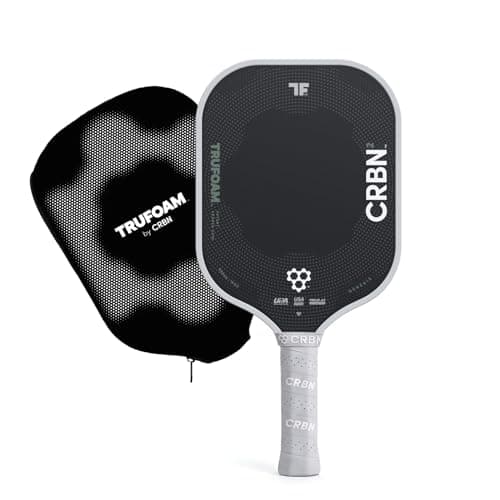 CRBN2 TruFoam Genesis (Square) A full foam core in the widest CRBN outline | Wins for most players | 8.3 | $199.99 · View on Amazon #adPrice as of October 24, 2026 |
| 2 | 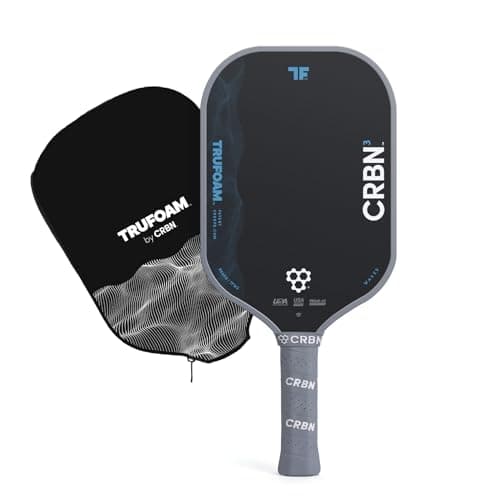 CRBN1 TruFoam Waves (Elongated) The heaviest-swinging CRBN we cover | Wins if you drive and reach | 8.0 | $199.99 · View on Amazon #adPrice as of October 24, 2026 |
| 3 | 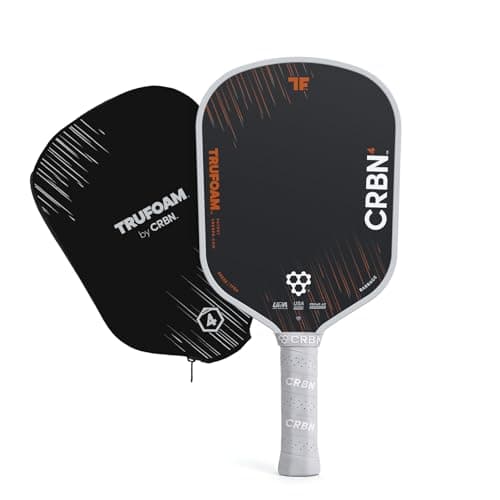 CRBN TruFoam Barrage Newest-gen foam power + stability | The third option: foam, but not all of it | 8.3 |
Tap any row to jump to the full write-up. Prices are pulled live from Amazon.
CRBN2 TruFoam Genesis (Square)
CRBN's 100% foam core in the square outline — the most forgiving paddle CRBN makes, and the only one we cover whose maker publishes a PBCoR .43 certification by name.
CRBN publishes a 14mm 100% foam core — not a foam-injected honeycomb, the whole core — behind a Toray T700 carbon face with an added fiberglass layer, in a 7.85 x 16in square outline with a 5.5in handle, a 4.125in grip and an 8.1 oz average within 0.2 oz. CRBN lists it as USAP approved and PBCoR .43 certified; its own pages are inconsistent on UPA-A, calling it approved in one place and provisionally approved in another, so verify before professional play. CRBN publishes no molding method.
For the player who wants the foam core and does not have a reach problem. CRBN publishes the Genesis at 7.85 x 16in on a 14mm 100% foam core, behind a Toray T700 carbon face with an added fiberglass layer, with a 5.5in handle, a 4.125in grip and an 8.1 oz average within 0.2 oz. It is the square one: the shortest, widest frame CRBN makes, which is why it carries a 9 on forgiveness against the Waves' 8 and why it turns over faster in a hands exchange. It is also the only paddle in our catalog whose maker publishes a PBCoR .43 certification by name alongside USAP approval. The cons: the extra fiberglass layer on the face is the only construction difference between the two and CRBN does not publish what it does to spin, so treat our matching 8s as a deliberate refusal to invent a gap; CRBN's own pages contradict each other on UPA-A status; and no molding method is published for the line.
- Core
- 14 mm
- Shape
- Widebody
- Face
- Toray T700 carbon with an added fiberglass layer, 100% foam core
- Weight
- 8.1 oz +/- 0.2
- Build
- Not published
- Gen
- TruFoam Genesis (100% foam)
Manufacturer-listed as USA Pickleball approved. Approvals and delistings change — verify against the current USAP equipment list before tournament play (checked 2026-07).
CRBN1 TruFoam Waves (Elongated)
The full-foam core in CRBN's longest outline, with a published swing weight of 118-120 — a genuine two-handed-backhand drive paddle, and hard work at the kitchen.
CRBN publishes a 14mm 100% foam core behind a Toray T700 carbon face in a 7.35 x 16.5in elongated outline, with a 5.75in handle, a 4.125in grip and a 7.9 oz average within 0.2 oz. Unusually for this category CRBN also publishes the measurements that matter most: a 118-120 swing weight, a 5.88 twist weight and a 246mm balance point. Read those together and the paddle describes itself - heavy through the swing, so it drives hard and reaches, with the lowest twist weight of the CRBNs we cover.
For the player who hits through the ball from the baseline and wants the extra inch of paddle at the stretch volley. CRBN publishes the Waves at 7.35 x 16.5in on the same 14mm 100% foam core and a Toray T700 face, with a 5.75in handle, a 4.125in grip and a 7.9 oz average. The reason to take this one seriously is that CRBN publishes the numbers almost nobody else does: a 118-120 swing weight, a 5.88 twist weight and a 246mm balance point. Read those together and the paddle describes itself - heavy through the swing, so it drives hard and reaches, with the lowest twist weight of the CRBNs we cover. It scores a 9 on power against the Genesis' 8 and a 7 on control against its 8. The cons are the exact mirror of the pros: that 118-120 swing weight is hard work at the kitchen when hands get fast, the narrow face is the least forgiving in the TruFoam line, and the same full-foam durability unknown applies.
- Core
- 14 mm
- Shape
- Elongated
- Face
- Toray T700 carbon over a 100% foam core
- Weight
- 7.9 oz +/- 0.2
- Build
- Not published
- Gen
- TruFoam Waves (100% foam)
Manufacturer-listed as USA Pickleball approved. Approvals and delistings change — verify against the current USAP equipment list before tournament play (checked 2026-07).
CRBN TruFoam Barrage
A Gen-4 foam-wall paddle: the foam core widens the sweet spot and adds stability on off-center hits without killing power.
Foam-injected 'Gen 4' construction is where the category is heading — the foam broadens the sweet spot and calms twisting on mishits while keeping the power high. The Barrage is CRBN's take, and it's one of the more polished foam builds you can buy.
For the player who likes what foam does and is not willing to be an early adopter of a core nobody has owned for two seasons. The Barrage is CRBN's foam-INJECTED paddle rather than a full foam core: a raw carbon face over a thermoformed, foam-filled perimeter, 14mm, elongated, about 8.0 oz. It scores a 9 on power with 8s on spin, control and forgiveness, which is the strongest overall card of the three here. Functionally it gets you most of the stability argument - the foam walls calm twisting on off-center contact - inside a construction with a known multi-season failure mode. The cons: it is the most expensive of the three on our live price layer, thermoformed paddles are the ones with the documented delamination history, and you do not get the published PBCoR certification that comes with the Genesis.
- Core
- 14 mm
- Shape
- Elongated
- Face
- Raw carbon face over a foam-injected core
- Weight
- ~8.0 oz
- Build
- Thermoformed
- Gen
- Gen 4 (foam)
Manufacturer-listed as USA Pickleball approved. Approvals and delistings change — verify against the current USAP equipment list before tournament play (checked 2026-07).
What is held constant, and why that is useful
Most paddle comparisons change four things at once — core thickness, face material, outline and molding — and then ask you to attribute the difference in feel to one of them. This pair does not have that problem. CRBN publishes the same 14mm 100% foam core for both, the same Toray T700 carbon hitting surface, the same 4.125in grip, and weights within 0.2 oz of each other. Two things differ: the outline, and a fiberglass layer CRBN lists on the Genesis face and not on the Waves'.
So if you have been trying to work out what paddle shape actually does to a paddle, this is a clean experiment someone else has already run for you. The general version of the argument is in our paddle shape guide; this page is that argument with two real listings attached.
The published specs
| Spec | CRBN2 TruFoam Genesis | CRBN1 TruFoam Waves |
|---|---|---|
| Outline | 7.85 x 16in (square) | 7.35 x 16.5in (elongated) |
| Core | 14mm, 100% foam | 14mm, 100% foam |
| Face | Toray T700 carbon + fiberglass layer | Toray T700 carbon |
| Handle | 5.5in | 5.75in |
| Grip | 4.125in | 4.125in |
| Listed weight | 8.1 oz +/- 0.2 | 7.9 oz +/- 0.2 |
| Swing weight | Not published | 118-120 |
| Twist weight | Not published | 5.88 |
| Balance point | Not published | 246mm |
| Molding method | Not published | Not published |
| Approval as listed | USAP + PBCoR .43 | USAP |
| Our spin / power / control / forgiveness | 8 / 8 / 8 / 9 | 8 / 9 / 7 / 8 |
Note what the table does not do: it does not invent a swing weight for the Genesis. CRBN publishes those three measurements for the Waves and not for the square, and filling the gap with an estimate would be the easiest and most dishonest paragraph on this page. What we can say from geometry alone is the direction — a shorter, wider frame with a shorter handle will swing lighter and twist less than a longer, narrower one — and that is what our scores reflect.
The 118-120 swing weight is the whole decision
Swing weight measures how heavy a paddle feels while it is moving, which is a different thing from what the scale says. The Waves is listed at 7.9 oz — lighter than the Genesis on a scale — and still swings substantially heavier, because its mass sits further from your hand. A 118-120 figure is at the heavy end of what this category produces.
Heavy through the swing is good for exactly two things: driving the ball from the baseline, where the paddle does the work instead of your arm, and reaching, where length is leverage. It is bad for one thing, and that one thing decides most intermediate doubles points — getting the paddle face to a speed-up at the kitchen before the ball arrives. If you keep losing hands battles, the Waves will make that worse, not better, and you want the Genesis or our hand-speed roundup. The full explanation of the measurement is in swing weight and twist weight explained.
The risk both of them share
These are 100% foam cores — not honeycomb with foam injected into the perimeter, which is what CRBN's own Barrage uses and what most "Gen 4" marketing refers to. The upside is consistency across the face, which is why both land high on forgiveness.
The downside is that no full foam core has a multi-season ownership record, anywhere, from any brand. Honeycomb paddles fail loudly: they delaminate, the sound changes, you know. A foam core that gradually compresses gets softer over months, and the player holding it adapts without noticing. We have no data on how fast that happens because there is none to have. If that bothers you — and it is a reasonable thing to be bothered by on a flagship-priced paddle — the TruFoam Barrage above is the foam-injected alternative with a known failure mode, and our delamination guide covers what that mode looks like.
One of them publishes a PBCoR number
CRBN lists the Genesis as PBCoR .43 certified by name. PBCoR is the power-limiting test the sport's governing bodies adopted to stop the arms race in ball speed off the face, and only three product lines we cover publish a .43 certification explicitly: JOOLA's Hyperion Pro IV, Vatic Pro's V-Sol Pro, and this. That is a small point of future-proofing if you expect to play in events that start checking it.
Two honest caveats. CRBN's own pages contradict each other on UPA-A status for the Genesis — approved in one place, provisionally approved in another — so verify before professional play rather than trusting a product page or this one. And a PBCoR certification is not the same thing as USA Pickleball approval, which is the list that matters for sanctioned amateur events. Both are explained in PBCoR .43 explained and USAP approval and delisting.
Who should buy which
Buy the Genesis if you play mostly doubles, your points are decided inside the kitchen line, and your misses are wide rather than short. It is the more forgiving frame, the quicker one in hands, and the one carrying the published certification. It is also the paddle we rank first on our widebody roundup's foam slot.
Buy the Waves if you drive from the baseline, play a two-handed backhand, or are tall enough that reach is a real weapon rather than a spec-sheet line. The 5.75in handle supports a second hand; the 118-120 swing weight is why the ball comes off it hard. Just go in knowing that number cuts both ways.
Buy the Barrageif the foam core is interesting but you are not willing to be the durability experiment. And if you want CRBN's honeycomb platform instead of either foam build, our CRBN brand roundup ranks the whole shelf.
What is the difference between the CRBN TruFoam Genesis and the Waves?
Shape, almost entirely. Both use the same 14mm 100% foam core and a Toray T700 carbon face. The Genesis is CRBN's square outline at 7.85 x 16in with a 5.5in handle; the Waves is elongated at 7.35 x 16.5in with a 5.75in handle and a published 118-120 swing weight. CRBN also lists an added fiberglass layer on the Genesis face.
Which CRBN TruFoam paddle should I buy?
The Genesis for most players. It is more forgiving on off-center contact, faster to turn over in a hands exchange, and the only one of the two whose listing names a PBCoR .43 certification. Choose the Waves if you drive from the baseline, use a two-handed backhand, or genuinely need the extra reach.
Is the CRBN TruFoam Waves swing weight too heavy?
At CRBN's published 118-120 it is at the heavy end of the category, which is an advantage on drives and a disadvantage at the kitchen. If you lose points because you are late to speed-ups, it is the wrong paddle. If you lose points because your drives sit up, it is the right one.
Is a 100% foam core durable?
Nobody knows yet, including us. Full foam cores are new enough that no brand has published a multi-season durability record. The specific concern is that foam can compress and soften gradually rather than failing visibly the way a honeycomb core delaminates. If that matters to you, CRBN's foam-injected TruFoam Barrage is the conventional alternative.
Is the CRBN TruFoam Genesis USAP approved?
CRBN lists it as USA Pickleball approved and PBCoR .43 certified. Its UPA-A status is less clear — CRBN's own pages call it approved in one place and provisionally approved in another — so verify against the current lists before tournament or professional play rather than relying on a product listing.